William Randolph Innes Hopkins (1827-1920) was born in the Scottish Borders, the son of businessman John C. Hopkins. William married twice, firstly in 1854, to Elsie Carolina Sophia Bolckow, the daughter of Henry John Bolckow, the iron master of Middlesbrough. Following her death, he married for a second time in 1864, to Evereld Catherine Eliza Hustler, the daughter of Thomas Hustler of Acklam Hall, Middlesbrough, a long established land owning family and entrepreneur from North Yorkshire. In 1871, upon the death of his father, he inherited the family’s business interests, notably the North Bitchburn Coal Company Ltd. and its collieries in South West Durham. He gave his name to Randolph Colliery, Evenwood in 1893. William R. I. Hopkins died in 1920 aged 93, at Norton, North Yorkshire. His effects amounted to about £5,345,000 in today’s money.
Family Details
1827: William Randolph Innes Hopkins was the son of John Castell & Agnes [nee Robson] Hopkins, born 16 December 1827 at Huntill House, Roxburgh in the Scottish Borders. He had 6 siblings:
- Charles Harrie born 1828 at Bideford, Devon, England
- Agnes Teresa born 1832 at Barnstable, Devon
- Henrietta Elizabeth Frances born 1834 at Barnstable, Devon
- John Castell born 1836 at Edinburgh, Midlothian, Scotland
- James Innes born 1837 at North Leith, Midlothian
- Henry Gordon born 1839 at Darlington, County Durham, England

In 1854, William R.I. Hopkins married Elsie Carolina Sophia Bolckow, the daughter of Henry John Bolckow, the iron master of Middlesbrough. In 1864, he married for a second time, to Evereld Catherine Eliza Hustler, the daughter of Thomas Hustler of Acklam Hall, Middlesbrough a long established land owning family and entrepreneur from North Yorkshire. William and Elsie had 4 children:
- Henry Castell born 1855 at Middlesbrough, Yorkshire, England
- Agnes C. born 1857 at Middlesbrough
- Charles Harry Innes born 1858 at Middlesbrough
- Harriet C. born 1860 at Middlesbrough
In 1861, William and Elsie and their 4 children lived at Tormoham, near Torquay, Devon with 5 domestic staff. William, aged 33, was recorded as, “Ironmaster”. The following year, 1862, Elsie Hopkins died at Tormoham, Newton Abbot, Devon. In 1864, William married Evereld Catherine Elizabeth Hustler. They had 6 children:
- William H. born 1867 at London
- George B. born 1870 at London
- Evereld F.F. born 1871 at Nunthorpe, Yorkshire
- Minnie L. born 1874 at Great Ayton, Yorkshire
- James Randolph Innes born 1876 at Nunthorpe
- Isabella Ann born 1876 at Grey Towers, Stokesley, Yorkshire
In 1871, William, his second wife Evereld and family lived at Grey Towers, Nunthorpe, North Yorkshire and 43 years old William was recorded as, “Iron Master and Land Owner”. With them, lived 2 children from his first marriage Agnes aged 14 and Harriet aged 11; William aged 4, and George aged 1 from his second marriage; his sister Agnes; their governor Mary A. Wise and 11 domestic staff.
16 April 1871, William’s father John Castell Hopkins died at Kingston-upon-Thames, Surrey.
In 1881, William and Evereld, together with 3 children, 10 years old Evereld, 7 years old Minnie, 4 years old James and 4 domestic staff lived at 3 Roslin Villa, Marske, near Saltburn, North Yorkshire. William, now 53, was recorded as, “J.P. and Coal Owner”.
24 April 1887, William’s second wife Evereld died at English Bicknor, Gloucestershire.
In 1891, William now 63 years old and a widower, lived at Witton Towers, Witton-le-Wear, County Durham with 3 of his children, 31 years old Harriet, 24 years old William recorded as, “Bachelor of Arts”, 21 years old George recorded as, “Student, Cambridge” and his widowed brother, 51 years old Henry recorded as, “Clerk in Holy Orders M.A.”, daughter-in-law, 27 years old Helen, grandsons Castell and John, granddaughter Helen, nephew Arthur (Student of Theology) and 7 domestic staff. William was recorded as, “J.P., D.L., Coal Owner”.
In 1901, William lived at Grimston Manor, Grimston, Gilling, near Helmsley, North Yorkshire. Aged 73, he was recorded as, “Land owner and Colliery Proprietor, J.P., D.L., employer”. His 2 daughters, 41 years old Harriet and 27 years old Minnie, grandson 7 years old Charles, visitor 20 years old Margaret Bruce and 7 domestic staff also lived there.
In 1911, William was recorded as a visitor to James and Agnes Pearson, his daughter, of 10 Sydney Street, Chelsea, London. James Pearson was recorded as a, “Barrister at Law”.
25 May 1915, William’s youngest son Captain James Randolph Innes Hopkins was killed in action. James married Doreen Maud Parker daughter of the Hon. Reginald Parker and they had 1 daughter Evereld. James was educated at King’s, Canterbury and studied at Corpus Christi College, Oxford. He served in the South African War from 1900-1901 as a trooper in the Northumberland Hussars, serving 7 years being commissioned as a Second Lieutenant in 1901. He later worked as an Assistant Manager for a coal company but was declared bankrupt in 1906. He emigrated to Saskatchewan, Canada in 1906 working as a financial agent and joined the local militia. At the outbreak of war, he offered his services and was given a commission as Captain, 5th [Saskatchewan] Battalion, Canadian Infantry, arriving in England with the first Canadian contingent 14 October 1914, entered France in February 1915 and arrived at the Hazebrook/Strazelle area, Belgium on 15 February 1915. The battalion was detailed to attack a German trench and redoubt at Neuve Chapelle, 24 May 1915. Captain J.R. Innes-Hopkins was killed in action aged 38. Casualties numbered 5 officers, 11 NCOs and 30 men killed and 8 officers, 30 NCOs and 174 men wounded. Captain J.R. Innes-Hopkins is buried at Le Touret Military Cemetery, Richebourg-L’Avoue. He was awarded the 1914-15 Star, the British War and Victory medals.
In 1916, William lived at the Leat, Norton, near Malton, North Yorkshire and was described as, “Gentleman”.
21 December 1920, aged 93, William Randolph Innes Hopkins died. He then lived at the Leat, Malton, Norton, North Yorkshire. His effects amounted to £116,568 14 shillings 5d, (about £5.345M today.)
Business Details
William’s father, John Castell Hopkins was one of the shareholders of the North Bitchburn Coal Co. Ltd., formed in 1839. He was listed, in 1849, along with Henry Stobart and his son Henry Smith Stobart, John and Thomas Mounsey and others. Much of the initial capital for the undertaking was provided by the Backhouse family, bankers of Darlington and Frederick Backhouse acted as the company treasurer. The Hopkins family was very well connected with the influential entrepreneurs associated with the railway, coal and iron industries of County Durham, Darlington and Cleveland.
William Hopkins was privately educated and studied architecture with Mr. Middleton of Darlington. In 1850, he was on the architectural staff of the Great Exhibition opened in 1851 at Hyde Park, London.
1851: His connection with Middlesbrough began when he came to the town and started the Middlesbrough based ironworks. For a number of years thereafter he was closely connected with the iron trade of the district and numbered many of the pioneers of the Cleveland iron trade among his colleagues and friends.
1868: William R.I. Hopkins was elected as an “Associate” of the Institution of Civil Engineers:
“Because of his connection with the productive arts as a coal owner and iron master and because he has been for many years extensively engaged in the manufacture of bridges, rails, railway plant generally locomotive and other engines and the ordinary work of a mechanical engineer.”
1871: Following the death of his father, William took control of the family business interests, notably the North Bitchburn Coal Co. Ltd., Linthorpe Ironworks, Elswick Steamship Company and the Weardale Railway.
The 1871 Directory of Lieutenancy and Magistracy of County Durham records William Randolph Innes Hopkins of Grey Towers, Middlesbrough. (Justice of the Peace and Deputy Lieutenant?)
In 1874, a contract was awarded to another family concern, Hopkins, Gilkes & Co., to supply iron for the construction of the proposed railway bridge over the River Tay, near Dundee Scotland. It was opened 1 June 1878. Tragedy struck 28 December 1879 when the bridge collapsed causing the deaths of 75 people. The reputations of its designer Sir Thomas Bouch and construction company Hopkins, Gilkes & Co. were ruined. By the end of 1880, Bouch had died and the company went bankrupt. William Hopkins retained his interest in the North Bitchburn Coal Co. Ltd. and developed this commercial enterprise.
The 1874-76 Directory of members of the Institute of Civil Engineers lists William Randolph Innes Hopkins of Grey Towers, Middlesbrough, as an “Associate”.
The NBCC Ltd. expanded its interests in south west Durham and, following the purchase of the Evenwood and Thrushwood Collieries in 1891, sank new collieries at Evenwood and Cockfield in 1893, namely Randolph with associated coke works and Gordon House.
In 1900, William Hopkins was Chairman of the North Bitchburn Colliery Company Ltd., (its owners had shares in the Lackenby Iron Company), a director of the Elswick Steam Shipping Company and of the Horden Colliery Company. That year, 1900, the Duchess of York visited Lord Barnard at Raby Castle and their party toured the colliery. As the company’s Chairman, William Randolph Innes Hopkins hosted the tour party. By 1914, Randolph Colliery and Coke Works employed over 1000 men and NBCC Ltd. over 4000 in its collieries in County Durham.
William R.I. Hopkins died in December 1920.
Below: Believed to be William Randolph Innes Hopkins

Interests, Political and Philanthropic Work
In 1843 he was appointed a Lieutenant in the Durham Artillery Militia and in 1860 became a Captain in the first North Riding of York Volunteer Auxiliary.
1853: He was elected on the incorporation of the Borough of Middlesbrough. He was a member of the first Middlesbrough School Board and the first County Council of Durham.
1859: He was appointed Deputy-Lieutenant of the North Riding and in 1900, was one of the oldest Deputy-Lieutenants of the county.
1862: He was elected to be a member of the Carlton Club, and was one of the earliest members of the Junior Carlton.
1866 and 67: He was Mayor of Middlesbrough and had the honour of entertaining Prince Arthur, afterwards created Duke of Connaught, when he visited Middlesbrough to perform his first public function, the opening of the Albert Park.
1874: William Hopkins was the first Conservative candidate to stand for the Middlesbrough parliamentary seat. It was three-cornered contest. His Liberal opponent was Mr. H.W.F. Bolckow, his brother-in-law, and Mr. John Kane, stood as an independent Labour candidate. The result was:
- Bolckow (Liberal) 3,719
- Kane (independent Labour) 1,541
- Hopkins (Conservative) 996
Although he failed in his bid for Parliament, he continued to support the Conservative party in Durham and the North Riding of Yorkshire.
For 32 years, he has sat as one of the Admiralty Commissioners and for some 40 years, he was a member of the Tees Conservancy Commissioners.
In the Evenwood and Cockfield area, William R.I. Hopkins and the NBCC Ltd. supported causes which benefited their employees such as the Randolph Institute opened in 1898, a project to commemorate Queen Victoria’s Diamond Jubilee. Financial assistance was given to St. Paul’s Church and Evenwood School.
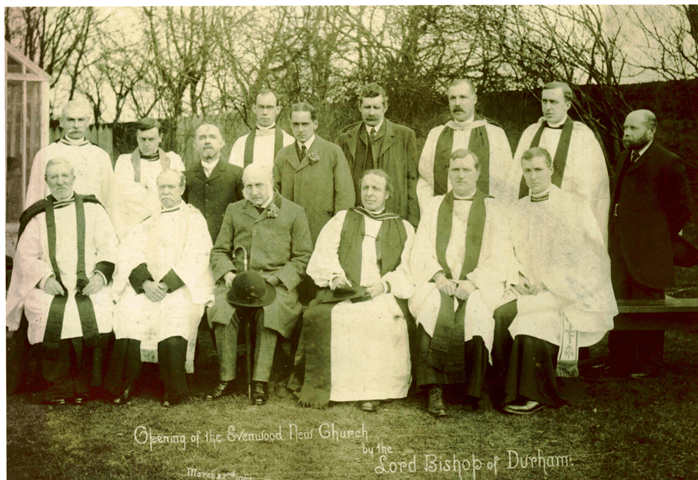
Below: March 1909: The opening of the rebuilt St. Paul’s church at Evenwood following its destruction by fire. William Randolph Innes Hopkins is sat in the centre holding walking stick and bowler hat. At the time, he was 81 years old.
An Obituary:
A correspondent of the North Eastern Daily Gazette wrote:
“Time has dealt kindly and lightly with Mr. Hopkins and he has deserved well of time, for he has made the most of it. Activities many and varied have filled all his days. Although immersed for many years in ceremonial affairs of no mean importance to the industrial welfare of the North, his constant devotion to outdoor pursuits, to the hunting field and the coverts, has never slackened, and today he is as ardent a sportsman as ever he was. Only the other day he made a respectable contribution to a bag of 150 brace of pheasants on his son’s Estate of Acklam. Thus he has maintained a sound mind in a sound body, and his upright carriage, clear eye, and fresh complexion speak eloquently of health, and justify in a special degree the confident hope of his friends that years of vigour still lie before him. There is a point about a love of field sports that it tends to dissipate melancholy and gives a man a cheerful and roseate outlook upon men and things.
Mr. Hopkins confesses that he has always been an optimist, and it is the optimist who scores most in an innings whether it be in the game of cricket or the game of life. A man who has scored ’82 not out’ in the great game can tell many stories, and the interesting hour I spent with Mr. Hopkins at his home at Leat House, Malton the other day was all too short…Mr. Hopkins tells a story about the changes that have come about in his time: In the year 1836 he travelled by stage coach from Devonshire to Edinburgh, and the journey occupied eight days. There was a stoppage at Warwick en-route for three quarters of an hour to all of the passengers to go and see a woman hanged. This was a spectacle not to be missed and Mr. Hopkins was one of the onlookers”
 EVENWOOD RAMSHAW & DISTRICT HISTORY SOCIETY