Billy Bell was born 13 February 1932 at Evenwood. His mother, Florence (nee Roxborough) was from Evenwood, his father, William was an Ulsterman. His brothers and sisters were Leslie, Doreen, Cecil, Jack, Sadie and Russell, (who was killed in the Second World War). His nephew was Evenwood lad, Jackie Bell, ex-Newcastle United wing half.
Billy played for Evenwood Town, making his debut at 16 years old and had trials at Fulham. He also played for West Auckland and Whitby before injury forced him into early retirement.
Below:
24 January 1953: 2nd Round, FA Amateur Cup, MARINE CROSBY 1 EVENWOOD TOWN 2. Players and supporters “ready for the off.” Billy Bell is at the front left, leaning on the table.

Billy Bell managed or coached Evenwood Town, Spennymoor United, Blyth Spartans, Gateshead and Tow Law. Evenwood Town was his first managerial position. He won 4 Northern League championships with 3 different clubs – Evenwood Town (twice), Spennymoor United and Blyth Spartans.
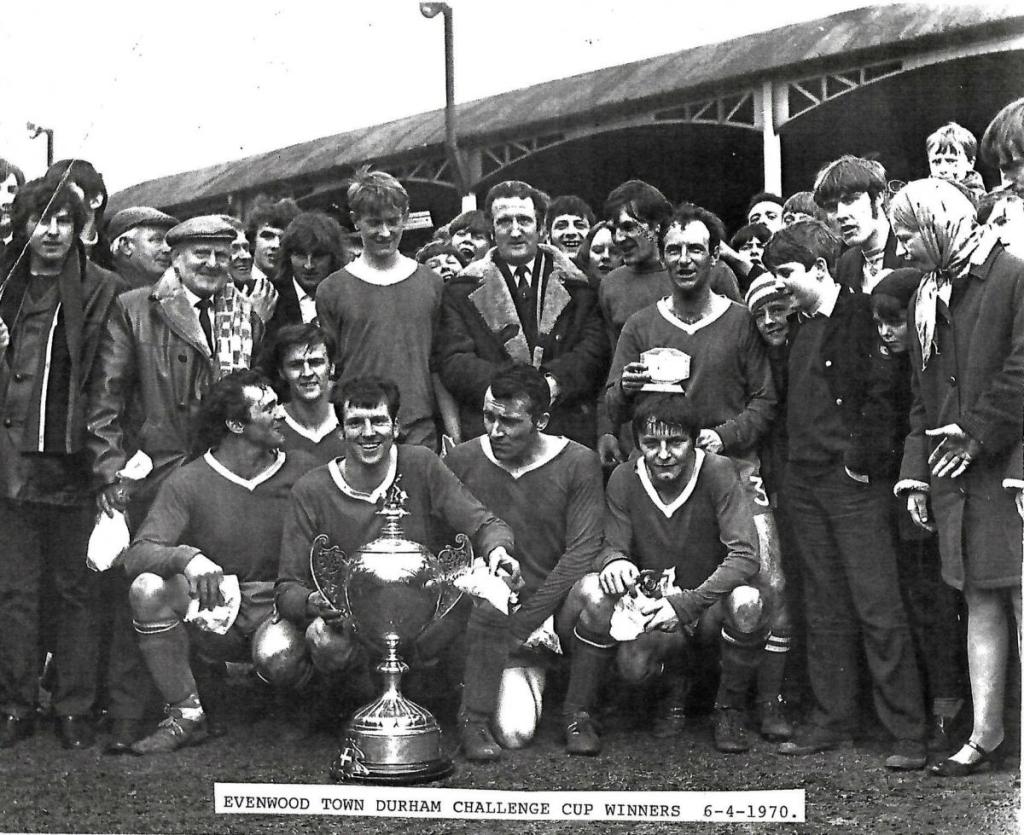
In May 1970, Evenwood Town epitomised the spirit of the Northern League by winning the league title for only the second time in their history and, just for good measure, took the Durham Challenge Cup as well. It was quite an achievement to win both trophies as they had to thwart the challenge of much bigger towns and clubs like Bishop Auckland, Crook Town, Whitley Bay, Blyth Spartans and Spennymoor United. They won the Durham Challenge Cup with wins over Durham County Constabulary, Annfield Plain, Whickham and Billingham Synthonia in the semi-final. Evenwood faced Wearside League’s Stockton at Darlington’s Feethams ground. A lone goal from Ray Young was enough to complete the first leg of an unthinkable double.
Below:
1970: Evenwood Town, Durham Challenge Cup winners. Billy Bell in the centre of the team and supporters
Back to the league and Evenwood won their last ten games. With two games to go, Evenwood held a 2 points advantage over Blyth Spartans but fate had it that both clubs would meet in what would effectively be the title decider on a Wednesday evening at the Welfare Ground. A point was all that Evenwood needed to be crowned champions and even if they lost on the night, a win at Penrith on the final day of the league season would be enough to lift the trophy. In one of the most dramatic nights in the club’s history, a crowd of over 1500 witnessed a very tense match which the home side always seemed to hold the upper hand but couldn’t turn their supremacy into goals until 3 minutes from time. Blyth centre back Ronnie Scott’s body check on Tommy O’Connor, wide on the flank, resulted in a free-kick which the striker decided to take himself. O’Connor delivered an inch perfect cross into the danger area for Stuart Leeming, another member of the Tyneside contingent, to head home the all-important goal which brought the Championship back to the village after a 21-year absence. Stuart Leeming must have been the smallest, lightest man on the pitch and for him to win a header was remarkable. Evenwood rounded the season off in style at Penrith with a 7-2 win. Their scorers were Brian Cunningham with a hat-trick, Ray Young netting a brace, Eddie Ross and Brian Newton.
Below:
Evenwood Town: Northern League Champions 1969 – 70 & 1970 – 71
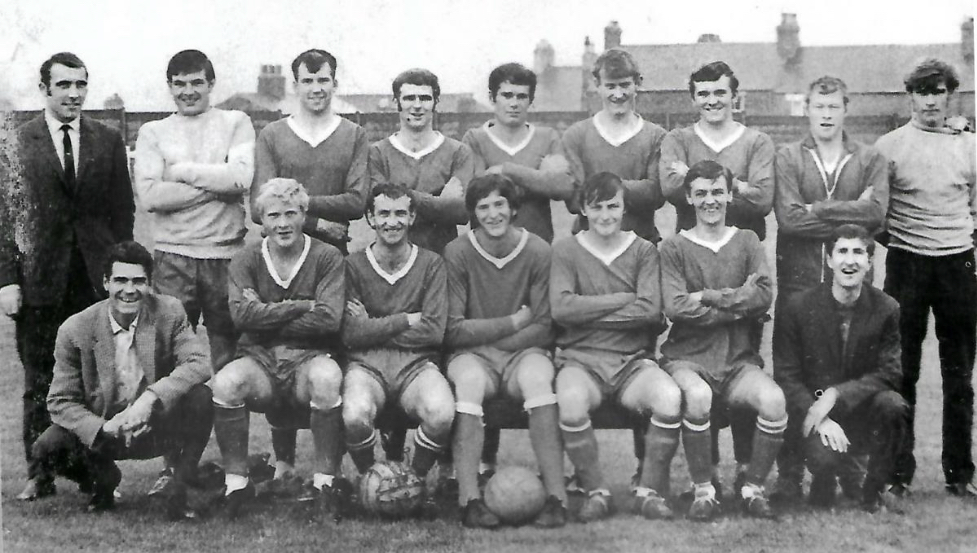
Tony Monkhouse was an integral part of the Evenwood championship winning team and recalled:
“Billy was 20 years ahead of his time and so dedicated that he got the best out of all of us. He was friendly with Don Revie, the manager at Leeds, and he often went to Leeds to watch them train.
“Training was taken seriously. One night we were all in the top goalmouth doing sit-ups, when a plane appeared in the sky, doing all kinds of manoeuvres. Eddie Ross said to me ‘I wouldn’t like to be up there in that plane.’ I replied ‘I wouldn’t like to be up there, and not in that plane.’ We both started to laugh so Billy came over. ‘You two, are you here to train, or behave like idiots?’ We soon shut up.
Bob Tookey was a member of that legendary Evenwood side. He came from nearby Cockfield and would be capped by England at amateur level during Town’s golden era. He spent nearly all his playing career with the club which spanned sixteen seasons and over 600 appearances. Bob was one of the cornerstones of an uncompromising defence upon which Evenwood’s success was built.
“It was some achievement for a little village side like Evenwood to win the Northern League two seasons in a row. I suppose it was all the more satisfying because we had big clubs such as Bishop Auckland, Spennymoor United and Crook Town right on our doorstep and the likes of North Shields who had won the F.A. Amateur Cup the previous season and Blyth Spartans on the other side of the River Tyne to contend with…Quite rightly, Billy Bell should take a lot of credit for the success. Evenwood was where Billy had been born and bred and this was his first managerial job and you could see from the very start he was serious about being successful in management.
“Until he arrived at the club we were pretty much a run-of-the-mill Northern League outfit but that was soon to change. It’s been said many times before that Billy was well ahead of his time and he was. He used to drive down to Leeds and study Don Revie’s training methods in an era where very few managers had ever thought of doing that.
“It didn’t matter whether it was training or a game on a Saturday – Billy set the bar high and it remained high as he wouldn’t let our standards drop. The good thing was as a group of players every one of us bought into his ethos and he had us well drilled and extremely organised plus I don’t think there was a team in the league fitter than us.
“It’s a totally different game those days to what is now. All the time I played at Evenwood, we never had floodlights and we never had such things as indoor training facilities or artificial pitches to train on. Rain, hail, snow or sun we trained on a part of the pitch at the Welfare Ground which had a spotlight which shined light onto an area near the bottom goalmouth. Even that wasn’t the best and Billy would often get a few of us players to drive our cars into the ground and leave the engine running so we could put our headlights on to improve the lighting.”
“We were mainly all local lads but Billy had recently moved to Tyneside through his work where he managed a Sports Centre in Wallsend. He was able to pick up two or three players from the Newcastle area who had pretty much passed under the radar of the bigger clubs up there and who made the difference for us. Ray Young was one. He was a striker and just a young lad who Billy had unearthed when he was training in the sports centre. What a find he turned out to be as he was a real handful up front and would score 30-goals that season.”
In 1977, Billy Bell joined the re-formed Gateshead club as coach to Ray Wilkie. He left after 18 months to become manager of Tow Law and just weeks before the season began, desperately rang Gateshead’s chairman, Bill Gibson to ask if they’d any surplus players. In response, an 18 years old player, Chris Waddle joined Tow Law. He was a revelation, joined Newcastle United at the end of that season and the rest, as they say, is history.
Bill Gibson, former Gateshead Chairman, recalled:
“We’d always be arguing about football. I’d never win, of course. Billy was one of those fellers who really should have had the kind of chance that Lawrie McMenemy had. His family was his first love, followed closely by football and then the horses. He said he had a system, swore he always bought his new cars out of his winnings.”
Sir Bobby Robson eulogised:
“Billy was passionate about a game he loved and cherished and that was the mark of the man. At this level we’re glamourised and that’s nice, but it’s people like Billy Bell who keep the game going.”
Mike Amos, the Northern Echo Chief Sports reporter, summed up:
“Billy Bell will be remembered with the utmost affection…a legend beyond argument.”
ACKNOWLEDGEMENTS
Much of the above account is derived from various articles in the Northern Echo and Evening Chronicle written by Mike Amos, John Phelan and Chris Sanderson
 EVENWOOD RAMSHAW & DISTRICT HISTORY SOCIETY