Family Details [1]
Willi Maass was born 20 April 1913 in Quedlinburg, Sachsen, Germany the son of Wilhelm and Emma [nee Schader] Maass. He was married to Alice Maass and they lived at Weddersleben über Quedlinburg, Thalenser Strasse 4. He probably was employed as a miller.
Military Service Details [2]
435N93 Obergetreiter Willi Maass served with the Luftwaffe, 3rd Reserve Flakabt which we understand to be the equivalent of a Leading Aircraftsman serving with ground forces, probably as an anti-aircraft gunner.
US POW
24 June 1944: Cherbourg, France: Obergetreiter Willi Maass was captured by the US Forces 18 days after D Day as the Allies swept into the Cotentin Peninsula, western Normandy.
His POW number was 31G124926 while in American hands. He was held at 2 POW camps in the US:
- Aliceville, Alabama then transferred 26 July 1944 to
- Como, Mississippi then transferred to the UK April 1946
UK POW [3]
30 April 1946: POW Willi Maass arrived in the UK and his first place of detention was POW Camp No.17 at Sheffield [possibly POW number D709597]. He was transferred to POW Camp No. 93 Harperley, Fir Tree, County Durham and allowed to work on local farms. During the Autumn and Winter on 1946, Willi Maass worked at Low Westgarth Farm, Copley Bent near Butterknowle in south west Durham for Mr. Edward “Ted” Stephenson on his 52 acre, mainly dairy farm.
BACKGROUND
1943: POW Camp 93, Harperley, Fir Tree, Crook, County Durham was purpose built on land owned by Mr. Charles Johnson, Low Harperley Farm. Initially, it was established to house Italian POWs captured in North Africa.[4] In February 1942, there were some 28,000 Italian POWs in the UK and the majority were required for agricultural work. This figure rose to 108,000 by June 1944.[5]
22 September 1944: At Harperley Camp, the Italian POWs were dispersed to hostels and farms to make room for 716 German POWs deemed to be a low security risk.
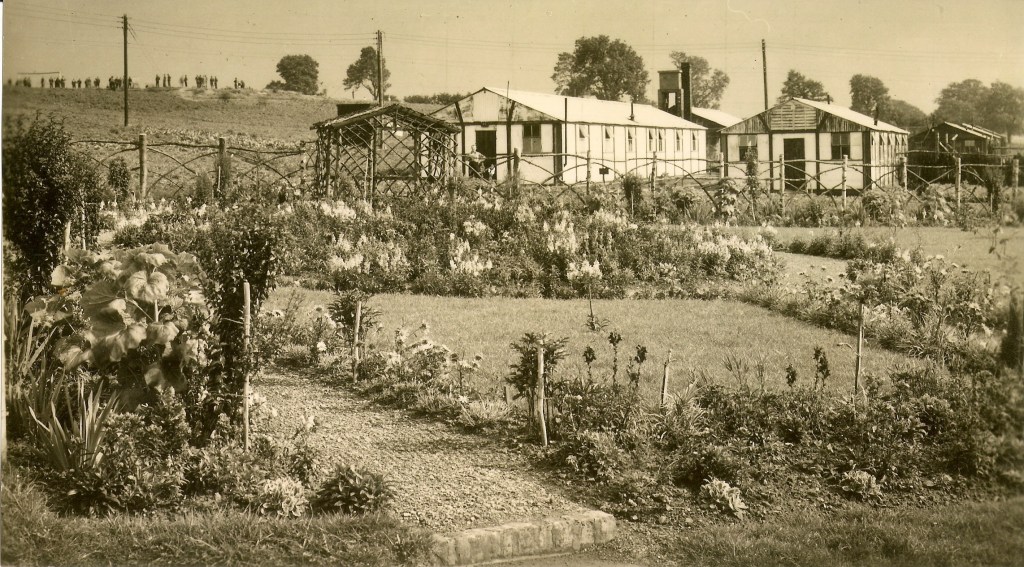
Above: Harperley POW Camp
Eventually, there were subsidiary camps and hostels at various locations – Bedburn Camp which could house about 150 men, Langton Grange 150, Windlestone Hall 100, Bishop Auckland Hospital [fluctuated], Mount Oswald 100, Usworth 100, Lanchester 100, Consett 100, Hamsterley Hall 100 and High Spen 100.
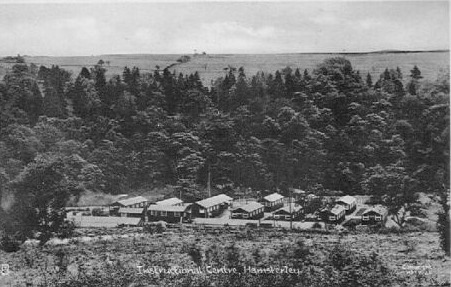
Above: Bedburn Camp
November 1946 to October 1947: Officers from the Foreign Office Re-education Section paid visits to Harperley Camp and recorded that POW numbers fluctuated from between 426 and 899 at the main camp with typically about 1000 at associated hostels and billets. It is possible that Willi Maass was interviewed since it is believed that he was held at Harperley at this time.
Christmas 1946: A watershed moment in the history of German POWs held in the UK when the Labour Government, relaxed fraternisation regulations, particularly the announcement that POWs would be permitted to accept invitations to private homes to celebrate Christmas. An occasion enjoyed by the Stephenson family and Willi Maass.
August 1947: From Harperley Camp, 633 POWs had returned to Germany, 8 had been granted civilian status in the UK and a further 34 men were waiting to have their applications considered.
The exact date when Willi Maass was repatriated is unknown. Anecdotal evidence suggests that he was still in County Durham in September 1947. Eric Stephenson [then 9 years old] recalls being at Wolsingham Agricultural Show with his father and meeting Willi. A meeting vivid in Eric’ s memory since he was greeted by Willi as a long lost son, being picked up and swung around.
Summer 1948: Harperley Camp is presumed to have ceased to function as a POW Camp although it may have continued to be used as a hostel for agricultural workers or displaced people waiting for new housing.
No.93 HARPERLEY POW CAMP: some notes
The Commandant
1943-45: The Commandant at the outset was Major Tetlow, a resident of Wolsingham. He retired in 1945.
1945-48: He was succeeded by Lieutenant Colonel George Kinnear Stobart, Durham Light Infantry [DLI]. Poor health caused Lieutenant Colonel G.K. Stobart to give up command of 2/DLI whilst in India and he returned to the UK. He held the position of commandant until the final closure of the camp in 1948. In 1939, G.K. Stobart lived at Helme Park Hall, just a couple of miles up the road from Harperley Camp, with his wife Ailsa and his parents G.H. and M.A. Stobart.
Distribution of POWs: a comment
The procedure for the employment of POWs in agriculture was overseen by local government, the civilian Durham War Agricultural Committee, a function of Durham County Council. The HQ was in the Shire Office, Old Elvet, Durham City. The DCC Labour Office official was Bill Phillips and his assistant was Dick Shier. The system was as follows:
“The Labour Office representative would visit a farm and negotiate with the owner the term of a contract for employing a POW on the farm. These were on a daily employment basis where the POW was transported each morning from the camp to the farm and returned each evening. If the farm owners preferred the POW could be treated as a billettee. This meant the POW would be housed, fed and employed on the farm for a specified period.
From 1945, the Commandant of Harperley Camp was Lieutenant Colonel G.K. Stobart, who was the eldest son of Colonel George Herbert Stobart CBE DSO ADC of Harperley Hall and Helme Park, County Durham. The Stobarts were a well-respected family in the county, land owners and their business interests were primarily in the coal industry, having numerous local concerns. It is highly likely that many of the local farmers knew Colonel Stobart and his son, in a business or personal capacity. Ted Stephenson’s parents were adjoining land owners to the Stobart family and farmed land to the south west of Harperley Hall, on the other side of the River Wear. It is not difficult to imagine that Ted Stephenson and Lieutenant Colonel G.K. Stobart knew each other and possibly enjoyed a long standing friendship. The distribution of POWs from Harperley Camp may well have taken place in an amicable, courteous manner rather than a bureaucratic, officious nature. Over the period, Ted Stephenson secured the services of 3 POWs – 1 Italian who didn’t last out the day, 1 German who lasted 1 week and then Will Maass who was a great asset and formed a friendship with Ted.
SOME STORIES
by Ena Gowland [nee Stephenson]
Willi was our third POW, the first 2, one was an Italian, did not suit and when Willi arrived he was over 6feet in height and same build as dad, about the same age, dad being 39. He was dependable, humourous and cooperative.
The first day he arrived, a Monday, when mam and dad had to go to Darlington on business, I was to invite him in to the farm house kitchen and make him tea and offer him a seat at the table. He opened a box of sandwiches, the likes I’d never seen before – 2 slices of dark grey bread, half an inch thick. I felt very sorry for him. I was 14 years old and had just left school to work on our farm and help in the dairy and housework. All through the war we had Land Girls who lived in – Lena Jones from Tyneside a beautiful, ginger haired glamourous girl then came Doris Laidlaw another beauty. On reflection, I think dad was very pleased to get somebody strong.
At the time, we were milking 18 dairy cows and after breakfast we had a delivery round in Butterknowle by horse and milk trap. The milk was in 10 gallon churns [2] and decanted into carrying cans, 2 gallons with 1 pint and ½pint ladles. The round took 3 hours, so Willi would arrive at 9am on the farm and set to work by himself until dad got back by 11.30am. Willi liked working with horses and always saw to their needs before coming in for his meal. One day after lunch he took Prince, yoked in the coop cart, loaded with oats down to the mill in the Slack. We fed rolled oats to the cattle. He was very late returning – the mill had broken down and Willi repaired it, so got the job done. He worked at a mill in Germany.
He had a wife and 2 children. He talked of missing them very much. I suppose sitting at our kitchen table with mam, dad, and 5 children, he was very homesick. After his meal, dad always had a smoke. The first time he offered Willi a Woodbine, he broke it in half and put one part in his little tin. Dad asked, “Why did you do that?”
Willi explained that he would enjoy it after supper. Dad gave him another cigarette and said, “Don’t do that, enjoy it now.” He never broke one again at the table.
I never realised how much we all affected him, so when at Christmas he asked what size shoe mam, dad and Marjorie took and was explaining how they made slippers with pom-poms, and what he had in mind, I remember dad saying, “No pom-poms”.
Willi came in with brown paper parcels, 7 in all, wrapped in string and all named. For me a handbag, made from uniforms with his name and number printed inside. For Jean a platform you held in your hand and jiggled it, it had chicks on strings that picked at corn. For Eric, a grey horse that looked like our Prince yoked in a coop cart. For James a wooden bull nosed German car. For Marjorie, mam and dad a pair of slippers each. Dads had the largest pom-poms, we all saw the joke and laughed and laughed. Alas, now in 2020, the only present surviving is my handbag. I’ve used it over the years mostly to keep hair rollers in – how apt as that first day when Willi came in the kitchen and saw 2 infants on the hearth rug playing, me in curlers under a turban and in broken English asked if these infants were mine. At 14 and very shy, I shook my head and said, “No, brother and sister.” He understood straight away.
While Eric and I reminisce, I’ve only just lately learnt about his special relationship with Willi. Willi asked Eric, aged 8, if he saw any cigarette ends, would he put them in a match box which he gave him. And later, when Willi left us, mam and dad went to Wolsingham Show with Eric and they met Willi. He was so pleased to see them, he picked Eric up and danced him around with pleasure.
In the 1940’s we went from all jobs done by horses and manual labour to buying a tractor, installing milking machines, which meant every acre was productive. The crops we grew fed the stock, milking cows and followers, hens for egg production, turkeys for Christmas so by 1946 when Willi came, he knew what the important jobs were. He did not need to be supervised all the time. He mucked out the byres, bedded them down with clean straw, fed and watered the stock, chopped the turnips, cut the hay each day with a great hay knife in the barn. Still a lot of heavy work which was carried out 365 days a year. Looking back, that is what farming is and we were glad to do it, for our country that had gone through a terrible time.
Ena Gowland (nee Stephenson)
Ena was born in 1932, the oldest child of Edward “Ted” and Doris Stephenson and sister to Marjorie, Eric, Jean, James and David. Between 1937 and 1954, the family farm was Low Westgarth Farm, Copley Bent, Butterknowle. It was 52 acres, largely dairy farm. They moved to Hunwick Hall Farm, Hunwick north of Bishop Auckland, County Durham. In 1954, Ena married Douglas Gowland.
Ena ran the baker’s shop in the Centre, Evenwood, now Mandy’s Hairdressers. In former times, this property was the Queens Head pub and it was split into 2 shops. Ena had the bakers and Wilkinsons, the butchers.
REFERENCES
[1] ICRC details 26 June 2020 received by email, sources of information capture card dated 30.06.1944, capture card dated 24.07.1944, list dated 04.08.1944, list dated 31.07.1944 both issued by the US Authorities and a form of personal particulars dated 30.04.1946 sent by the British Authorities.
[2] ICRC details
[3] ICRC details & conversation with Mrs. Ena Gowland
[4] “Prisoner of War Camps in County Durham” Arcumes & Helvet 2002 p.10 & p.102
[5] “Temporary Settlements and Transient Populations: The Legacy of Britain’s Prisoner of War Camps 1940-1948” 1999 Hellen J.A. p.193 & 194
 EVENWOOD RAMSHAW & DISTRICT HISTORY SOCIETY