Commercial Interests: Henry Stobart & Co. Ltd.
The Stobart family had commercial interests in coal and railways, which they developed throughout South Durham from the 1830’s to about 1923. Between December 1837 and February 1838, correspondence was exchanged between Edward Backhouse, Ashburne House, Sunderland and Henry Stobart of Etherley for the purchase of the lease of Railey Fell, Low Etherley , Bitchburn and Brusselton coal royalties. Perhaps, this was the beginning of the Stobart family interest in Railey Fell. In 1843, Margaret Ward surrendered a Railey Fell lease. There is a lease dated 31 December 1846, from the Bishop of Durham to Stobart and Backhouse. In 1849, Henry and his son Henry Smith Stobart were shareholders in the North Bitchburn Coal Co. Ltd. and the Stobart name features regularly on the Ecclesiastical Commissioners deeds and leases, such as 31 December 1846. John Kitson surrendered a lease 28 December 1877 which seems to have been taken up by Alfred Backhouse & Another 29 December 1877. It would appear that Henry Stobart & Co. Ltd. was intent on acquiring leases at Railey Fell from about 1837 into the 20th century, for example there are leases dated 27 July 1893, 26 October 1905, 29 July 1907, 31 January 1908, 2 March 1911, 18 March 1915, various dates in 1924, 19 February 1925, and 10 March 1932.
It is understood that the management of the company was as follows:
- Henry Stobart [1795-1866] J.P. formed the company, Henry Stobart & Co. Ltd. Upon his death, it was passed down to his son, Henry Smith Stobart.
- Henry Smith Stobart [1826-1880] managed the company from about 1866 to 1880.
- William Culley Stobart [1837-1899], upon the death of H.S.S., his brother, W.C.S. managed the company from about 1880 to 1899.
- William Ryder Stobart [1864 – 1938] upon the death W.C.S. in 1899, W.R.S. took over the management of the company until about 1923. It is believed that the Stobart family ceased its commercial interest with H. Stobart & Co. Ltd. when it was absorbed into the Pease and Partners “empire”. William R. Stobart died in 1938.
There follows some details of the Stobart coal mining interests together with some comment relating to the prevailing state of the industry and industrial relations.
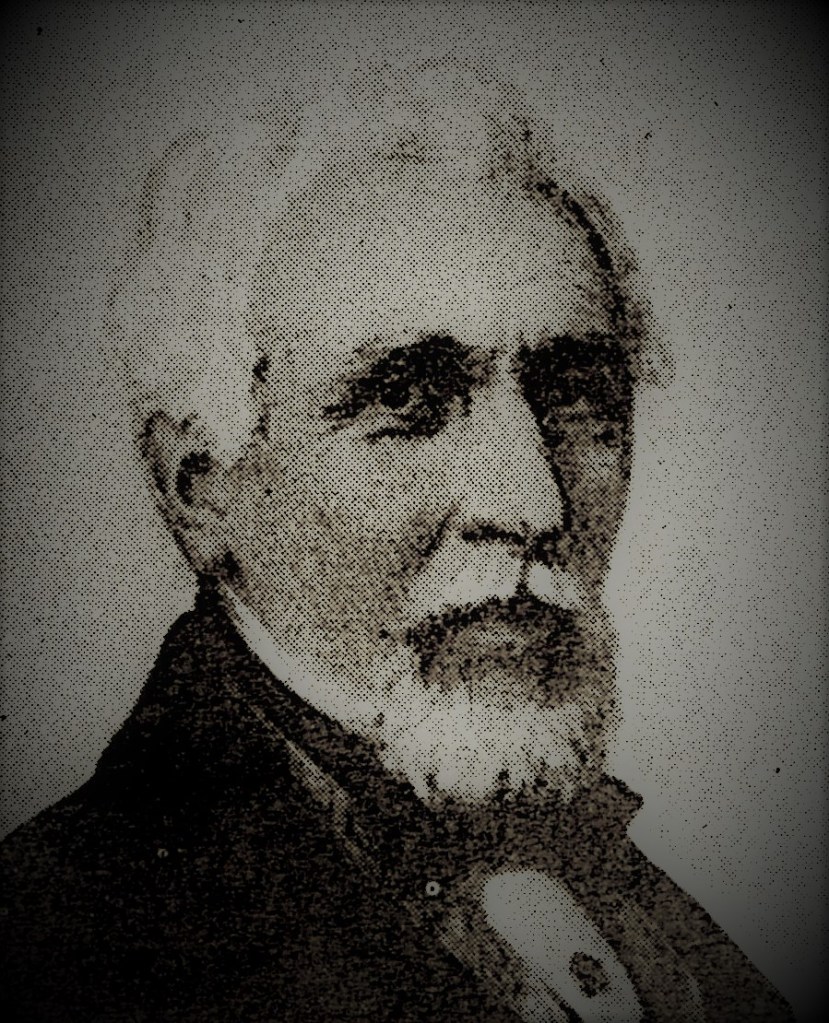
Above: Colonel Henry Stobart
1846: H. Seymour Tremenheere, the Government appointed commissioner into the “State of the Mining Population” interviewed Henry Stobart, a magistrate of the County and employer of coal miners extending over 20 years, and he reported that:
“The habits and mode of life of the colliers of that district generally had improved and that efforts were now making more commensurate to the need than formerly, for their enlightenment and religious guidance, though much still remained to be done.”
In today’s language, it is understood that this means that efforts had been made to improve the lives of pitmen and their families but more needed to be done. At that time, most of the working population could not read or write, there was no universal education, most were born into poverty and squalor, pitmen in County Durham were bound to work for an employer for one year at a time by use of the bond, a system akin to slavery until it was abolished in 1872, there was no local government as such, no treatment for illness and efforts to improve their lot, such as the pitmen’s strikes of 1832 and 1844 were met with violence and the full force of the State. Indeed, much more needed to be done.
1890: The Evenwood entry in a County Directory records that Henry Stobart & Co. were colliery proprietors, George Young was the manager at Railey Fell and Lands Collieries and the head office was at Etherley.
1894: The Evenwood entry in Whellan’s Directory records that Henry Stobart & Co. were described as coal owners, Reiley Fell and Lands collieries and the head office was at Etherley.
“Reiley Fell Colliery, by Messrs. Henry Stobart & Co. Here are the Busty, 3ft 8in to 4 ft. and the Brockwell 5ft 10in. This pit is at present idle but there are 70 coke ovens, which are supplied from the Lands Colliery which was sunk in 1879 and at which are worked the Harvey 2ft 2in, the Busty 4ft 6in to 6ft and the Brockwell 5ft 10in, employing 100 hands.
1896: COLLIERIES
- Etherley George – manager, J. Fairs – 491 employed
- Lands (Standing)
- Morley Green – manager, J. C. B. Hendy – 13 employed
- Newton Cap, A & B Pits
- Railey Fell – manager, J. C. B. Hendy – 201 employed
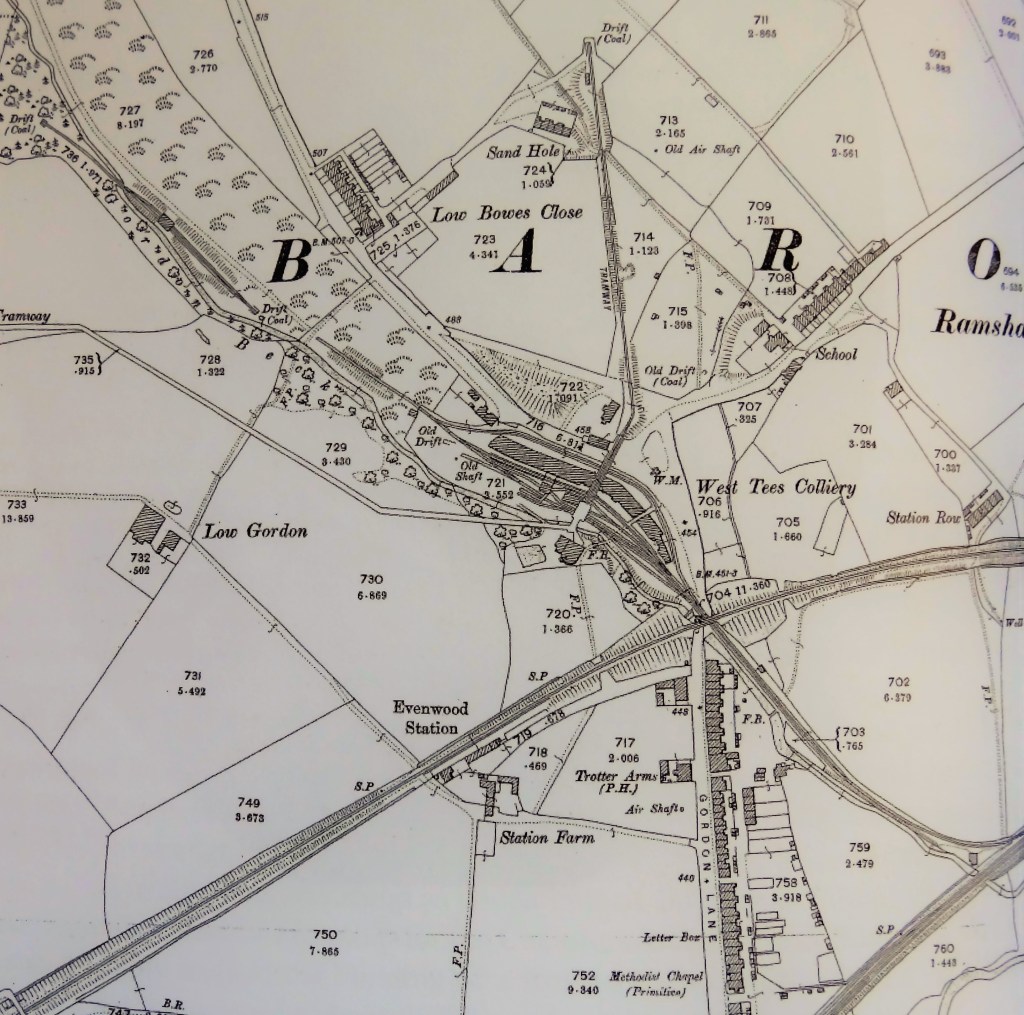
Etherley George pit was at Witton Park/Escomb and Newton Cap Colliery was at Toronto, north of Bishop Auckland and are beyond the scope of this work. Morley Green was a small working situated to the north west of Evenwood in the area of the Parish known as the Barony. Lands Colliery was “standing” meaning it was not working. Evidence suggests that it probably ceased working about 1892/93. The 1898 OS sheet shows the Sand Hole Drift feeding into West Tees Colliery (known locally as, “Railey Fell”) and a battery of coke ovens to the north end of Gordon Lane, Ramshaw. In addition, there were drift mines located along Gordon Gill which was linked to the coke works. An “old tramway” is indicated and this is evidence of the connection to the above described, Lands Colliery.
Below: Map to show the Railey Fell/West Tees Colliery, Gordon Gill & Sand Hole drift mines at Ramshaw and the railway connection to the Haggerleases Branch Line (1898 OS Sheet)
Below: Believed to be about 1890, Lands Colliery which was connected to Railey Fell coke ovens by a tramway

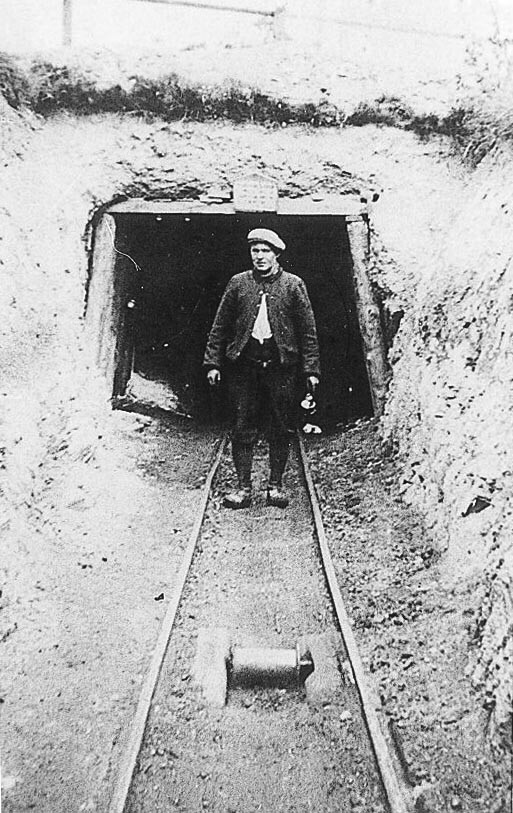
Below: Pitman at Sand Hole Drift, Ramshaw.
1902: COLLIERIES
- Chilton
- Etherley George – manager, J. C. B. Hendy – 476 employed
- Newton Cap A & B Pits
- Norwood – manager, R. M. Brown – 86 employed
- West Tees, Evenwood – manager, Arthur Parkin – standing
- West Tees, Morley – ditto
- West Tees No. 2 – manager, R. M. Brown – 57 employed
- West Tees Railey Fell – manager, Arthur Parkin – 239 employed
- Victoria
- Woodhouse Close – standing
Chilton, Etherley George, Newton Cap, Victoria and Woodhouse Close Collieries are beyond the scope of this work. Norwood Colliery was at Ramshaw and had been worked by several companies, including the Durham County Coal Company which sunk the pit about 1848, Messrs. L.P. Booth & Co., Messrs. Hedley & Co., The Norwood Coal Co., Thomas Charlton & Co. It was put up for sale in 1898 and it seems that Henry Stobart & Co. bought the concern. It was worked by 2 drifts, either side of the River Gaunless, with 86 men employed. The Busty, Five Quarter and Brockwell seams were abandoned in 1904 and it subsequently closed.
The working at West Tees/Railey Fell was by means of a number of drift mines such as Sand Hole and those at Gordon Gill. Others were located at Morley and Lands. A detailed examination of numerous plans of “abandoned seams” would be required to establish the sequence of closures. Any statements included in this work are “a best guess”. The main concentration of work was at Ramshaw where tramways from drifts fed into screens and supplied coke works where some 239 were employed. West Tees No 2 was north of Cockfield Fell, close to the Haggerleases Branch line where another 57 men were employed.
During this period, the trading situation was reported in the local press as being difficult. By December 1906, demand for coke improved and an extra shift commenced at Railey Fell to enable the colliery to draw coal for 17 hours rather than 10 each day. Uncertainty was evident in December 1907 when hewers were given notice due to lack of orders. Coke was being stored at both Randolph and Railey Fell Collieries during the summer of 1908 and men at Railey Fell, the coal hewers were placed on short time.
1909: COLLIERIES
- Chilton
- Etherley George
- Etherley Jane
- Newton Cap
- Railey Fell – A. W. Parkin
In December 1909, Frank Widdas, manager of Railey Fell Colliery left for Thrislington Colliery, West Cornforth.
1910: Henry Stobart & Co. Ltd., were the colliery proprietors at Norwood, Railey Fell and Lands collieries and the head office was at Etherley.
1910 appears to have been a year of poor trade and industrial disputes. At Railey Fell there were disputes in April, May and June. In June 1911, Railey Fell miners received their notices and the colliery closed down in August. Some of the most respected families in the area left the district such as John and Stephen Mattimoe and their families left for Eldon, near Bishop Auckland. In September, 4 men were re-engaged at Railey Fell. Industrial unrest over the minimum wage continued throughout 1911 and a national strike ensued 1st March 1912, lasting into April before being resolved. In May 1912, a few men were set on at Railey Fell. In November 1912, the manager of Railey Fell, Mr. Page resigned since he had decided to emigrate to Australia. He was replaced by Mr. Hampson who was transferred from the Stobart’s Chilton Colliery. 1912 was not a good year, as it ended with a national rail strike meaning that coal could not be moved and short time working was introduced. In 1912, H. Stobart & Co. Ltd. employed Joseph C. Hampson as manager and Henderson Lister as Engineer at West Tees/Railey Fell Colliery.
Despite the uncertain local situation at Railey Fell, between 1904 and 1914, there was an overall growth in coal output of 29.5% at collieries owned by H. Stobart & Co. Ltd., as the following statistics demonstrate.
1904: 521,209 tons
1905: 584,239
1906: 596,704
1907: 644,598
1908: 635,198
1909: 675,889
1910: 606,488
1911: 598,026
1912: 567,863
1913: 647,325
1914: 664,768
Other collieries in the group such as Chilton, Fishburn and Newton Cap are presumed to have been performing well, having regard to the history of unrest reported at Railey Fell. The Great War, 1914-18, followed and this led to a huge demand for coal. There was a shortage of pitmen since many had enlisted for war service “in the colours”. There was plenty of work for those willing to go down the pit.
1914: COLLIERIES
- Chilton, No.1 & No.2
- Etherley Rush
- Fishburn
- Newton Cap
- West Tees Railey Fell – manager, Joseph Hampson – 250 employed
Etherley Rush Pit was located to the south east of Etherley near Greenfields Lane.
Below is a selection of photographs dated about 1914 of pitmen, pit lads and ponies at various sites at Railey Fell colliery.
Below: Railey Fell Colliery: Pit lads and pit ponies, including Nathan Mills, John Hannon, Maurice Mattinson, and a Nicholson, Parkin and Redfearn.
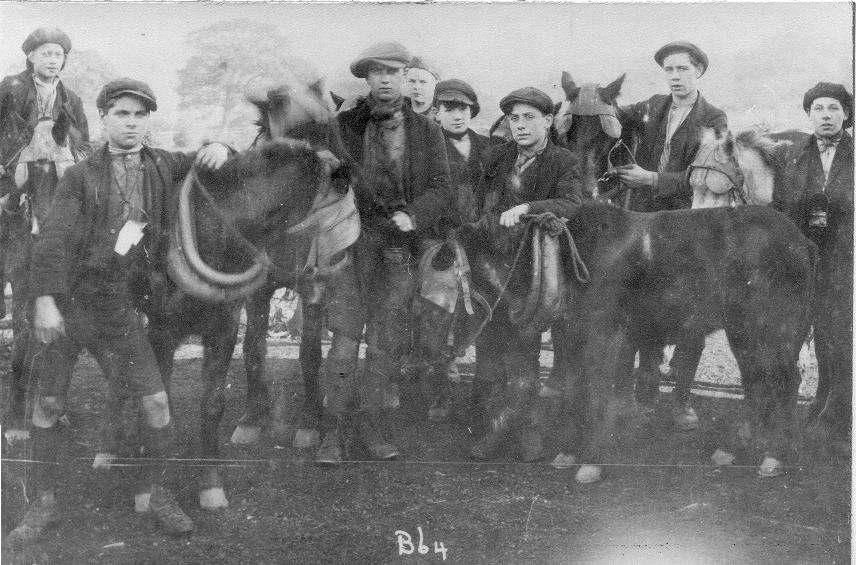

Below: Including at the back Geordie Kell, ? Million, Taffy Anderson, ? Maddison, Jos Stubbs at the front Joe Peacock and John Teasdale.

Below: Believed to be William Ryder Stobart (1864-1938) to the left. (Photo courtesy of the descendants of the Stobart family particularly Ianthe Tollast)

After the war, servicemen previously employed as miners were demobilized as a priority since there still was demand for coal to keep the country going.
1921: COLLIERIES
- Chilton No1 & No2
- Etherley Jane
- Fishburn
- Newton Cap
- West Tees Railey Fell – manager Joseph C. Hampson – 278 employed
1921: Henry Stobart & Co. Ltd were colliery proprietors with Joseph C. Hampson recorded as its manager and Henderson Lister, as the engineer at West Tees Colliery.
1923: COMPANY DETAILS
Registered Office – Etherley, Bishop Auckland
Chairman: Sir A. F. Pease Bart.
Directors: Sir J. B. Dale, Lord Gainford, W. H. Hustler, R. J. Mounsey,
C. E. Pease, E. L. Pease, Hon. J. Pease, R. A. Pease, Rt. Hon. H. P. Pease
Secretary: J. A. Parker
The above directors were associated with Pease and Partners and the North Bitchburn Coal Company Ltd. Since there are no members of the Stobart family listed as directors, it appears that the family ended its association with coal mining in the district at this time. Collieries owned:
- Chilton No.1 & No. 2
- Etherley George
- Etherley Jane
- Fishburn
- Newton Cap
- West Tees Railey Fell – manager Joseph C. Hampson – 303 employed
1924: COLLIERIES
- Chilton No.1 & No.2
- Etherley George
- Etherley Jane
- Fishburn
- Newton Cap
- West Tees Railey Fell – manager Joseph C. Hampson – 337 employed.
There are 2 manager’s reports compiled by W.E. Donald for the years ending 31 March 1923 and 1924 relating to the collieries and works of Henry Stobart & Co. Ltd. which may infer that the directors of Pease and Partners were closely examining “the books”.
1927: COLLIERIES
- Fishburn
- West Tees Railey Fell – manager, Joseph C. Hampson – 327 employed closed 16/04/1927
1929: COLLIERIES
- Fishburn
- West Tees Railey Fell – manager, Joseph C. Hampson – 236 employed
1930: COLLIERIES
- Fishburn
- West Tees Railey Fell – manager, Joseph C. Hampson – 279 employed
1932: Pease and Partners refused to fund any further losses for the subsidiary company, the North Bitchburn Coal Co. Ltd. and it was placed in the hands of the receiver. Under a scheme of arrangement Thrislington Colliery was transferred to Henry Stobart & Co., (another subsidiary) in return for the liquidation of the NBCCLtd.’s debt of £119,751 to Pease and Partners.
1934: COLLIERIES
- Fishburn
- Thrislington
- West Tees Railey Fell – manager, Joseph C. Hampson – 187 employed
There is a “Board Folder” of R.J. Mounsey containing monthly reports of the general manager of Henry Stobart & Co. Ltd., 1933 – 1934 which will provide interesting details of the performance of each colliery.
1938 September 29: William Ryder Stobart died.
1939 July: Tees West Colliery closed, the Busty seam was abandoned.
Below: 1939 West Tees/Railey Fell Colliery at Ramshaw: the site was being cleared. (Ada Temple)
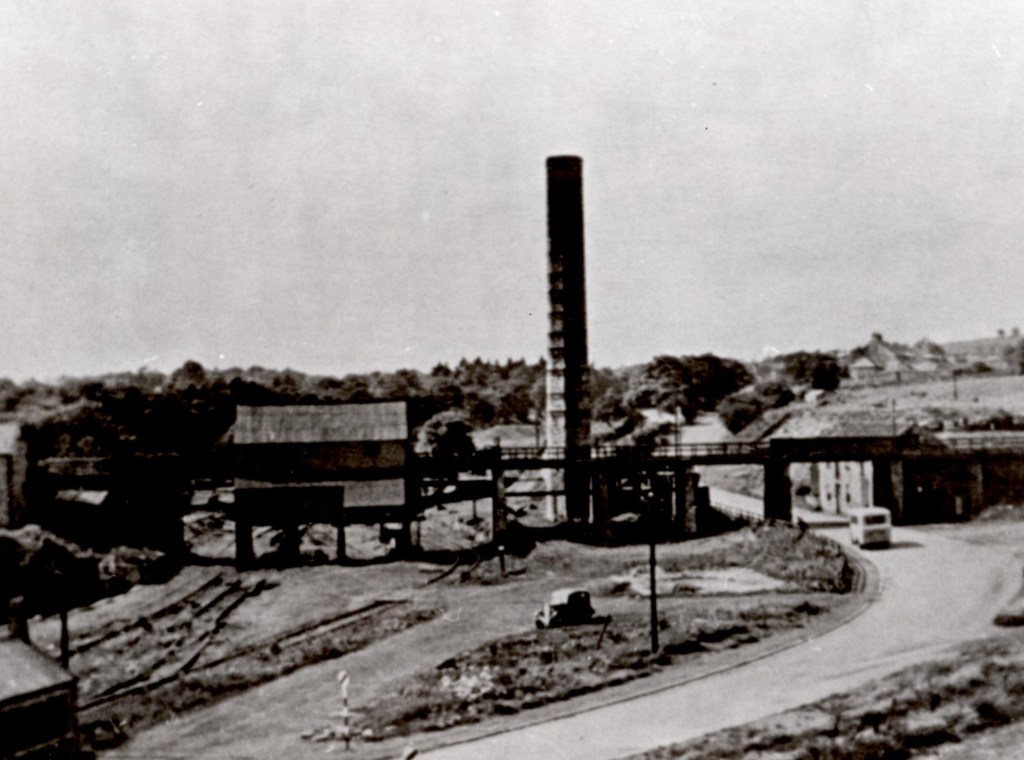
The photo above shows the tramway entering the site over a road bridge to the screens (from the right of shot) and rail tracks leading to the Haggerleases Branch (to the left). The chimney is believed to have served the coke ovens.
1939 August: A press article confirmed the closure of the colliery and intimated that the loss of a lease to work coal had had an effect on the decision. It is understood that there was a dispute between H. Stobart & Co and Henry Lowson Ltd. concerning a royalty issue. From 1921 to 1934, Henry Lowson Ltd. worked New Morley Colliery (Busty, Harvey and Hutton Drifts) which were in close proximity to West Tees/Railey Fell No.2 and it is likely that H. Stobart & Co. Ltd., lost the legal case. The closure of Railey Fell resulted in the loss of 125 jobs.
“West Tees Colliery Ramshaw, better known as Railey Fell Colliery, carried on by Henry Stobart and Co., has raised a serious problem with regard to the future of Etherley and District Miners’ Welfare Association sports ground and to a lesser degree the Etherley Literary Institute. Altogether 125 men were thrown out of work by the closing of the colliery and immediate steps are being taken for the dismantling of the buildings and for several weeks a dozen or so men will be re-engaged on this work…It is understood that the lease of coal royalty previously worked by the colliery has been acquired by the owners of a neighbouring colliery but whether this will mean some of the men affected being re-engaged is not yet known.”
The article mentions 2 members of the management of the company, Mr. J.C. Hampson and Mr. D.C. White.:
“Mr. J.C. Hampson of Toft Hill…served his apprenticeship for his manager’s certificate with Wigan Coal Co. at Wigan and came to Durham County 40 years ago. The whole of which period he has spent in the South Durham coalfield with Henry Stobart and Co. His first appointment was under-manager at Chilton Colliery, where he spent 10 years and later he was for 3 years at Newton Cap before being appointed to West Tees. While at Chilton he lost his left leg in a mining accident.
Mr. D.C. White has been manager at West Tees Colliery for the past 27 years and it is understood that when dismantling operation are completed at the colliery he will begin a well-earned retirement.”
1940 COMPANY DETAILS
Registered Office: 20/26 Northgate, Darlington
Chairman: Andrew Whyte
Directors: R. Dick, E. L. Milward, R. J. Mounsey, Sir R. A. Pease Bart.
This Company is controlled by Pease & Partners Ltd.
Collieries owned:
- Fishburn
- Thrislington
PHILANTHROPIC ACTIVITIES
Henry Stobart & Co. contributed to a number of facilities at Etherley and Ramshaw. It is understood that in 1833, Henry Stobart built a school at Etherley. It is the middle portion of the present church hall. It opened on 13 October 1833. The Stobart family were great benefactors to St. Cuthbert’s Church at Etherley. Other ventures include:
- 1864: The Etherley Literary Institute: it cost about £500 and consisted of a large lecture hall, used in daytime as an infants’ school, reading and recreation rooms, library and bath-room.
- 1865: The Ramshaw Colliery School: it was built for 150 children.
- The Etherley and District Miners’ Welfare Association sports ground: it is understood that it was wholly maintained by members of the Stobart family.
- St. Cuthbert’s Church, Etherley: The family were patrons of the church, presenting many gifts in memory of family members, of whom many are buried in the churchyard.
In addition leading members of the family held numerous official positions in public life, being magistrates and Major George Henry Stobart (1873-1943) was Deputy Lieutenant of the County in 1924. Other family members were associated with the County Regiment, the Durham Light Infantry either in official or voluntary roles. During the Great War, like many other families their commitment to the cause was total and one of their homes, Red House was used as a hospital for wounded servicemen.
THE 17th DURHAM VOLUNTARY AID HOSPITAL, THE RED HOUSE, ETHERLEY, BISHOP AUCKLAND
At the outbreak of the Great War in 1914, the Red House at Etherley was offered for use as a hospital. The offer was accepted and Mrs. Jessica Octavia Stobart was appointed as the Commandant. At the time, she was about 42 years old and no doubt relished the opportunity to do her bit for the country as did many other women.
Below: Red House, Etherley

Below: Mrs. Jessica Octavia Stobart OBE [1872 – 1951]
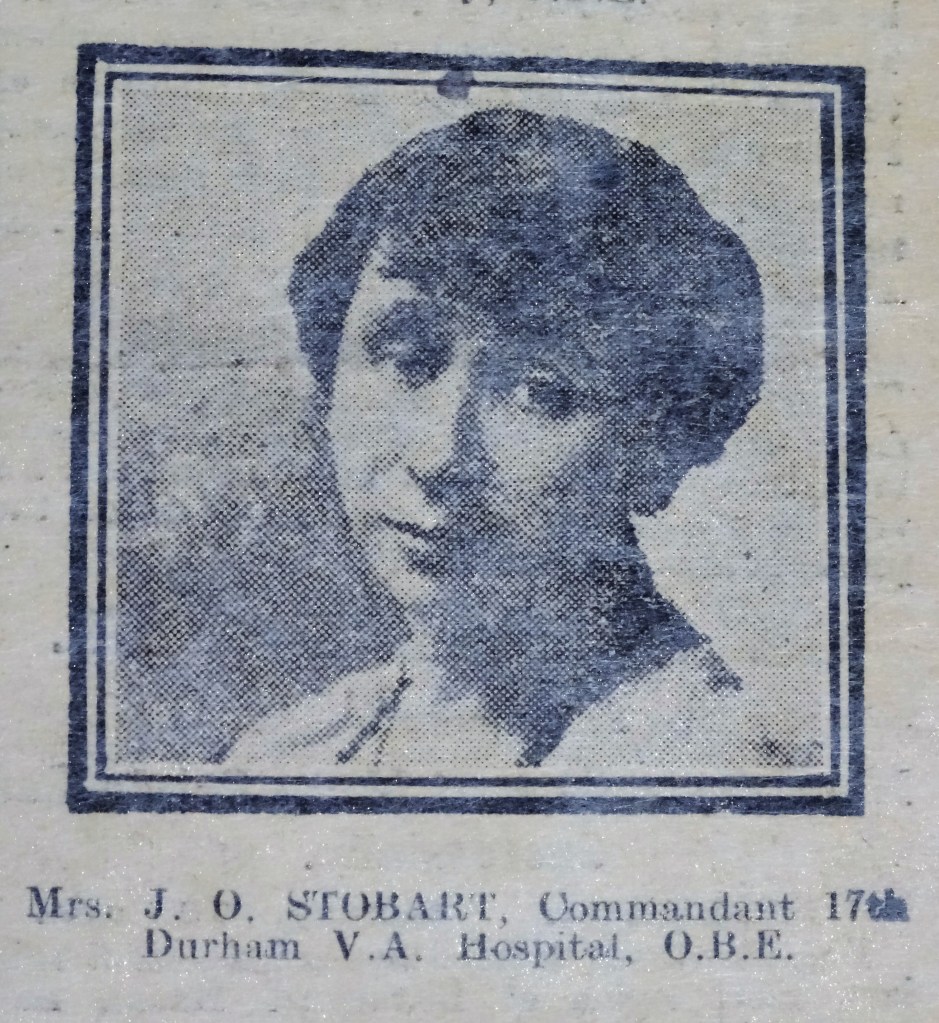
The Etherley VA Hospital operated between 18 March 1915 and 15 April 1919. In June 1918, Mrs. Jessica Stobart was awarded an OBE for her services to the war effort.
POST WAR
The Stobart family left the village in 1920. By the time of the 1921 census, Red House and Etherley Lodge were under new occupation. Major G.H. Stobart (1873-1943) continued to live at Harperley Hall, near Fir Tree. It is believed that the Stobart family’s business involvement with South West Durham ended well before the commencement of the Second World War. Jessica Stobart died in 1951 aged 78. Her death was registered at Henley, Oxfordshire.
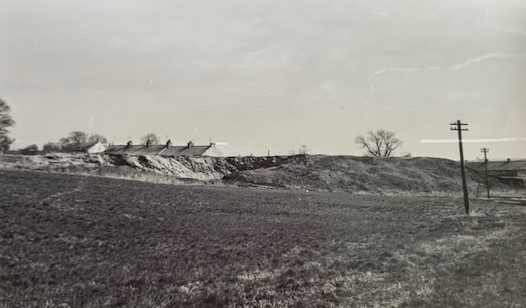
Sandhole Drift at Ramshaw
Below: c.1939: Map to show the Sand Hole pit heaps at Ramshaw

Below: Late 1950’s The Removal of Sandhole Pitheap (Photos courtesy of Aline Waites)


ACKNOWLEDGEMENTS
ER&DHS would like to thank Ianthe Tollast and her relatives, the descendants of the Stobart family for lending us photographs and providing family details.
Mike Ellis from Etherley for additional Stobart family details.
Aline Waites for the above photos which she posted on the I Came from Evenwood and Ramshaw Facebook page and has allowed us to display here.
“Etherley Parish Church St Cuthbert – the Story of 150 Years 1832-1982” Peter Kilmister BA republished 2018 by Michael Maddison and Wayne Michael Davison.
 EVENWOOD RAMSHAW & DISTRICT HISTORY SOCIETY