Including REV. GEORGE MADDISON 1873 – 1906
Summary
An ornate headstone found in an abandoned cemetery, uncovered by the Evenwood Cemetery Volunteers[1] led to this story. An Evenwood born Wesleyan missionary, Rev. George Maddison was stabbed in the neck by one of a group of angry, intoxicated, indigenous African men in the aftermath of the Bambatha Rebellion. He died of his wounds on Friday 6 July 1906 which was his 33rd birthday. The incident occurred near Johannesburg, South Africa when George and 5 friends were cycling. All were wounded and 3 died. Questions about the incident were raised in the British Houses of Parliament.
The Headstone
A fine sandstone headstone in Evenwood Cemetery remembers 6 members of the Maddison family:
- George Maddison born 31 August 1835 died 23 August 1884
- Elizabeth Mary Ann his wife born 14 June 1838 died 4 May 1903
and their children:
- Margaret Edith died 5 December 1893 aged 22
- Harriet Arabella (Sissie) died 22 September 1897 aged 22
- Jane and
- George Edward who both died in infancy
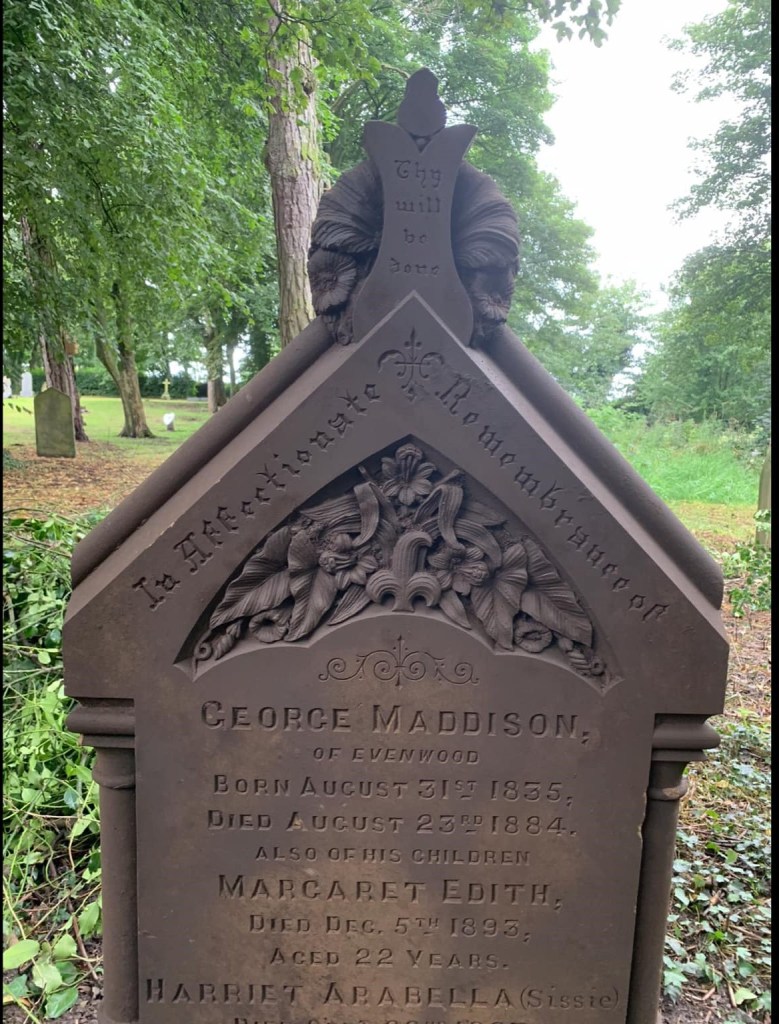
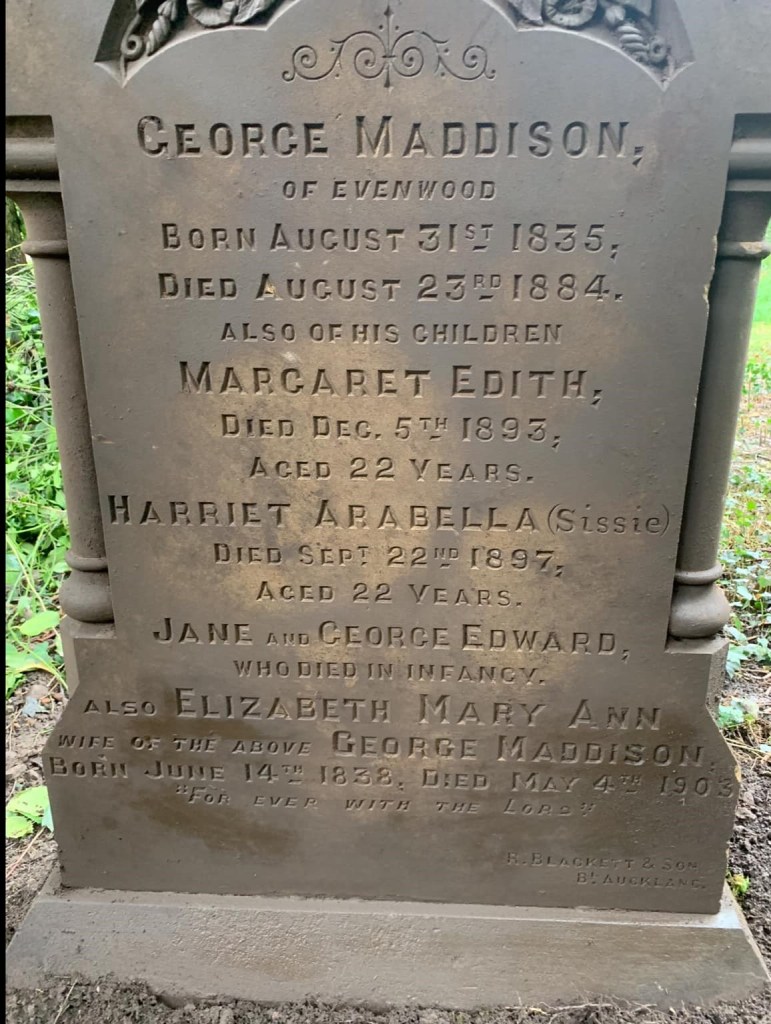
Above: The Maddison family headstone, Evenwood Cemetery
Three of the Maddison family emigrated to South Africa:
- Elizabeth Mary Ann, probably 1898
- Charles John probably 1903
- George (junior) 1904
George Maddison junior followed the calling of his father as a Methodist minister. He was born and raised in Evenwood, moved to Hunslet near Leeds in pursuit of work and later served as a Wesleyan Minister in Nottingham before emigrating to South Africa in October 1904.
Family Background [2]
George Maddison was born in July 1873, at Evenwood, the son of George (1835-1884) and Elizabeth (1838-1903) Maddison and grandson of William and Ann Maddison. In 1841, William Maddison was recorded as a coal miner then living at Evenwood Bridge with his wife Ann, 3 daughters and 3 sons.
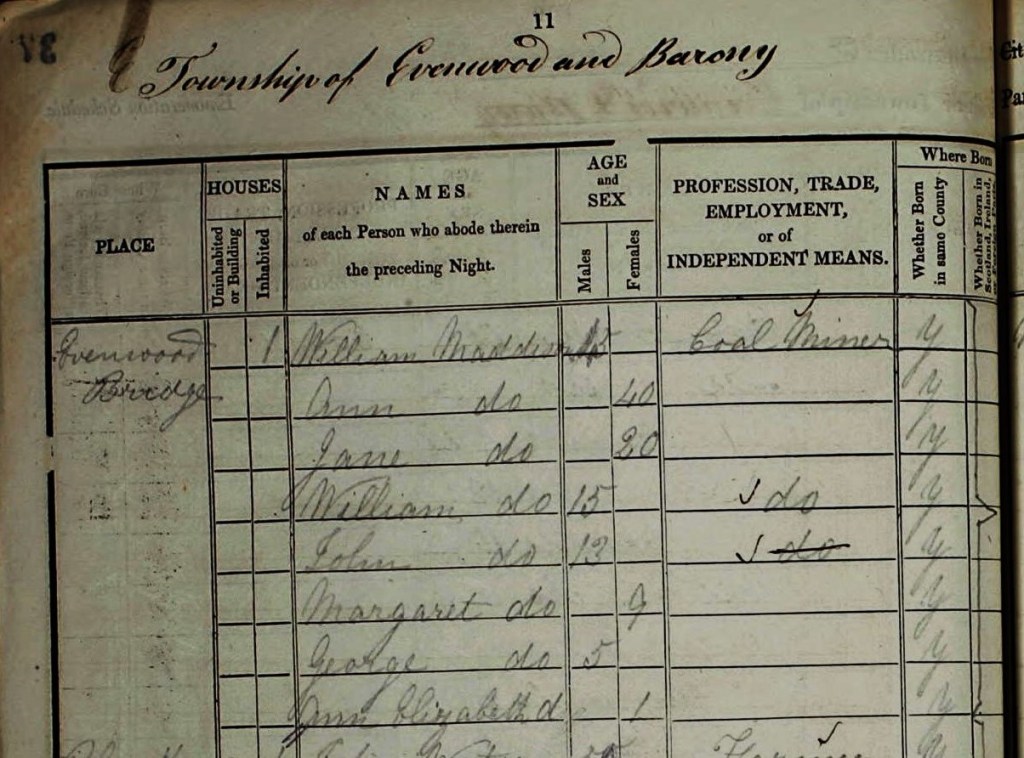
Above: 1841 Census entry for William Maddison & family
By 1851, William had died and his wife Ann was living at Morpeth with their 6 children – Jane, William, John, Margaret, George and Ann Elizabeth. By 1861, Ann was back in Evenwood employed as a “Grocer & Draper.” George (aged 25) Anne Elizabeth (21) helped in the shop.
In 1861, George Maddison married Elizabeth Grant and they lived at Evenwood. By 1871, George, now 35 years old was recorded as an, “Independent Minister.” They had 3 children, 8 years old Annie Little, 6 years old William Arthur and Elizabeth Mary Ann aged 4. Two children, Jane and George Edward, died in infancy.
In August 1880, Rev. George Maddison is mentioned in the Northern Echo[3] in relation to a murder at Evenwood. On Wednesday 18th August, 22 years old William Brownless murdered his 25 years old fiancée Elizabeth Holmes by cutting her throat. He then attempted suicide by cutting his own throat but failed. He was held at an Evenwood public house, the Drovers Arms [4] where, at Brownless’ request, he was visited by Rev. Maddison who, “tendered appropriate counsel.” 29 October, Brownless was tried, convicted of murder and sentenced to death. He was hung at Her Majesty’s prison, Durham, 16 November 1880.
The 1881 census records George (aged 45) as an, “Evangelist Independent.” He and Elizabeth lived at the Post Office, Evenwood. Their family had grown to 5 daughters and 3 sons:[5]
- Annie (1862-1911)
- William Arthur (1864-1941)
- Elizabeth Mary Ann (1866-1935)
- Margaret Edith (1872-1893)
- George (1874-1906)
- Harriet Arabella (1875-1897)
- Charles John (1878-1948)
- Mary Jane (1891-1917)
Annie, now 18 years old was employed as a School Mistress’ Assistant and 16 years old William was a Drapers’ Apprentice. The other children were at school including 7 years old George junior.

Above: 1881 Census: Entry for George Maddison & family
23 August 1884, George Maddison senior died.
George Maddison junior [6]
Born 6 July 1873 at Evenwood, by 1891, 17 years old George junior lived at East Hunslet, near Leeds employed as a, “Telegraph Clerk.” He boarded with the Haywood family. In 1901, George now 27 years old was recorded as being a, “Wesleyan Minister” and he, along with Frederick W. Welbon, were visitors to George H. Hibbert and his family, a solicitor of Mansfield, Nottinghamshire.

Above: 1901 Census entry for George Maddison junior
4 May 1903, back home in Evenwood, George’s mother Elizabeth died.
To South Africa
It seems that 2 of George’s siblings had emigrated to South Africa before he made his decision to leave the UK – Elizabeth Mary Ann, probably in 1898 and Charles John probably in April 1903. Rev. George Maddison junior was next to depart UK shores.
3 October 1904, aged 25, Reverend George Maddison boarded S.S. Sophocles, a vessel operated by Geo. Thompson & Co. shipping line, bound for Cape Town, South Africa. He was to start a new life as a Methodist missionary.
25 November 1905, George Maddison married Mabel Hallam at Witwatersrand, Johannesburg, Gauteng, South Africa. Mabel was born in 1882, the daughter of George and Martha Hallam, living at West Bridgford, Nottinghamshire.[7] The witness at the wedding was Charles John Maddison (1878-1948), George’s younger brother, who had been in South Africa since April 1903. From 1886, the Witwatersrand Gold Rush attracted huge numbers to work in the mines and associated industries. The city of Johannesburg was established as the centre of the goldfield.
Circumstances relating to Rev. George Maddison’s death
Monday 2 July 1906: Rev. George Maddison was stabbed in the neck by one of a group of angry, intoxicated, indigenous African men in the aftermath of the Bambatha Rebellion. He died of his wounds on Friday 6 July 1906 which was his 33rd birthday. The incident occurred near Johannesburg, South Africa when George and 4 friends were cycling. All were wounded and 3 died.
Background
The incident was one of a number of attacks on the “white population” during, what is commonly called, the Zulu Rebellion (or the Bambatha Rebellion) of 1906: [8]
“Allocation of farms in Zululand to Whites for sugar farming was met with dissatisfaction and had resulted in squatting and, in some cases, exorbitant rentals in the form of hut tax on those farms. Registration of births and deaths, made compulsory by the Natal government was foreign to the Blacks and the 1904 census was viewed with great suspicion.”
Another account records that: [9]
“The Bambatha Rebellion of 1906 was one of the last organised military resistances by indigenous Africans against British rule in South Africa. It was primarily led by Bambatha kaMancinza Zondi, a minor Zulu chief from the Greytown district, in opposition to British encroachment and, particularly, to the imposition of a new “poll tax” in 1905. The poll tax, of one pound per adult male in addition to existing hut taxes, was intended to coerce African men into working in mines and on white-owned farms. When colonial officials began using force to collect taxes, anger and frustration grew among the Zulu population and Bambatha and his followers began a guerrilla campaign.”
Bambatha and other chiefs expressed their displeasure and launched a series of guerrilla attacks.

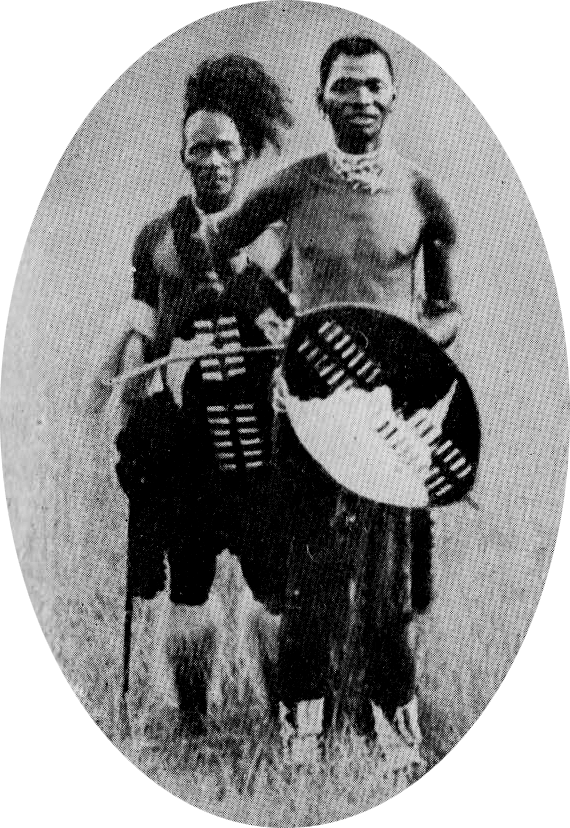
Above: Zulu Warriors [10]
10 June 1906, the rebellion was crushed when British troops met the rebels at Mome Gorge. Spears (assegais), fighting sticks (knobkerries) and cow hide shields had little effect against cannon and machine guns. It was estimated that between 3,000 and 4,000 Zulus were killed, 7,000 were imprisoned and 4,000 were flogged. At the time, it was claimed that Bambatha had been killed but this was disputed. Some believed that he fled to Mozambique.[11]
Above: The Zulu leader Bambatha [12]
The attack of 2 July 1906 on Re. George Maddison’s cycling party took place about 3 weeks after the Battle at Mome Gorge. It is not difficult to believe that retribution was on the minds of many Zulu men.
Press Reports
Press reports infer that the Zulu men were drunk. There are 4 press reports which provide further details about the incident:
Rev. G. Maddison’s Condition Worse – Mr. George Hallam of 61 Loughborough Road, West Bridgford, father-in-law of the Rev. George Maddison, the Wesleyan missionary who went out to Johannesburg in October 1904, from Nottingham and who on July 2nd was stabbed in the back of the neck by natives, received a cable today stating that Mr. Maddison had had a relapse and there was great cause for anxiety.
Rand Outrage – Death of a Wesleyan Minister – A telegram was received yesterday during the Wesleyan Conference at Nottingham announcing the death in Johannesburg Hospital of the Rev. George Maddison, Wesleyan missionary, who went from Nottingham to South Africa and was the victim of a native outrage.
Mr. Maddison, with five friends, were attacked by a party of natives when cycling near Johannesburg. All were wounded and Mr Maddison was stabbed in the neck. He is the third of the party whose wounds have terminated fatally. He died on his thirty third birthday.
Johannesburg July 20 – Prior to his death Mr. Maddison declared that the natives were mad with drink, and he went to the assistance of another white, hoping that the natives would respect a clergyman’s cloth. The churches are organising a meeting to protest against illicit sale of drink to natives – Reuter
Murdered by Kaffirs – Death of wounded Minister (Reuter’s Telegram) Johannesburg, Friday – The Rev. George Maddison, Wesleyan minister, who was brutally assaulted by natives on the 2nd inst., died today as the result of his injuries.
Prior to his death he declared the natives were mad with drink and he went to the assistance of another white, hoping the natives would respect a clergyman’s cloth.
The churches are organising a meeting to protest against the illicit sale of drink to natives.
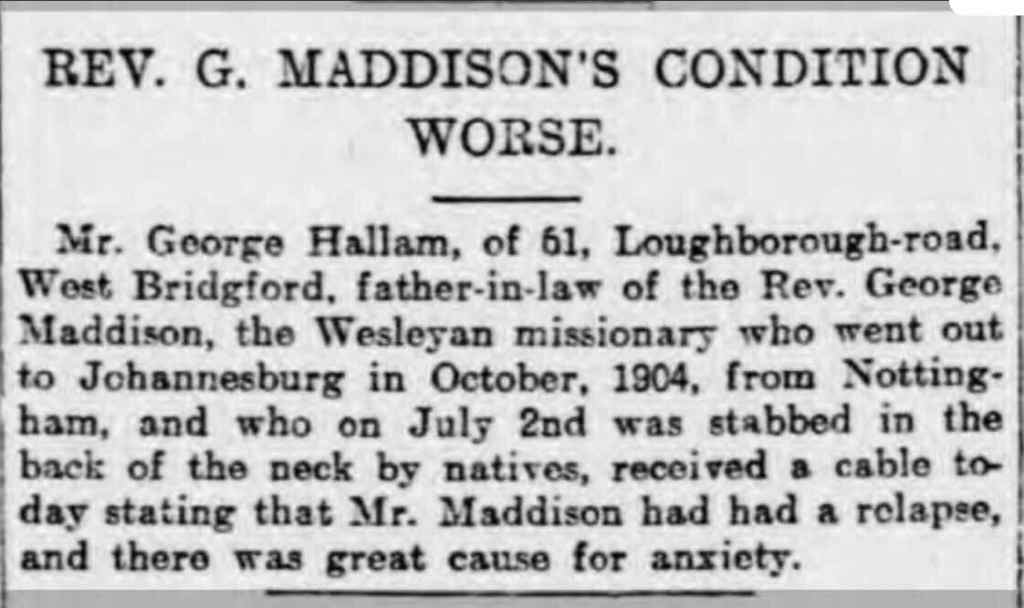
Above: A Contemporary Newspaper Report
Parliamentary Question
The issue of the South African murders was brought up in the British Houses of Parliament. Mr. Rees MP for Montgomery Boroughs [13] informed the Undersecretary of State for the Colonies, Mr. Churchill, that Rev. George Maddison, a Wesleyan minister of Johannesburg, was assaulted by natives in the early part of this month, had died of his wounds and asked what action was proposed for the protection of Europeans in South Africa. Mr. Churchill replied that it was the duty of the local Government to afford all reasonable protection.[14]
Subsequent Events
After George’s death, his pregnant wife Mabel returned to the UK where she gave birth to their son, George Grant Maddison at West Bridgford, Nottingham.
Charles stayed on in South Africa where he married Marion Marshall at Potchefstroom 29 June 1907. His sister Elizabeth Mary Ann was a witness to the wedding.
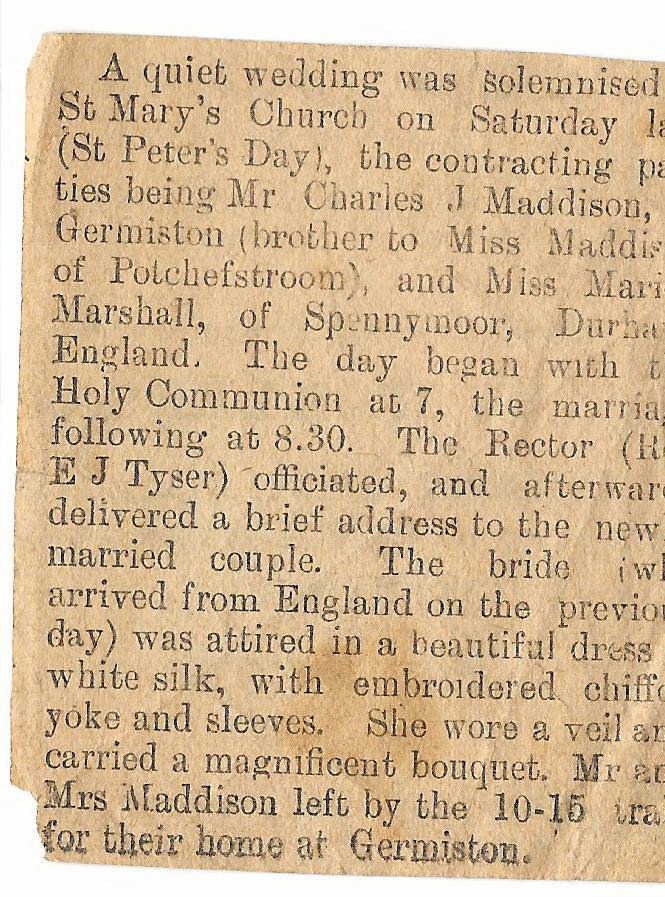
Above: 1907: Press report of the wedding of Charles Maddison and Marion Marshall
The officiating clergyman at this wedding was Rev. Edward Jarrett Tyser. The 1891 and 1901 census records that he was Elizabeth Mary Ann’s employer, living at Pudsey, Yorkshire then at Gloucester. She was his housekeeper. It seems likely that Elizabeth Mary Ann emigrated to South Africa, with Rev. E.J. Tyser, probably about 1898. He officiated at the Church of St. Mary, Johannesburg between 1898 and 1902, was the vicar at Germiston between 1902-03, rector of Potchefstroom between 1903-06, and held other positions at Pretoria, Windhoek and Johannesburg before returning to the UK in 1922 where he died in London 20 February 1927. [15] In 1917, 51 years old, Elizabeth married Peter Jacobus Peteres in Potchefstroom but sadly he died 2 years later. She then moved to Germiston where she died in 1935.
Charles and Marion Maddison went back to the UK (probably for a holiday) then returned to South Africa from London to Cape Town on Lund’s Anchor Blue Line, “Narrung,” 1 March 1909. They stayed in South Africa and raised their family there.
ACKNOWLEDGEMENTS
Gavin Stansfield
Aline Waites
REFERENCES
[1] The Gallimore Girls, Aline, Dawn and Joy with the help of Tony and Stuart.
[2] 1841, 1851 & 1861 census
[3] Northern Echo 23 August 1880
[4] Now the Travellers Rest
[5] 1881 census
[6] 1891 & 1901 census
[7] Ancestry family tree
[8] https://www.battlefieldsroute.co.za/the-bambata-rebellion-of-1906-nkandla-operations-and-the-battle-of-mome-gorge-10-june-1906-by-k-g-gillings-jcd/
[9] Gavin Stansfield
[10] Public Domain, https://commons.wikimedia.org/w/index.php?curid=857091
[11] https://en.wikipedia.org/wiki/Bambatha_Rebellion & https://www.sahistory.org.za/people/chief-bhambatha-kamancinza-zondi
[12] “History of the Zulu Rebellion 1906” 1913 Stuart J. Public Domain https://commons.wikimedia.org/w/index.php?curid=18408089
[13] https://en.wikipedia.org/wiki/Sir_John_Rees,_1st_Baronet – Liberal MP for Montgomery Boroughs 1906-1910 & Unionist MP for Nottingham East 1912-1922 .
[14] Hansard Vol.162; debated Thursday 2 August 1906
[15] https://www.ancestry.co.uk/discoveryui-content/view/86890:3997
 EVENWOOD RAMSHAW & DISTRICT HISTORY SOCIETY