1848: The first attempt was made to draw up rules and regulations. As Victorian society developed, so did sporting activities and the quest for organisation and ideals such as, “sportsmanship”. Arguably, the upper class thought that the masses could benefit both morally and socially with the discipline that organised sport could bring. The term, “muscular Christianity” has been used to describe the work of some organisations engaged in the “civilisation” of sport and those that took part. If nothing else, it would give some lucky young lads the opportunity to take part in activities whenever they had a free afternoon and possibly keep them out of the taverns and gambling dens.
1863: The Football Association was formed. 20,000 attended the first FA Cup final at the Kennington Oval in London.
1864: The first international match was played, England v Scotland.
1879: Representatives from football clubs in Durham and Northumberland combined to form a regional football association.
1885: Professionalism was legalised. Many Lancashire teams brought in players from Scotland.
1888: The Football League was formed.
1889: The Northern League was established.
1893-94 season: the FA Amateur Cup competition was introduced. In the 22 FA Amateur Cup competitions which took place prior to 1915 when the Great War called a halt to organised games, football teams from the North East of England provided 20 of the 44 finalists and 11 cup winners.
24 June 1887: South Durham and Auckland Chronicle provide an account of the Evenwood Wanderers Football Club Annual Gala.
18 November 1887: Evenwood Wanderers 3 Brankin Moor 1. The Evenwood team was:
Kirby; Heseltine; M. Bell; Roxbrorough; Hewitt; Moore; H. Bell; Deighton; Kipling; Sayers; Purdy.
9 December 1887: Darlington 3 Evenwood 0. The team was:
Raey; Heseltine; M. Bell; Roxborough; Hewitt; Moore; H. Bell; Sayers; Deighton; Purdy; Kipling.
1897-98: Ten seasons later, both senior and junior teams were playing in Evenwood.
11 November 1897: Cockfield 2 Evenwood 0 in the Lady Eden Charity Cup.
Evenwood Juniors 4 West Auckland Juniors 3.
April 1898: A meeting was to be held at the Trotters Arms (Mr. G. Proud) for all clubs wishing to join the proposed Evenwood & District Football League.
1898-99: A report on the Etherley Institute v Evenwood Juniors match informs of an unsavoury incident. Etherley led 1 nil at half time but one of the Evenwood players threatened the referee. The allegation was denied by an Evenwood correspondent. Unfortunately, nothing more is about the incident was reported so its conclusion remains subject to speculation.
8 March 1899: a junior league table shows the following teams – Norwood Rangers, Cockfield Nops, Lands Red Stars, Evenwood Juniors, Woodside Rangers, Butterknowle Reserves, Woodland Reserves and Etherley Institute. At this time Norwood Rangers were top of the table from Cockfield Nops, by 2 points.
1900 – 1914: EVENWOOD ALBION, HEROES, SWIFTS, JUNIORS & CRUSADERS (SEE SEPARATE SECTION)
A number of named clubs are known to have existed.
1901-02: Evenwood Albion played in the Wear Valley League. Other teams were Stanley Heroes, Shildon Athletic Reserves; Etherley Institute, Sunnybrow Olympic Reserves, Waterhouses Albion, Eldon Albion Reserves, Page Bank United, Spennymoor Swifts and Brandon Village.
1902-03: This season, Evenwood Albion competed in the Gaunless Valley League with Cockfield Nops, South Side, Staindrop, West Auckland Reserves, Woodlands, Butterknowle Reserves, Wham and Copley. Evenwood Albion enjoyed a thrilling race for the title with Cockfield Nops. At this time, teams received 2 points for a win and 1 point for a draw. In early March, Nops topped the table from Albion but Albion had 2 games in hand. A crunch game between the top two resulted in a 3 nil victory for Nops thus their lead was extended to 4 points. The final league table shows Cockfield Nops top, by 3 points, with Evenwood Albion in second place. Albion’s players included C.T. Walton (goalkeeper), Tarn, Blenkinsop, Jackson and Priestley.
August 1903: Evenwood Albion disbanded and several players joined West Auckland and Staindrop.
About this time, there were at least 3 junior teams playing in Evenwood:
- Evenwood Heroes, aged 15-17; Arthur Cook of Raby Street was their secretary.
- Evenwood Swifts, aged 15-17; F. Roberts of Copeland Lane was their secretary.
- Evenwood Juniors, aged 11-13; R. Parkin was secretary.
1903-04: The Heroes and Swifts played 2 games against each other, a 1-1 draw and a 4-1 victory for the Swifts. The Heroes included Bussey. Chapman and White who scored in their 3-0 win at Staindrop. In December 1903, Clay (2), Lowson, Chapman, Metcalfe and Tom Howe scored in Heroes 6-0 rout of Etherley Dene Blue Star. For Swifts, Priestley (2) and Dunn scored in their 3-0 win over Copley. Evenwood Juniors enjoyed a 4-2 victory over Spring Gardens with Welsh, Daniel, Million and Etherington scoring.
1904-05 and 1905-06: The Heroes played in the Wear Valley League for these two seasons when C. Blackett of the Sloat was reported to be secretary.
1906-07: The Heroes then changed to the Gaunless Valley League for the next season and it was reported that they suffered a 3-2 home defeat at the hands of Barnard Castle in November 1906.
In 1910, Ramshaw fielded a team which played in the Gaunless Valley League. There is a photo of a team outside the Railey Fell Colliery Institute which includes Robert and Jack Brunskill, Herbert Maughan and Albert “Fatty” Proud.
Not surprisingly, the 1914-18 period did not see much football in civilian life with so many young men on active service during the First World War, although the Chronicle reported that in November 1914, Ramshaw Institute played Evenwood Harriers and in October 1917, it is reported that Evenwood Rovers were defeated 2-1 by Chilton.
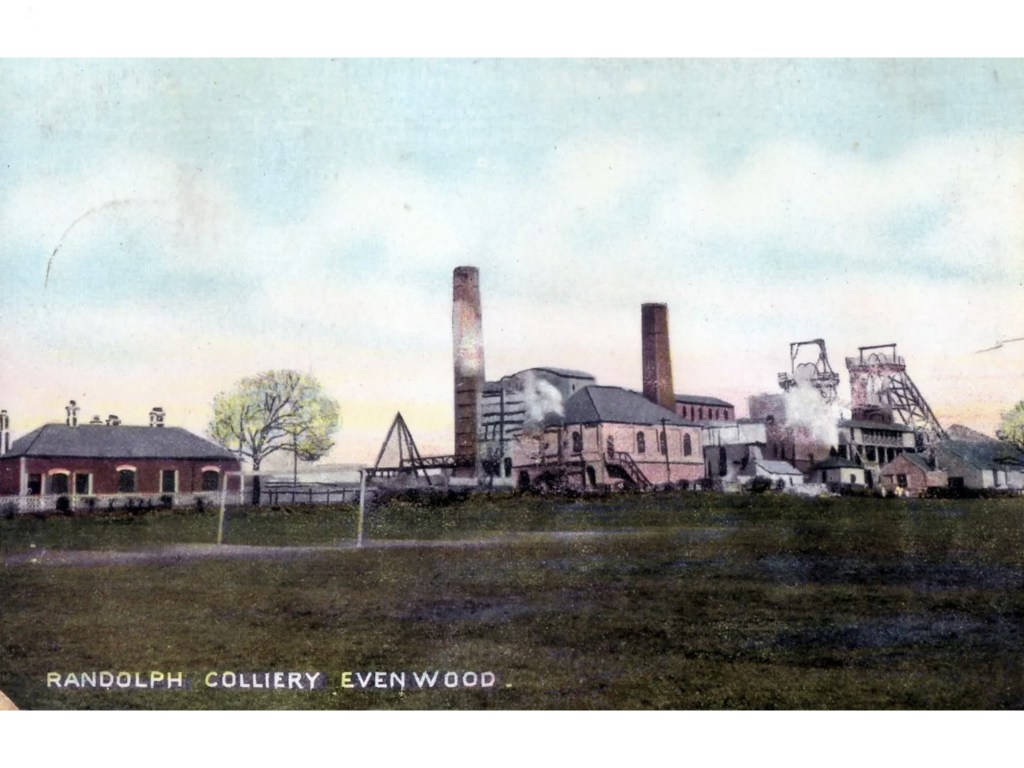
Below: A photo of Randolph Colliery with goal posts in the foreground, which is presumed to be the Gala Field.
EVENWOOD FOOTBALL CLUBS
It is evident that most local colliery villages supported football teams at various levels. The most popular league appears to have been the Auckland and District League. The following list has been identified as hosting various Evenwood teams.
- 1893-94: Barnard Castle and District
- 1894-95: ordinary matches
- 1895-96: Auckland and District
- 1896-97: Wear Valley
- 1899-1903: friendly matches
- 1903-04: Auckland and District
- 1904-06: Wear Valley
- 1906-07: Gaunless Valley
- 1907-08: friendly matches
- 1908-23: Auckland and District (No organised football during the 1914-18 war years)
- 1923-24: friendly matches
- 1924-25: Wear Valley
- 1925-27: friendly matches
- 1927-28: South Durham
- 1928-31: Auckland and District
Given the economic situation which prevailed after the war, the industrial turmoil of the 1920’s and the great worldwide economic depression of the 1930’s, working men, particularly miners were in and out of work as the market conditions dictated therefore it would be difficult for any club to get commitment from players and committee alike. With the lack of money which was the case during this period, it is to the great credit of all those involved that football actually survived those difficult times.
 EVENWOOD RAMSHAW & DISTRICT HISTORY SOCIETY