The Bishop Auckland to Barnard Castle line formed part of the South Durham and Lancashire Union Railway which ran from Bishop Auckland via Barnard Castle and Tebay where it connected with the Lancaster and Carlisle Railway. The line opened in 1863 and was to provide an important link between industry on both sides of the country.
Below, the seal of the South Durham and Lancashire Union Railway

From Ulverston, haematite ore was transported to Teesside to serve the iron making foundries. In the other direction coal and coke was transported from the Durham Coalfield to iron manufacturers of Low Furness. In the 1950’s train loads of up to 44 loaded wagons could be seen, worked by 2, sometimes 3, locomotives.
A passenger service served stations at West Auckland, Evenwood and Cockfield Fell. The service in the 1950’s often started from Sunderland could end up Middleton-in-Teesdale! It ran via Bishop Auckland and Barnard Castle en route.
An interesting through train inaugurated in the 1930’s was a summer Saturday service from Tyneside to Blackpool which survived until the summer of 1961.
The passenger service was finally withdrawn in June 1962 along with all through traffic between Bishop Auckland and Barnard Castle. The line between Bishop Auckland and Fieldon Bridge (Tindale Crescent) was closed to traffic in 1964. The line from Shildon via Fieldon Bridge and West Auckland to the foot of the incline from Randolph Coke Works was closed August 1969.
Below:
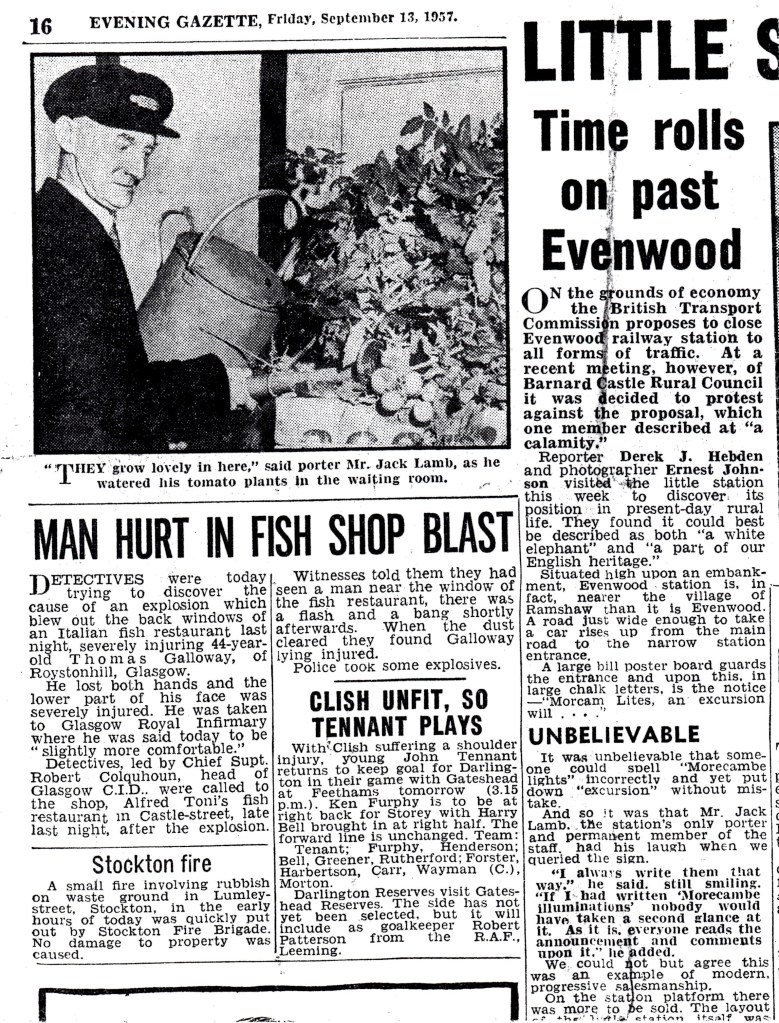
Evenwood Station. Originally, there was a “halt” at Station Row. The Station House and offices was opened in 1884 and closed to all traffic 14 October 1957.

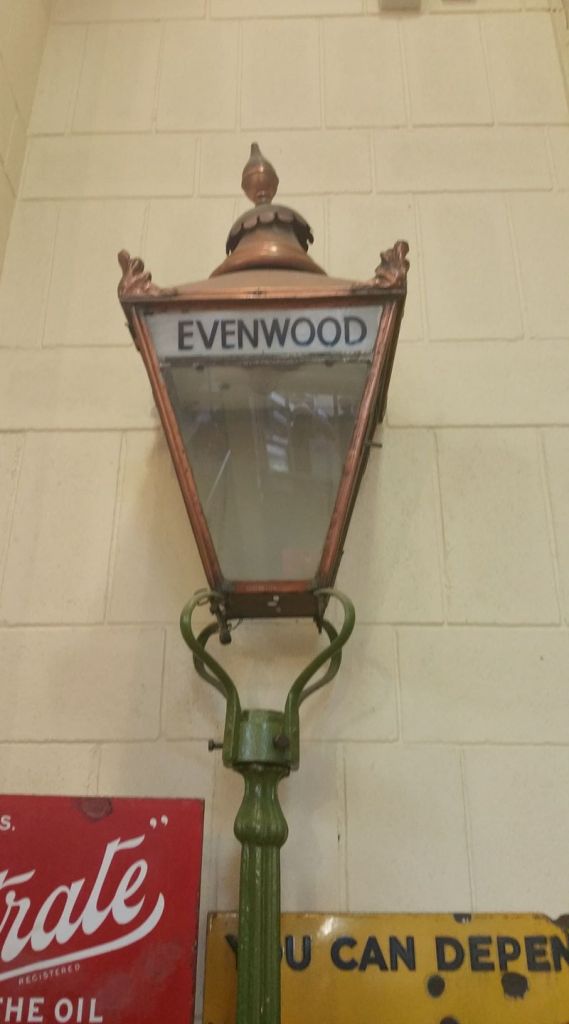
Below: Evenwood Station lamp at Heads of Steam, North Road Railway Station, Darlington
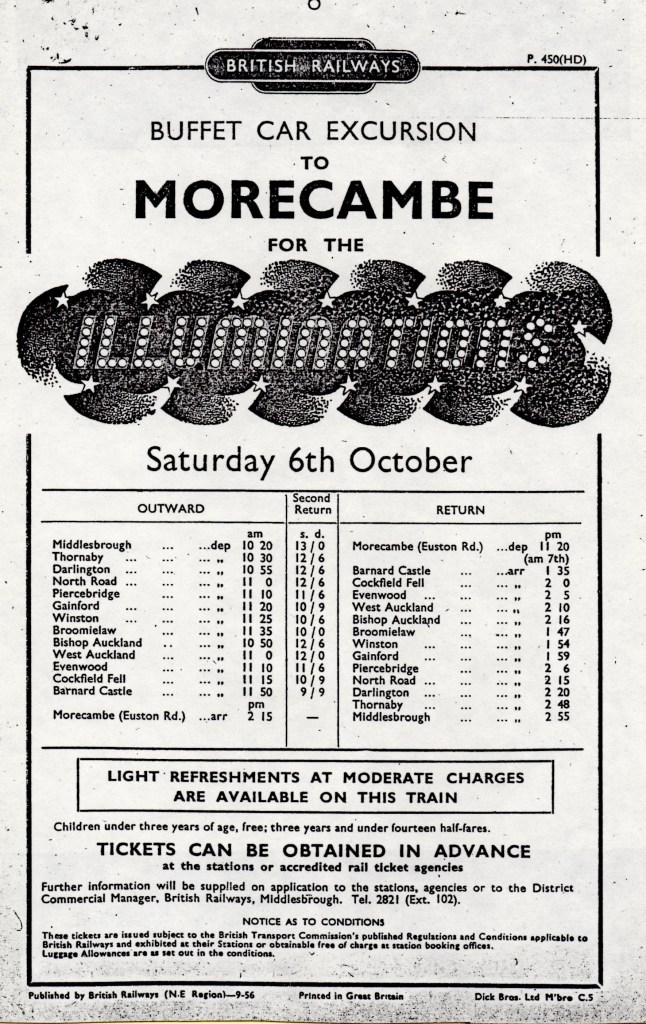
Below, 1956 Middlesbrough to Morecambe timetable
Below, September 1957, the closure of Evenwood Station
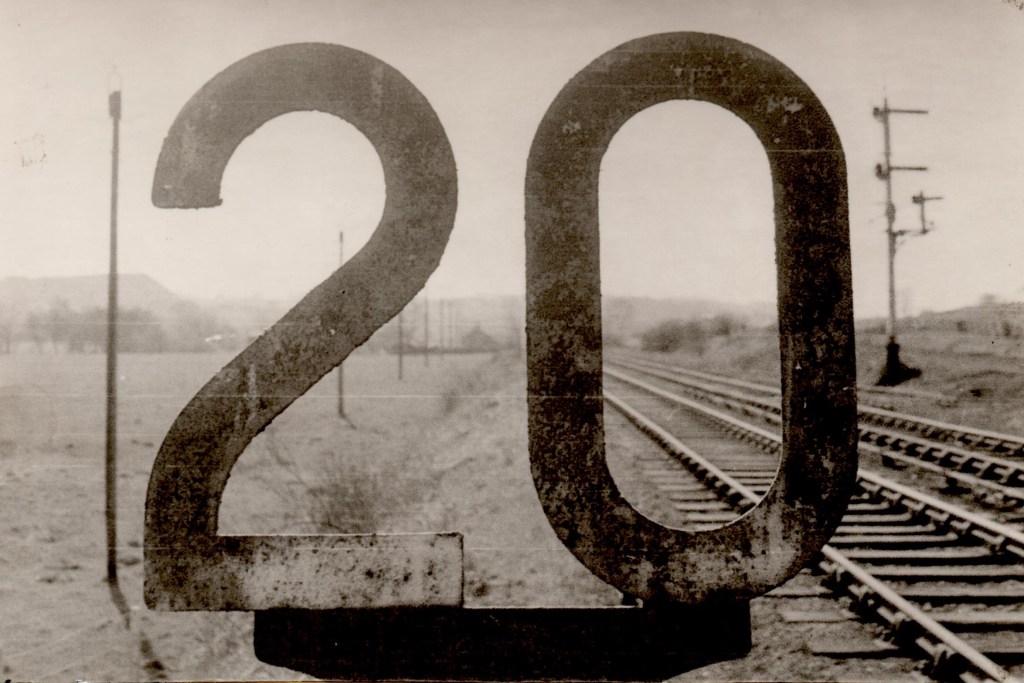
Below, Near Spring Gardens Junction, Randolph Colliery pit heap in the background

1890: Station Master was GEORGE HENRY COATES (1846 – 1921)
George Henry Coates was born 1846 at Appleby, Westmorland, the son of Robert and Ann Coates, brother to at least 5 siblings. In 1861, George’s father Robert was employed as a, “Solicitor’s Clerk.” In 1868, it is believed that George married Elizabeth (surname unknown). George H. Coates was employed for at least 30 years, from 1871 to 1902 as the station master at Evenwood.
- The 1871 census records George as the station master, he and Elizabeth lived at Ramshaw.
- By 1881, the family lived at Evenwood Station with their 4 children Alfred aged 13, Louisa aged 11, Fanny aged 9 and Ernest 2 months. Other sources indicate that the station house was not built until 1884 which conflicts with the above information.
- By 1891, the family are recorded as living at Gordon Lane, Ramshaw. Alfred was not living with the family. Louisa, now 21, was a dressmaker, Frances (Fanny) now 19 was a domestic servant, 11 years old Ernest was a scholar and 1 years old Henry was the latest addition to the family.
- By 1901, George and Elizabeth lived at Evenwood Station together with 20 years old Ernest, employed as a railway clerk and 11 years old Henry.
By 1911, George and Elizabeth now both 64 years old, lived at Coronation Street, Barnard Castle. George was recorded as a, “Pensioned Station Master.”
Elizabeth died about March 1911, aged 66 and George, 19 January 1921, aged 75. At this time, George lived at the Old Engine Inn, Copley with his son Henry (Harry) Coates, the innkeeper. He left his estate £1301 to his son and Harry Crawford Watson, solicitor, worth about £81,500 today (2023).
1902: Station Master George H. Coates, E.C. Hobson was the traffic agent.
21 October 1909: Evenwood Station was awarded 1st Prize for the Best Kept Station. Walter Harrison was the porter.
1910: Station Master: William R. Preston, E.C. Hobson, traffic agent.
2 October 1913: It won 1st Prize for Best Kept Station in the North East.
8 January 1914: the Station Master, Mr. Preston left to work elsewhere.
WILLIAM ROBERT PRESTON (1873 – 1945)
William Robert Preston was born 16 March 1873 at Potto near Stokesley, North Yorkshire the son of Robert and Ann and brother to at least 3 siblings. William’s father Robert was employed as a, “Railway Signalman.” In 1891, 18 years old William worked as a railway clerk at Stokesley. In 1894, William married Jane Hugill at Stokesley. By 1901, William, Jane and their son Robert, aged 4 lived at Great Broughton, near Stokesley where William was still employed as a railway clerk. By 1910, William R. Preston was recorded as the station master at Evenwood. The 1911 census confirmed this. William now 38 years old and Jane lived at Evenwood Station with their 14 years old son Robert Harold. William was employed as a, “NER Station Master”. William left his employment at Evenwood. By 1939, William and Jane lived at Saltburn, North Yorkshire when he was described as a, “Retired Station Master.” William died in 6 April 1945, aged 72 leaving his estate of £342 to his wife Jane, about £19,000 today (2023).
1914: Station Master Ernest Coates, E.C. Hobson traffic agent.
ERNEST COATES (1881 – 1942)
Ernest Coates was born 5 February 1881 at Evenwood, the son of George and Elizabeth Coates and was the brother to Alfred, Louisa, Frances and Henry. Ernest’s father George was the Station Master at Evenwood for at least 30 years. In 1901, 20 years old Ernest was employed as a railway clerk. In 1905, he married Florence Maude Soulsby at Barnard Castle, County Durham. By 1911, Ernest, Florence and their 3 children lived at Hollyhurst Road, Darlington where he worked as a railway clerk. By 1914, Ernest was employed as the Station Master, Evenwood following in his father’s footsteps. By 1939, Ernest and Florence were back in Darlington where Ernest worked as a labourer for Darlington Corporation Parks Department. Ernest died in 1942, aged 61 at Darlington.
29 July 1915: There was no competition that year but that didn’t deter the officials from keeping up its reputation as one of the prettiest stations in the North East.
1921: Station Master Harry Wright, E.C. Hobson traffic agent.
EDWIN CHARLES HOBSON (1857 – 1927)
Edward Charles Hobson was born 1857 at Evenwood, the son of William and Hannah Hobson and brother to at least 5 siblings, John, Henry, Elizabeth, William and Margaret. Edwin’s father William was recorded as a, “Railway Mineral Inspector” and also as a, “Railway Agent”. Edwin followed in his father’s footsteps and between 1881 and 1921, at least, he was employed by the railway.
In 1893, Edwin married Elizabeth Watson. By 1901, they lived at Swans Row, Evenwood together with their son William (aged 3) and Edwin’s widowed mother, Hannah. At this time, Edwin was recorded as a, “Railway Agent.” By 1911, Edwin and Elizabeth had 2 children William and Sarah, aged 13 and 10 respectively. Edwin was recorded as a, “Railway Agent” and they lived at Evenwood. Other sources indicate that between 1902 and 1921, E.C. Hobson was recorded as a, “Traffic Agent”.
Edward Hobson died 12 March 1927, aged 69. He left his estate worth £3705 to his children, William and Sarah Hobson, worth about £298,000 today (2023).
Below: Some views of EVENWOOD STATION
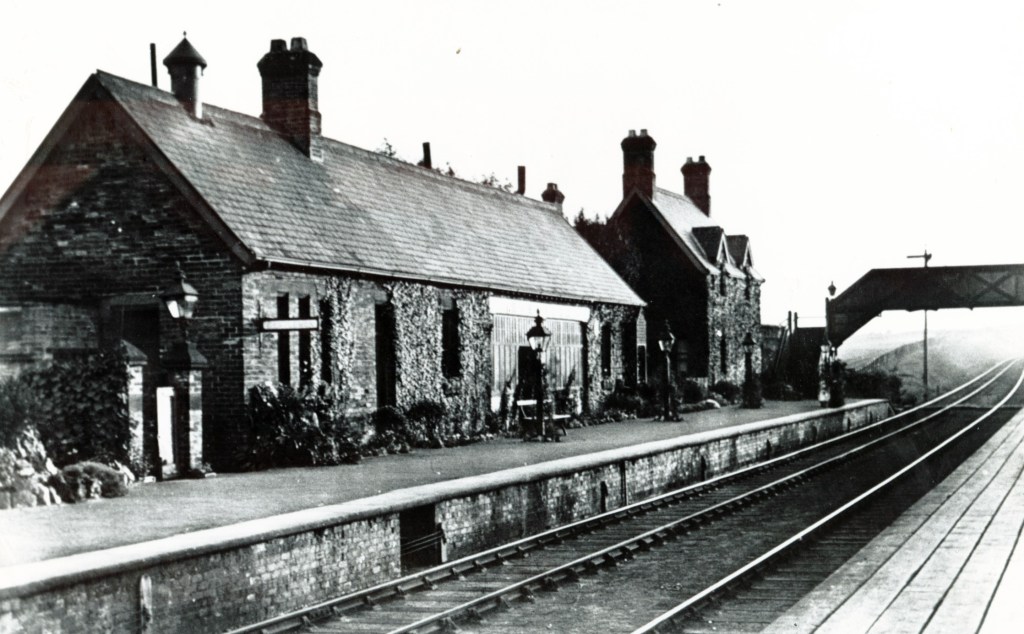
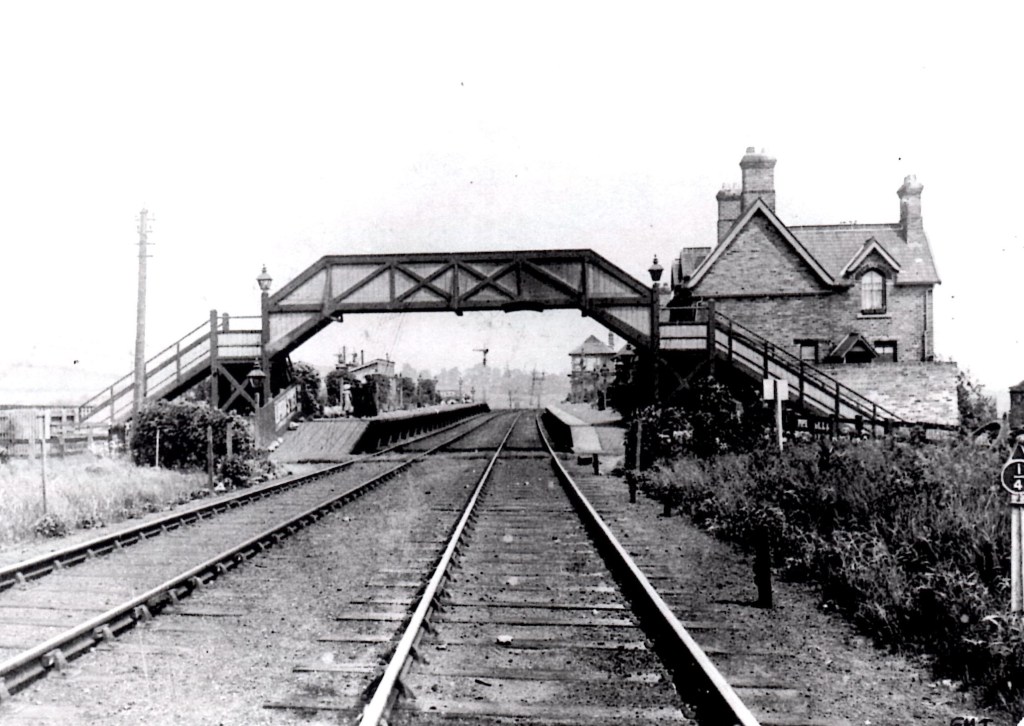
21 July 1910: Thomas Graham sued NER for negligence – an engine killed a mare in foal and destroyed a cart on the level crossing at Evenwood station, 26 March 1910. The case was adjurned.
17 August 1911: James William Harrison, High Etherley, was found dead on the down line at Evenwood Station. He suffered a, “nasty cut on the forehead”.
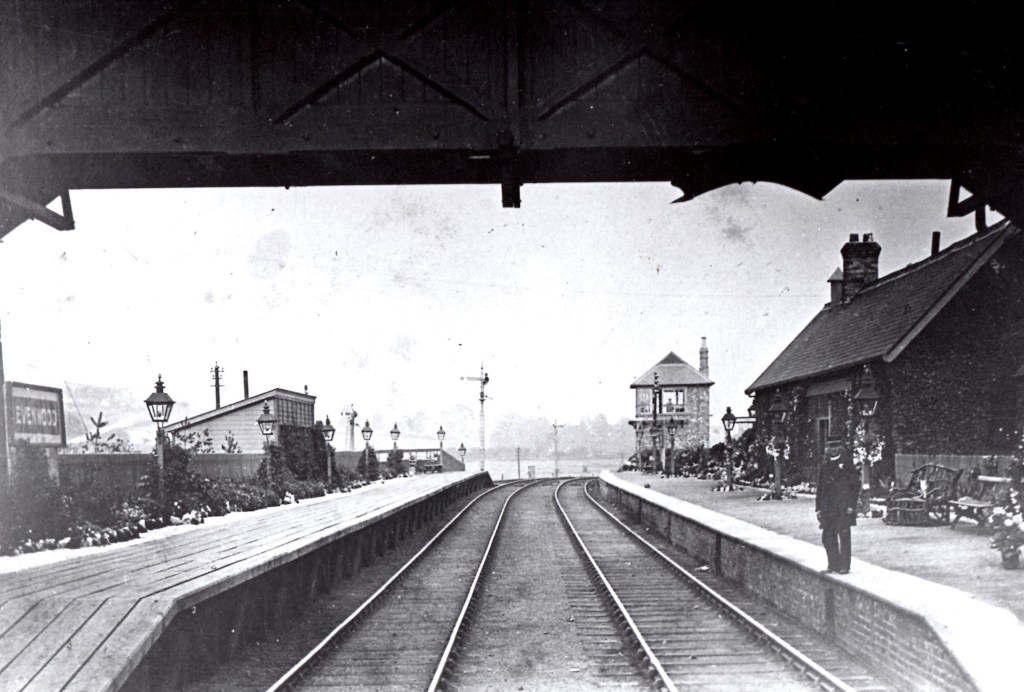
SOME FEATURES ALONG THE BISHOP AUCKLAND TO BARNARD CASTLE LINE
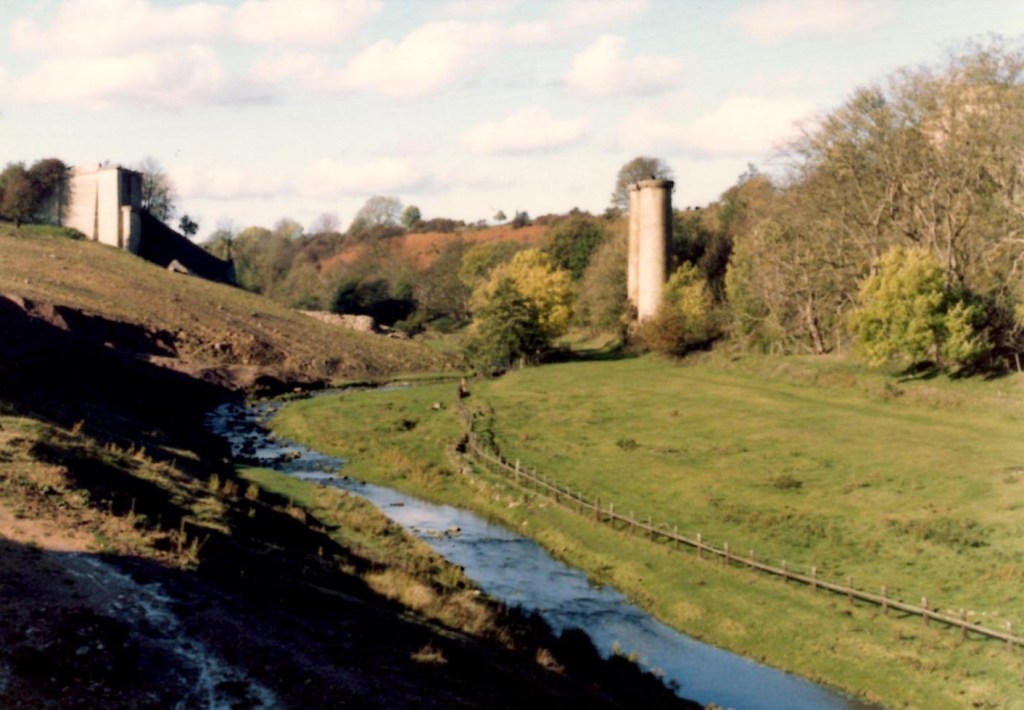
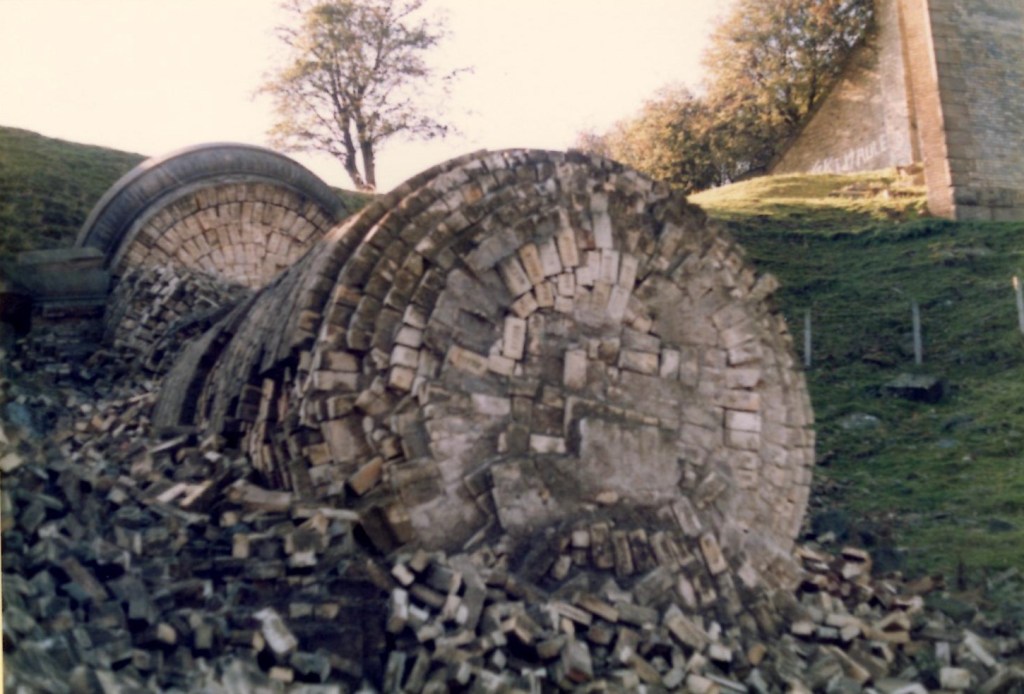
Below: OS map to show the location of the Gaunless Viaduct, otherwise known as Lands Viaduct or Cockfield Viaduct
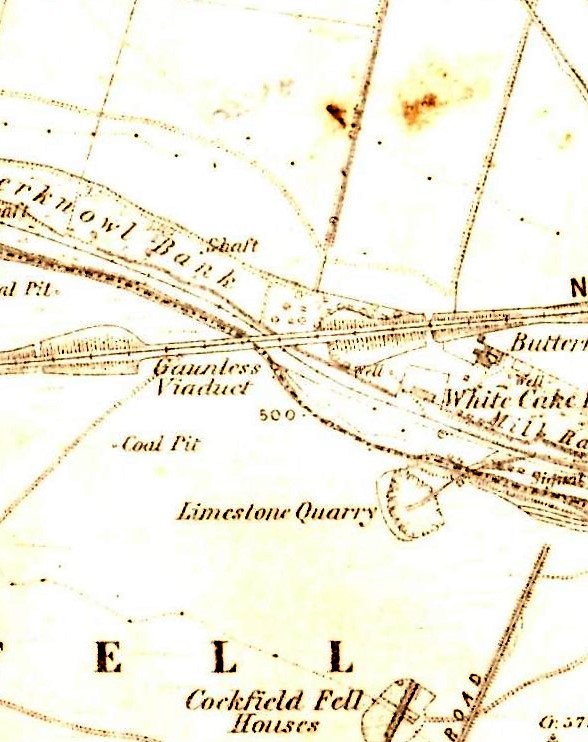
Below: Photos of the viaduct

Below: 1901-1905. presumably when the track was being doubled.



SOME DATES
17 June 1857: Act of Parliament authorising Barnard Castle Junction to Tebay.
13 July 1857: Spring Gardens to Barnard Castle Junction.
1 August 1859: Deviation
25 August 1857: Construction started when the first sod was cut by the Duke of Cleveland at Kirkby Stephen.
26 March 1861: the eastern section from Barnard Castle to Barras was opened for mineral traffic
4 July 1861: the whole section authorised by the first act of parliament, 35 miles was opened for goods traffic
8 August 1861: above section was opened for passengers.
1 August 1863: the second section, nearly 15 miles, was opened for goods and passengers.
The eastern section between Spring Gardens junction and Barnard Castle was doubled over the period 1901-1905, except for a short section between Forthburn and Coal Road Crossing.
SECTIONS CLOSED
5 April 1965: Barnard Castle East to Spring Gardens Junction
Below: Cockfield Station and New Copley Coke Ovens chimneys in the background

Below, 3 photos of Cockfield Station
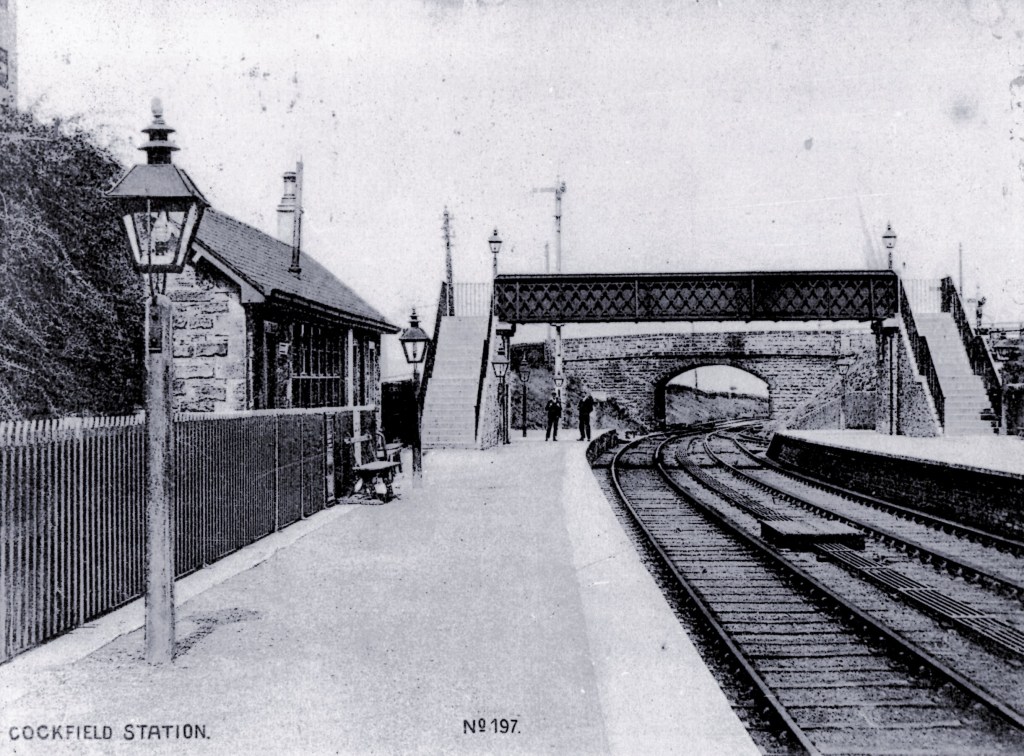
Below: Staff at Cockfield Station

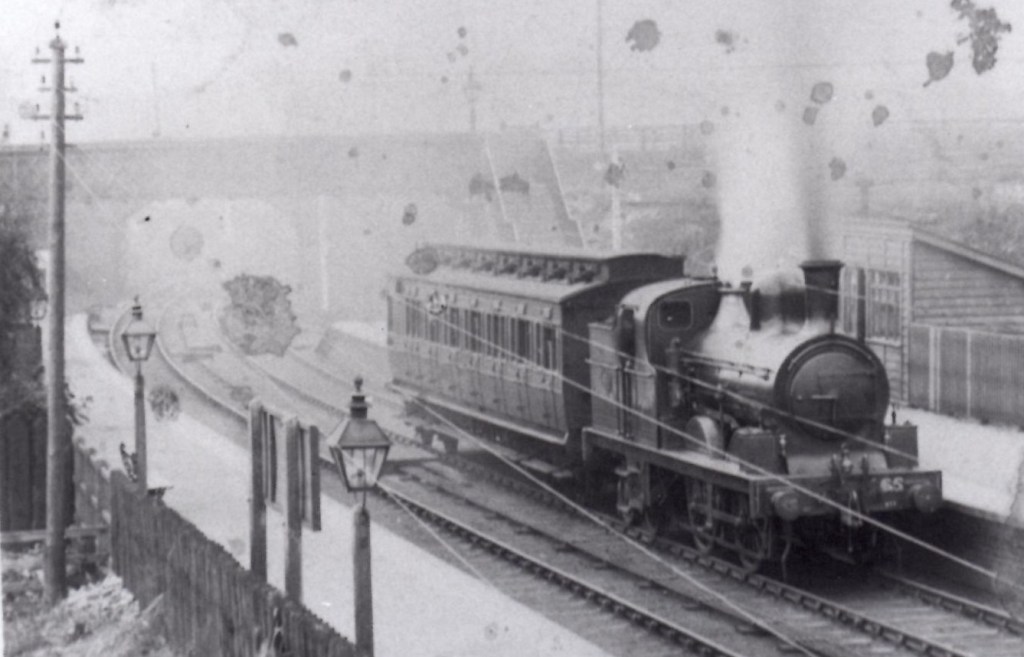
Another timetable

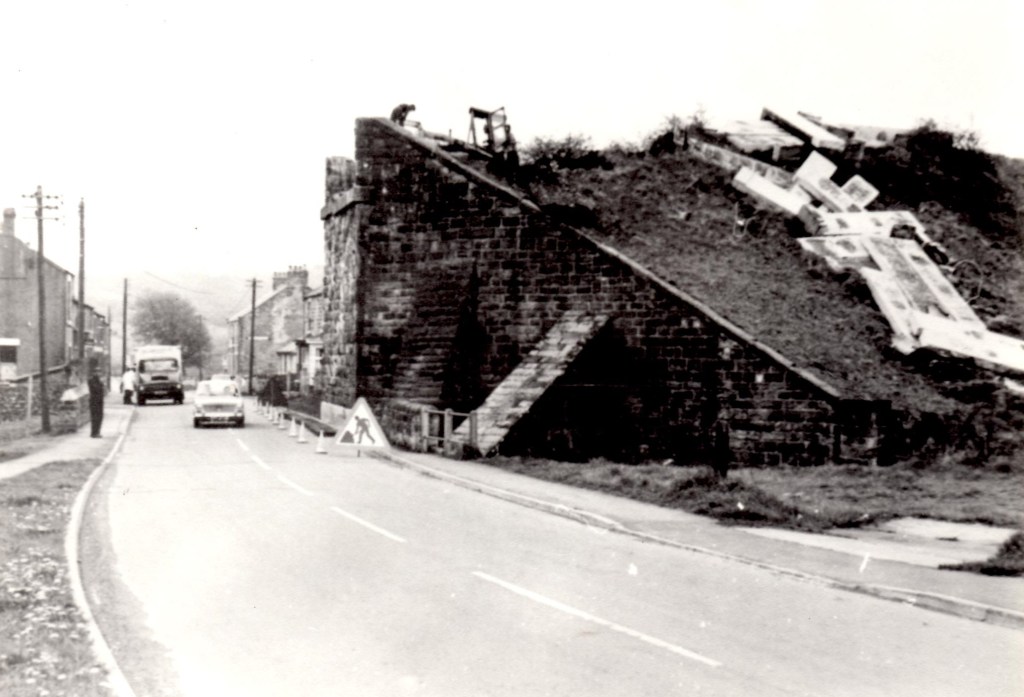
Below: Ramshaw Bridge, demolition day preparations

Below: Job done
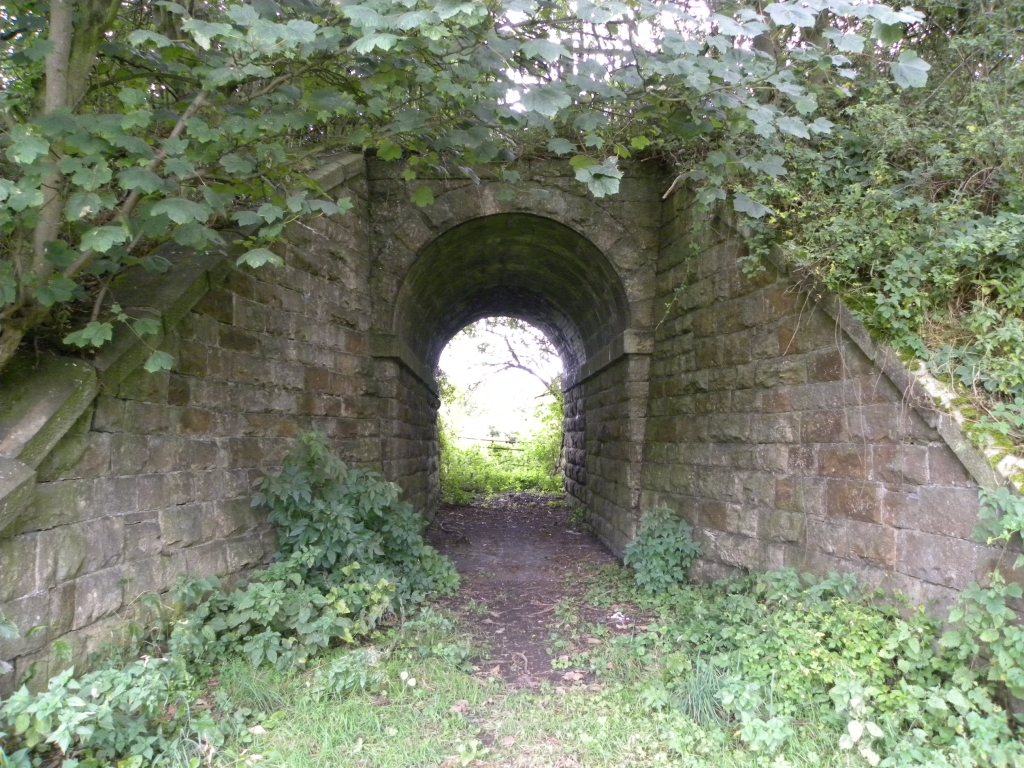
Below: 2009, the farmer’s accommodation bridge beneath the railway line, along the footpath between Ramshaw and Station Row.
 EVENWOOD RAMSHAW & DISTRICT HISTORY SOCIETY