The Peeters family were residents of Aarschot and one member was to become a victim of the August executions. Joannes Baptist Peeters was the coach driver to the mayor, Josef Tielemans
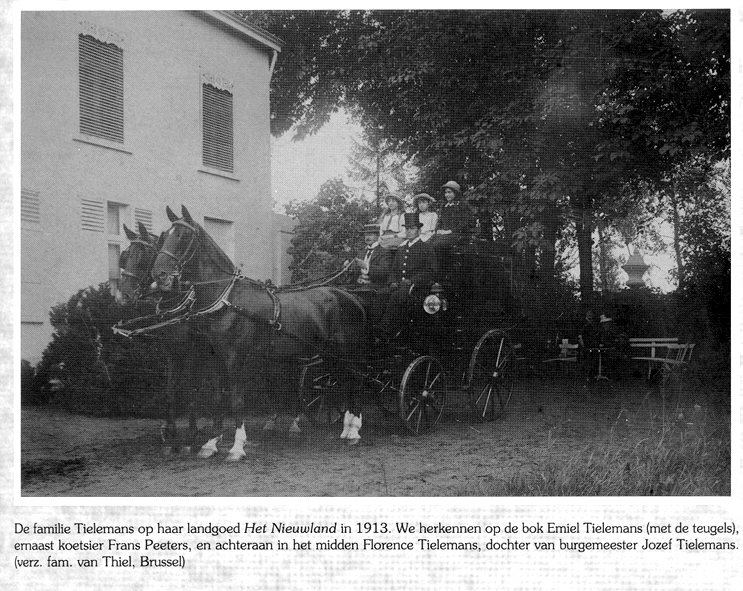
The Tielemans family on their Het Nieuwland estate in 1913. Emiel Tielemans, holding the reins, coachman Frans Peeters and at the back in the middle Florence Tielemans, daughter of mayor Josef Tielemans (courtesy of the Van Thiel family, Brussels)
Joannes and Theresia Peeters had 7 children. By 1914, their first born, son Franciscus (Frans), was married to Maria Clementina Sidonia Verstrepen and they had a daughter, Sophia Joanna Francisca. Their other children were the twins Jan and Louis (born 1898), Anna (born 1900), Justine (born 1906), Mathilda (born 1910) and Edward (born 1913).
On the 20th August, Joannes and his twin sons, Jan and Louis, were rounded up and brought to Leuvensestraat. The mayor, his brother, his 2 sons and the Peeters family group were all lined up with others from the town. Every third person was selected for execution. It is understood that a young German officer pleaded for the lives of the 16 years old Peeters twins. Fortunately, they were released, but only to witness their father and 38 other civilians being shot. Joannes’ sons were ordered to bury their father.


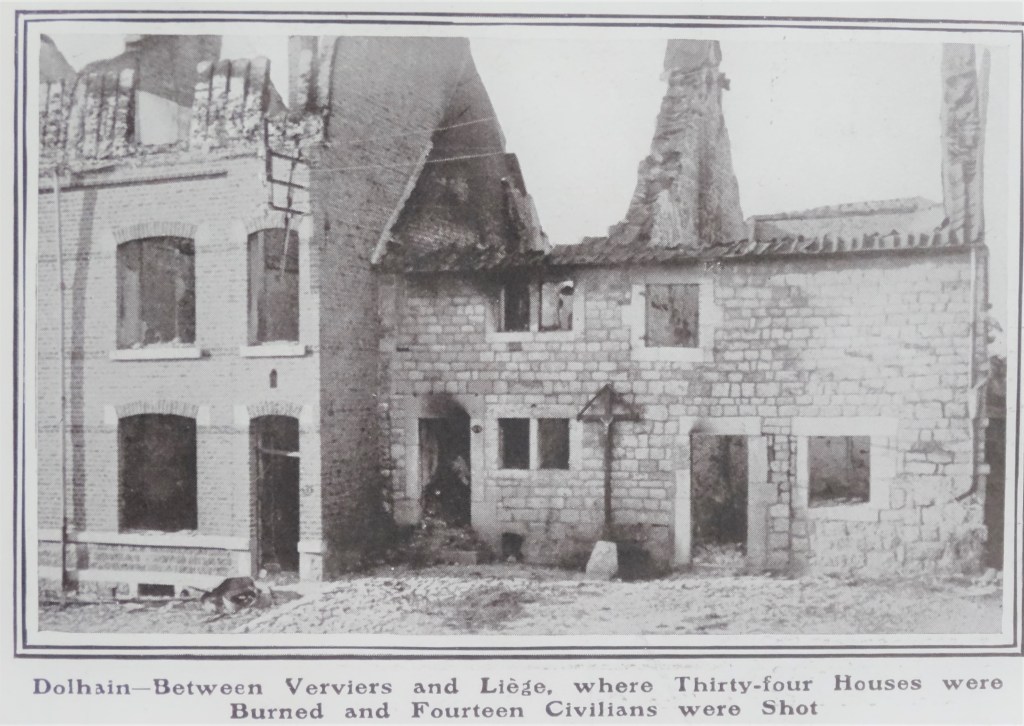


Above: Images of the devastation of the Belgian Villages
Aarschot to Witton Park
Only sketchy details are known of the journey from Aarschot to Witton Park. The Peeters family, widowed Theresia and her 6 young children, loaded some of their belongings onto a wheelbarrow, and fled Aarschot through fields and byways, heading northwards. They arrived at Westerlo, the home of a nobleman called de Merode, where they were permitted to shelter for a while. The family then continued their journey to Antwerp. After receiving identity cards in Antwerp, Theresia Peeters and her children boarded a ship heading for London. It is understood that they moved from place to place in England, eventually settling in Witton Park. 6 October 1914, the Peeters family arrived in a group of 43 refugees.
The oldest son Frans, his wife Sidonia and their daughter Joanna also fled Aarschot but their whereabouts was unknown at this time. They arrived at Witton Park at a later date – they are not pictured on the 1914 photos.
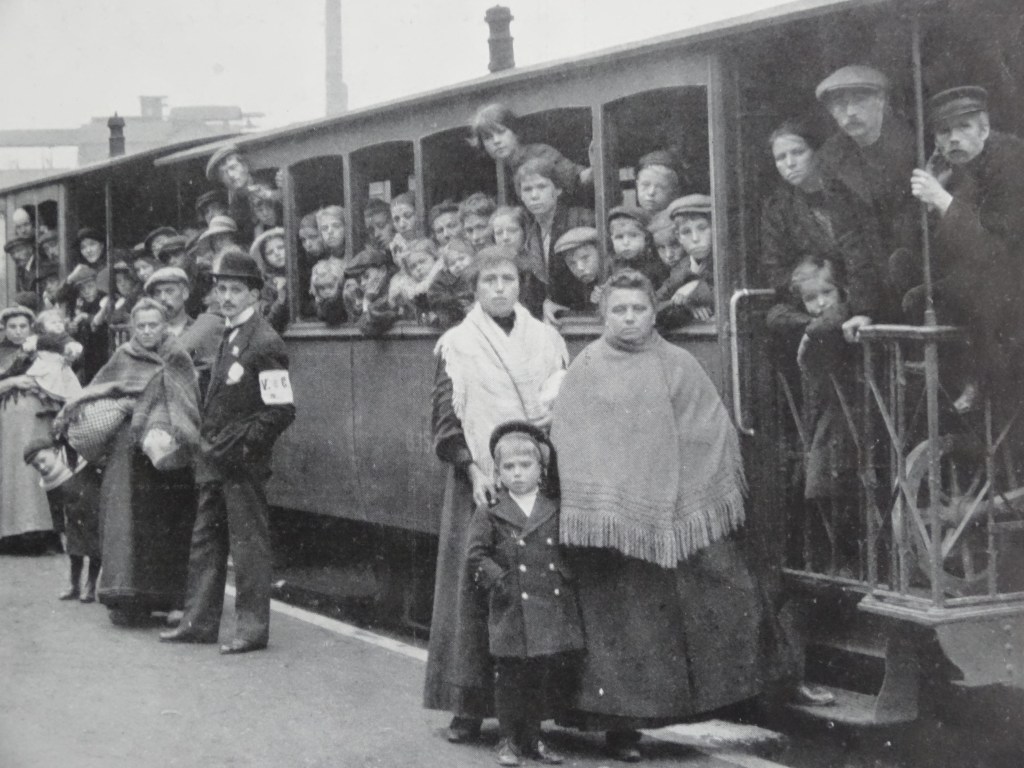
Above: A full train of Belgian Refugees en route for England
Refugees at Witton Park
19 May 1882, the Messrs. Bolckow and Vaughan iron works at Witton Park was closed down when the industrial enterprise was relocated to Middlesbrough. Many houses in the village were vacated as the workers moved to Middlesbrough to find work. Employment for coal miners was still available in the local area, particularly the George Pit at Escomb, so not all the properties were vacated.
Witton Park’s Roman Catholic priest, Father John Francis Krajicek was instrumental in finding houses for the Belgian refugees. A local story tells of him going to London to inform the authorities about the vacant houses in Witton Park and suggesting their occupation by the Belgian refugees. The validity of this story is lost in time. The MP for Barnard Castle, which was the neighbouring parliamentary constituency, was Arthur Henderson, a leading figure in the fledgling Labour Party and President of the Ironfounders Union. He would have been well acquainted with the former iron producing village of Witton Park. He supported the war, stirred by patriotism and by the violation of Belgian neutrality, he accepted Grey’s rationalisation for British intervention and felt that the honour of the nation was involved in defending innocent Belgium. It follows that he would want to help Belgian refugees. Ben Spoor was MP for the Auckland Division which included Witton Park. He and Henderson were political allies. Between them, Spoor, Henderson and Krajicek, are likely to have promoted the homes at Witton Park.
A local account reported:
“It was in the early months of the war that fame in a somewhat unexpected form came to the village. Up to that time its streets of empty houses had been regarded as a reproach or referred to with ridicule; but there was at least one person the late Father Krajicek, who saw in those empty houses a haven of refuge for Belgians driven from their own homes by the relentless cruelty of German invaders. It was on the night of October 6th, 1914, that the first party of 43 Belgian refugees arrived to take up temporary residence in the village. Thousands of people gathered from all parts of the district and invaded the township to help the inhabitants to accord a real north country welcome to the exiles. Witton Park in that one night had re0established its fame, since it was the first place in the north to welcome refugees. Altogether some 170 individuals were adopted and it is not unlikely that in various parts of Belgium today Witton Park is regarded as a spot for ever associated with Belgian history and its great struggle for freedom.”

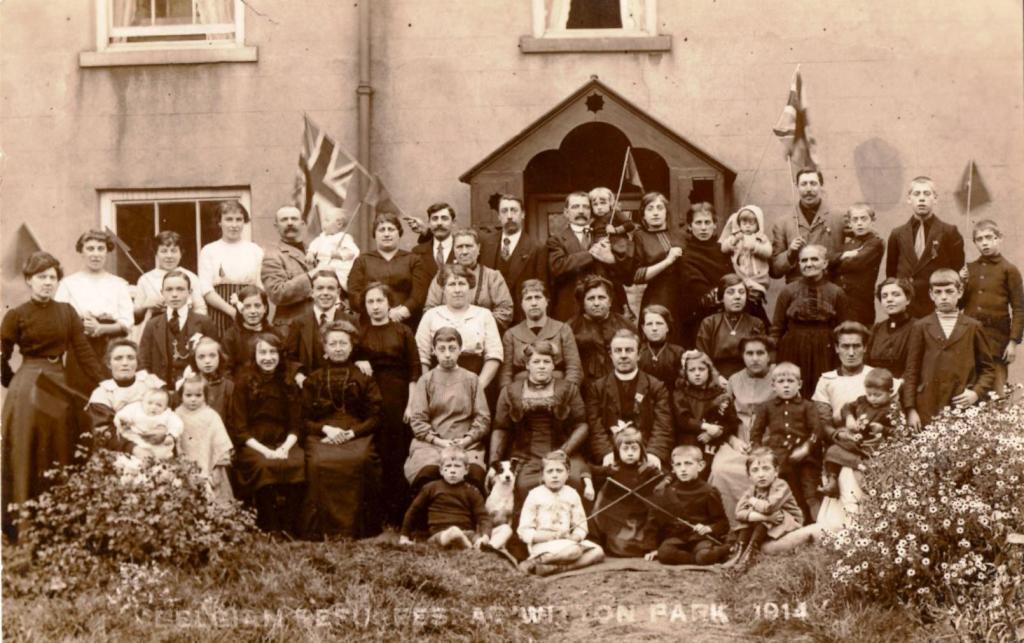
Above: Father Krajicek with refugees.
The Peeters family are assembled front left and the Cuypers family, front right.
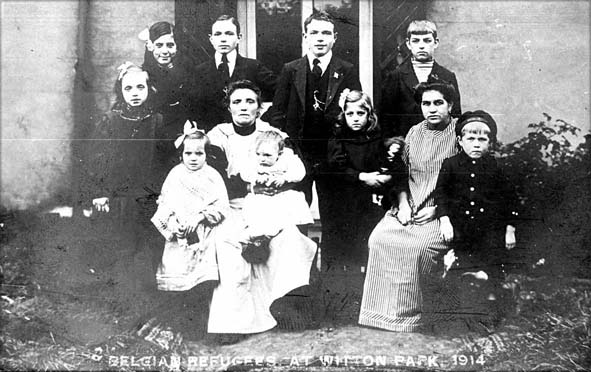
Above: The Peeters & Cuypers Families in Witton Park 1914.
Back left to right: Anna twins Louis & Jan (who is who?) unknown boy
Front left to right: Justine Mathilda Theresia with Edward unknown girl, Cypriass Cuypers, Victor Cuypers
The Belgian children attended St. Chad’s mixed RC school. The log book confirms that 2 November 1914, a party of Belgian schoolchildren attended the school. Maria Van Criekinge was their teacher. It appears that there was a shortage of space by January 1915 since it was reported that:
“Owing to lack of accommodation, the Belgian class has been transferred to a room usually occupied by Infants.”
The Belgian children were enrolled under the numbers 149 to 188 with 5 missing numbers thus it is assumed that 34 children attended the school. Anna and Justine Peeters were numbered 171 and 172.
21 September 1915, the following entry was recorded:
“School closed for afternoon session as Belgian children are going to Durham.”
By October 1915, many Belgian families were settled in Elisabethville but some still remained in Witton Park, as the details from the Peeters family birth certificate proves – 29 October 1915, Sidonia Peeters gave birth to her second child, named Louis Jean Baptist. At this time, the family lived at 15 Low King Street, Witton Park. Frans, Louis father, was recorded as a munitions worker. Sidonia’s mother lived at Rue Dixmude, Elizabethville, Birtley. The date when Frans and Sidonia relocated to Elisabethville is unknown.
4 September 1916:
“This morning I transferred Belgian Class children three to Class III, and five to Class II, as Belgian teacher in charge completed her duties August 31 and will leave W. Park.”
By 4 September 1916, only 8 children remained. Presumably, 26 children left when their families moved to Elisabethville, the camp provided for Belgian workers at the munitions factory at Birtley.

Above: St. Chad’s School Log Book 1914: see the entry for Nov. 2nd.
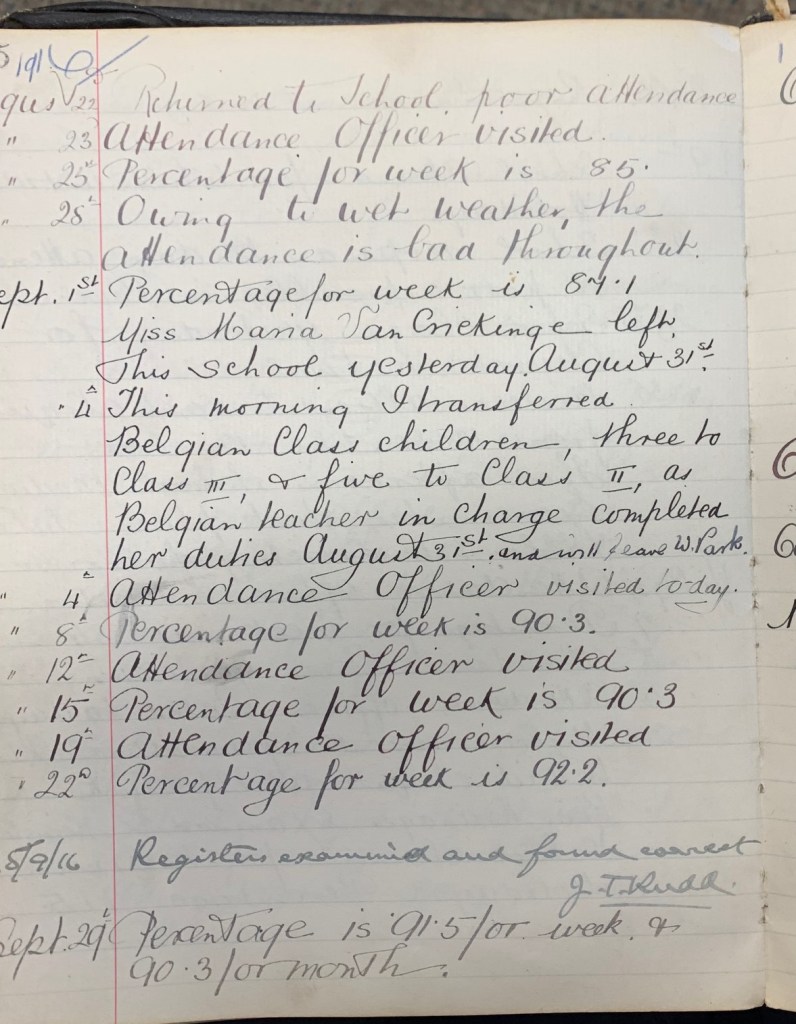
Above: St. Chad’s School Log Book 1916: see the entry for September 4th
To sum up, some Belgian families were at Witton Park from at least 27 October 1914 to 31 August 1916, with 8 children attending St. Chad’s school beyond this date. The school log does not inform when these children left the school. One source informs that some Belgian refugees arrived at Witton Park on the night of 6th October, 1914.
 EVENWOOD RAMSHAW & DISTRICT HISTORY SOCIETY