2 August 1914, having invaded neutral Grand-Duchy of Luxemburg, Germany declared war on France the following day. The German Army crossed the border into Belgium 4 August and marched towards France. In doing so, Germany violated Belgian neutrality guaranteed by the Treaty of London of 1839. The British government immediately drew the German government’s attention to its protective treaty with Belgium. The German Chancellor famously dismissed the treaty as a, “scrap of paper”, German troops were not withdrawn and accordingly, Britain declared war on Germany.
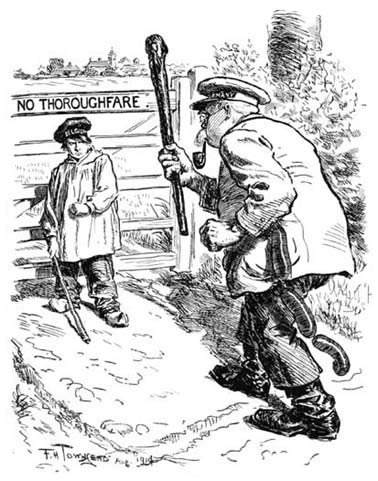
Above: A Contemporary poster: No Thoroughfare
The Belgian King, Albert I, was unwilling to allow Germany access through his country. He offered firm protest and chose to stand and fight. The Belgian army, on a war-footing stood at about 158,000 men including those garrisoned in the fortress cities namely Liege, Namur and Antwerp. Bridges were destroyed, roads were blocked, barricades were erected, the army fought valiantly and managed to slow down the advance of German forces which comprised some 840,000 men in 4 Armies.
Between 4 and 17 August, the city of Liege and its fortifications was under siege, the capital Brussels surrendered 20 August and the Belgian Army retired westwards behind the Antwerp defences. Namur with its fortifications was under siege between 21 and 25 August. The village of Aarschot, situated to the north east of Brussels and about 10 miles from the university town of Louvain was behind the German front line by 20 August. The German attack was accompanied by “atrocities against the civilian population of Belgium, hostages being executed, towns pillaged and homes destroyed”.
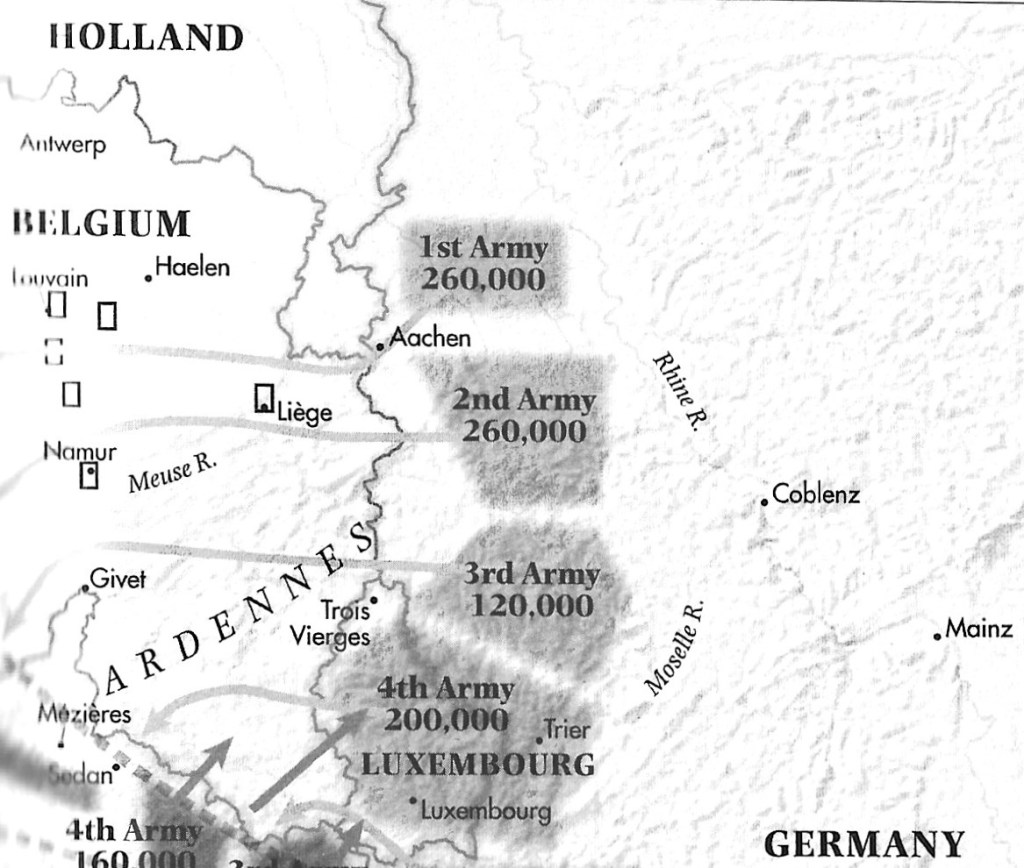
Above: The Invasion of Luxemburg and Belgium
Atrocities against the Civilian Population
This initial phase of the war, undoubtedly, was characterised by terror of the civilian population, the extent of which may have been exaggerated by propaganda on both sides but the fact of the matter is that there is too much evidence to dismiss it as, the usual violence of warfare. Below are 2 citations:
“The German right wing was the epicentre of violence in which other armies further south also participated and which resulted that summer and autumn with the murder of 5,521 Belgian and 906 French civilians and the deliberated demolition of between 15,000 and 20,000 buildings…Louvain…destroyed a sixth of the city, including the university library …and cost 248 citizens their lives…Vise, the first Belgian town to face systematic destruction with 23 civilian dead, Aarrschot, where 156 inhabitants were killed; Tamines with 383 massacred and Dinant which suffered 674 killed, almost 10% of its population; these quickly became notorious sites of German brutality.”
And:
“On August 19 after the Germans had crossed the Gette and found the Belgian Army withdrawn during the night, they vented their fury on Aerschot, a small town between Gette and Brussels, the first to suffer a mass execution. In Aerschott 150 civilians were shot. The numbers were to grow larger as the process was repeated by von Below’s army at Ardennes and Tamines, by von Hausen’s in the culminating massacre of 664 at Dinant.”
To put this terror into context:
- The total Belgian deaths during the war amounted to some100,000 – 40,000 military deaths and 60,000 civilian deaths. Of those civilian deaths who died as a direct result of war, some 6,000 were executed.
- Nearly 1.5 million Belgians were displaced by the German occupation of their land, with impoverished refugees fleeing in every direction. Some 200,000 ended up in Britain and another 300,000 in France. The most, by far, nearly a million fled to the Netherlands. During the course of the war, 3,000 Belgians died attempting to escape to the Netherlands after the 200km long electrified fence along the border had been erected by the German army.
- 120,000 Belgian civilians were used as forced labour during the war, roughly half were deported to Germany to work in prison camps and factories and half worked behind the lines repairing damaged infrastructure, laying railway tracks, manufacturing weapons of war, even digging trenches.
The Germans argued that the Belgian authorities supported the, “francs-tireurs” (free shooters) or non-military partisans who organised guerrilla tactics against German troops and lines of communication thus it was justifiable to take retaliatory action.
Following reports in the Times, and weekly magazines such as “The Sphere” when it was reported that:
“It was at Aerschot that Burgomaster Tielemans, his son, his brother and a whole group of their fellow citizens were shot dead.”
The Bryce Report was commissioned by HM Government to examine numerous outrages including those at Aarschot, Malines, Vivorde, Louvain and Gelrode. Evidence in the form of first-hand witness accounts such as those of Mme. Tielemans, the murdered Mayor’s wife, was collected. The report concluded that:
- There were systematically organised massacres of the civil population.
- Generally innocent civilians were murdered in large numbers.
- Looting, house burning, wanton destruction was countenanced by officers of the German Army.
- The rules of war were frequently abused.
And:
“Murder, lust and pillage prevailed over many parts of Belgium on a scale unparalleled in any war between civilised nations during the last three centuries.”

Above: Occupied Belgium: Aarschot is to the north of Brussels
19 August: Aarschot, Scenes of Civilian Terror
After the Battle of Aarschot-Ourodenberg, 19 August 1914, the German army marched into the centre of Aarschot. Two army convoys converged on the Market Place in order to continue their march to Louvain together. Belgian soldiers had already retreated from Aarschot. It is widely believed that German soldiers misbehaved and that houses were looted, some set alight, civilians beaten and some arrested. At about 3pm, Colonel Stenger, Chief Commander of the 8th German Infantry Brigade, together with 2 officers, Schwartz and Beyersdorff, occupied the Mayor’s house. They occupied a room with a balcony which overlooked the Market Place which was filled with wagons and soldiers. Gunfire was heard and it was claimed that German soldiers were fired upon by local citizens. There was panic in the convoy, wagons collided and German soldiers started firing indiscriminately. During a 20-minute spell of chaos, Colonel Stenger was shot dead. His officers concluded that he was killed by a Belgian sniper. Soldiers searched for a culprit. Houses were set on fire, escaping citizens were captured and brought together in the Market Place. A group of 75 men and boys were taken to Leuvensesteenweg and executed. Later, a second group, including the Mayor Tielemans, his 15 years old son Louis and 20 others were taken to Leuvensesteenweg, closer to Louvain, nearer Stockman’s farm, and shot. Women and children were herded into the Market Place and kept there overnight while the executions took place. Surrounding buildings were afire. In the morning, residents were ordered to evacuate the town, immediately. About 3,000 civilians were made refugees and fled the scene.
Another account reports that after the initial shooting incident in the Market Place, mayhem ensued, buildings were set on fire, houses were looted, the “city treasury” was broken open, goods were stolen from citizens, people were rounded-up, around 7pm 80 prisoners were executed then later another group were taken away and the following morning, 39 civilians were killed. In total about 170 civilians were murdered. It was also claimed that a Belgian sniper did not shoot Colonel Stenger but it was carried out by a German soldier, allegedly, the officer was disliked among his men.
Whatever the actuality, the fact remains that there was a mass execution including the mayor, the town was destroyed and 3000 Belgian civilians were made refugees.
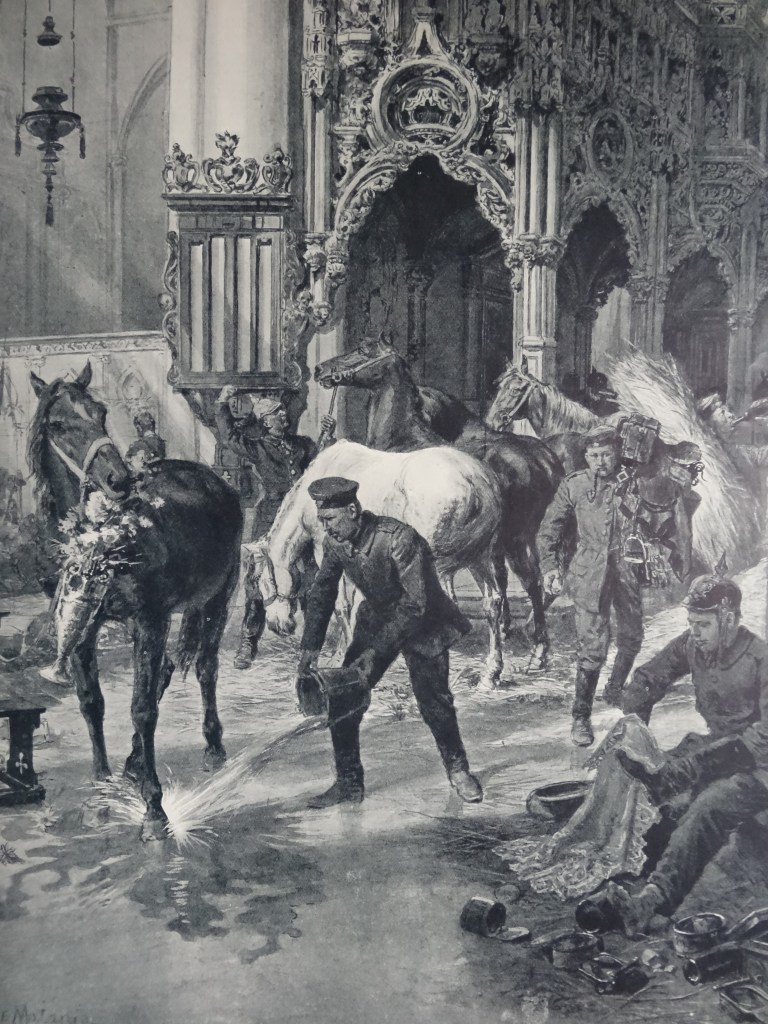
The Sack of Aerschot: The interior of the church at Aerschot during the German occupation
 EVENWOOD RAMSHAW & DISTRICT HISTORY SOCIETY