Summary
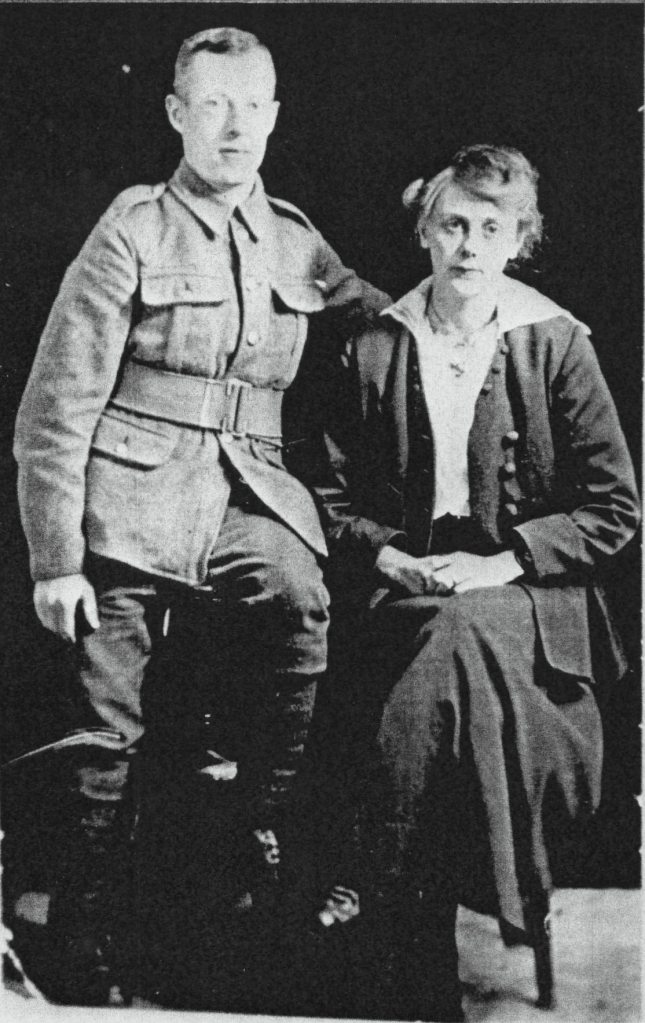
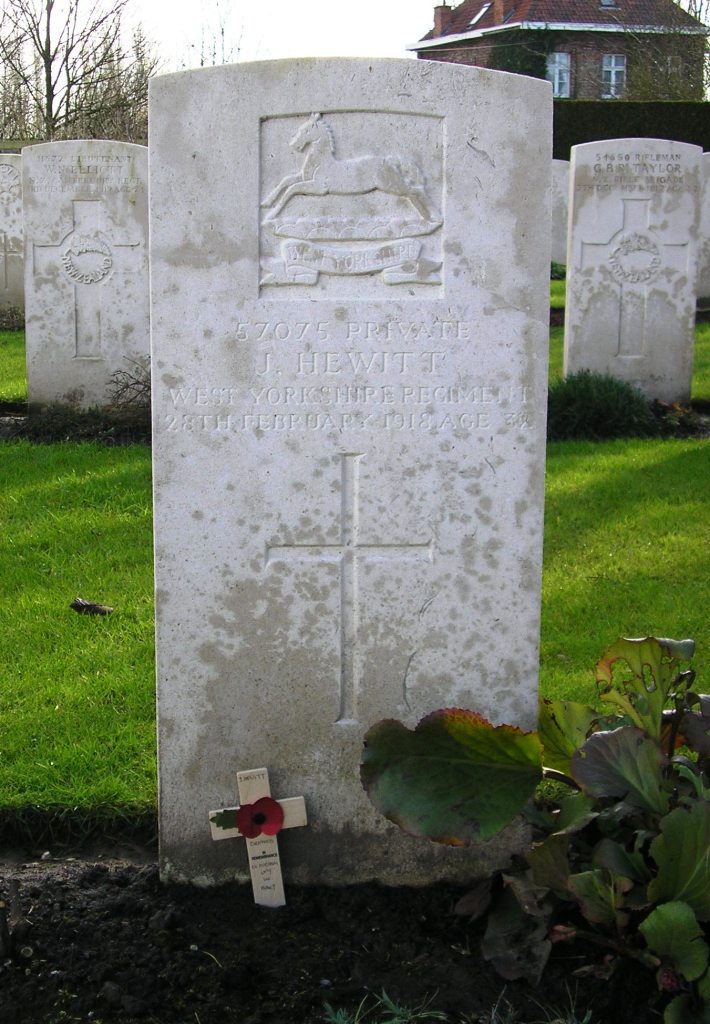
57075 Private Jonathan Hewitt, 2/6th Battalion, West Yorkshire Regiment was killed in action 28 February 1918 and is buried at Menin Road South Military Cemetery, Ypres, Belgium.[1] He was 32 years old and is commemorated on Evenwood War Memorial and the Memorial Plaque in St. Paul’s Church, Evenwood.
Family Details
Jonathan was born about 1886 [2] at Hamsterley, the son of William and Elizabeth Hewitt. There were at least 4 children: [3]
- John T. bc. 1882 at Etherley
- George William bc.1884 at Howden-le-Wear
- Albert Edward bc.1886 at Howden-le-Wear
- Jonathan bc.1887 at Hamsterley
By 1901 the Hewitt family lived at Victoria Terrace, Evenwood and Jonathan’s father William worked as a “colliery stationary engine driver”, his brother John was a “colliery banksman”, George was a bricklayer, Albert was a “colliery screener” and 14 year old Jonathan worked as a “colliery labourer”.[4]
By 1911, the family lived at Alexandra Terrace, William and Elizabeth had been married for 32 years and he worked as a colliery engineman. George William (Bill), Albert Edward (Ted) and Jonathan (Jonty) were all single, all worked at the colliery and all lived at home. There was a boarder, 23-year old G.H. Dixon who was a colliery fireman. Their older brother John did not live with the family.
28 December 1912, Jonathan Hewitt married Jessie Bannister of Evenwood at St. Paul’s Church, Evenwood and by 1915 they lived at 12 Victoria Terrace, Evenwood. [5]
Service Details
10 December 1915: Jonathan Hewitt attested aged 28 years 11 months.[6] He was 5ft.2½” tall and weighed 121 lbs.[7] Private J. Hewitt served in the Army Reserve.

24 May 1917: Mobilized, being posted to 2/6th Battalion, the West Yorkshire Regiment. [8]

The 2/6th Battalion of the West Yorkshire Regiment [WYR] was formed at Bradford 12 September 1914 and attached to the 185th Brigade of the 62nd (2nd West Riding) Division. [9] Units in the 185th Brigade were:
- 2/5th Battalion, the West Yorkshires joined March 1915 left August 1918
- 2/6th Battalion, the West Yorkshires joined March 1915 left January 1918
- 2/7th Battalion, the West Yorkshires joined March 1915 left June 1918
- 2/8th Battalion, the West Yorkshires joined March 1915 left February 1918
- 212th Brigade Machine Gun Company joined 9 March 1917
- 185th Trench Mortar Battery
The reserve units were formed up into a 2nd Line Division initially called the 2nd West Riding from early 1915. Early clothing and equipment for these units was haphazard and many had to train in civilian clothes. It was only from very late 1915 that proper equipment was received. The Division concentrated on the Western Front by 18 January 1917 and fought with distinction until the Armistice playing a part in major actions, including: [10]
- 14 March to 5 April 1917: the German Retreat to the Hindenburgh Line as part of the V Corps Fifth Army
- The Flanking Battles in support of the Battle of Arras, on the Bullecourt Flank, as part of the V Corps, Fifth Army namely:
- 11 April 1917: the first attack on Bullecourt
- 15 April 1917: the German attack on Lagnicourt
- 3 May to 17 May 1917: the Battle of Bullecourt
- 20 May to 16 June 1917: actions on the Hindenburgh Line
- 20 and 21 November 1917: as part of the IV Corps, Third Army- the Battle of Cambrai, the Tank Attack.
5 January 1918, the Division took over the front line in the Arras area between Gavrelle and Oppy. [11]
July, August 1917 and January 1918: It is known that Private J. Hewitt suffered illness, a septic foot needing 4 days hospital treatment at Ashington V.A. Hospital, Northumberland in July 1917. He was sick with trench foot for 33 days in August 1917.[12] In early January 1918, Private J. Hewitt suffered with laryngitis and was treated at a Field Ambulance.[13]
The date he entered France is undecipherable but if he was suffering from trench foot in August 1917 then it would have been contracted in France/Belgium therefore it follows that he must have been overseas prior to this date.
Private J. Hewitt served a total of 2 years 81 days. According to the CWGC, he was killed in action 28 February 1918 while serving with 2/6 WYR [14] although, the reverse side of Army Form B.103 indicates that Private J. Hewitt was posted to 1/6 WYR, 30 January 1918.[15] The Register of Soldiers’ Effects record that he served with 1/6 Battalion.[16]
The War Diary of 2/6 WYR has not been researched since it seems likely that he was with 1/6 WYR. Its War Diary records that from 23 February to the end of the month, it was stationed at Hussar Camp East (Potijze) near Ypres, Belgium in the Brigade Reserve. The battalion provided working parties for the 456th Company, Royal Engineers in the forward area and 19th Battalion, the Lancashire Fusiliers in Zonnebeke carrying material from Crucifix Dump to the forward area.
26 February: 2 working parties of 2 officers and 100 other ranks and 4 officers and 100 other ranks were provided for the forward area.
28 February: No details are given for this date – the date when Private J. Hewitt was killed. The front line battalion HQ is given at position D28b4.3.
29 February: The battalion relieved 1/7 WYR in the front line from position D23d2.8 to J5b2.8. No details of casualties are given. [17]
Later research records that between 26 February and 1 March 1918, 1/6 WYR lost 1 Other Rank [240362 Private J.W. Clarke] and the 2/6 WYR lost 1 OR, he being Private J. Hewitt. [18] Regardless of in which battalion he served, either the 1/6 or 2/6 WYR, it is presumed that Private J. Hewitt was killed as a result of the usual violence of warfare – shelling or gun-shot wound from rifle of machine gun fire.
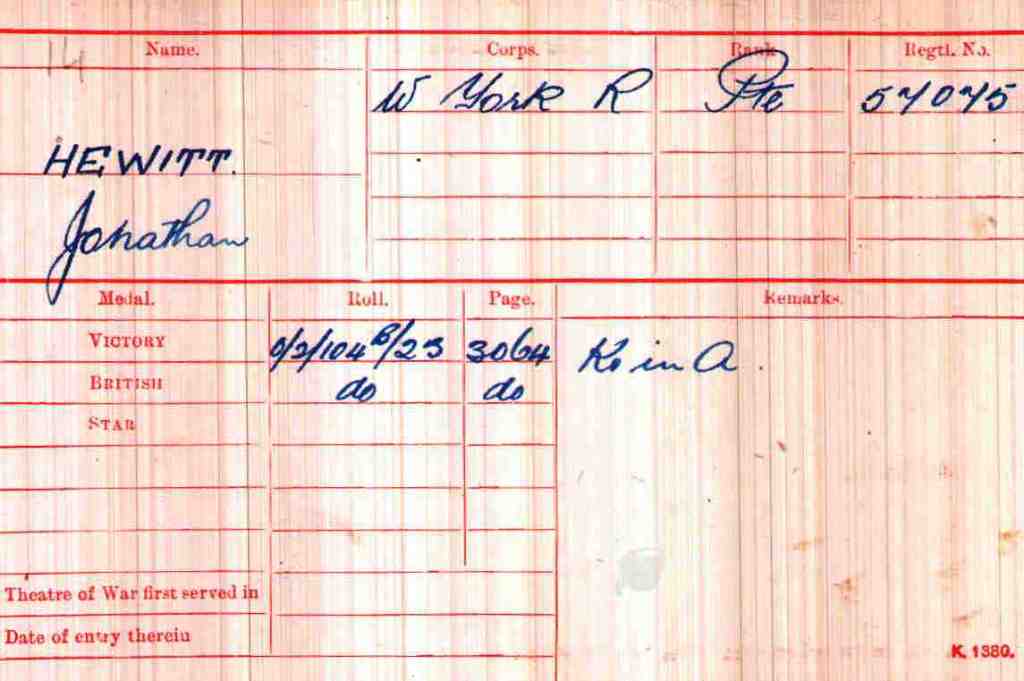
Private J. Hewitt was awarded the British war and Victory medals.[19]
News of his Death
The Evenwood Parish Magazine of April 1918 reported as follows:
“I am grieved to say that news has arrived that Pte. J. Hewitt, son of Mr. and Mrs. Hewitt of Alexandra Terrace, has fallen in action. Our deepest sympathies and condolences will go out both to his young wife and to his parents. We think of these sacrificed young lives with both grief and gratitude. We owe them so very much because they have given us their all. We grieve for them because the places of such as these are hard to fill. However, their memory will endure.” [20]
Burial
Private J. Hewitt is buried at grave reference 111.H.31 Menin Road South Cemetery, Ypres. The cemetery is 2km east of Ypres town centre, West-Vlaanderen, Belgium. The cemetery was always within Allied lines and it was used by the Field Ambulances until the summer of 1918. There are 1,657 servicemen of the First World War buried or commemorated in the cemetery.
Commemorations
Private J. Hewitt is commemorated on the Evenwood War Memorial and the Memorial Plaque in St. Paul’s Church, Evenwood [originally located in the Comrades’ Hall].
ACKNOWLEDGEMENTS
Brenda Robinson & Anne Harvey, Evenwood.
REFERENCES
[1] Commonwealth War Graves Commission. The Register of Soldiers’ Effects records 1/6 West Yorkshire Regiment
[2] England & Wales Birth Index 1837-1915 Vol.10s p.212 Auckland 1887 Q1
[3] 1891, 1901, 1911 census & CWGC Note: CWGC details inform that Jonathan was the son of William and Jane Hewitt of Evenwood however the 1891, 1901 and 1911 census details confirm her name as Elizabeth. Perhaps she had 2 names and preferred Jane.
[4] 1901 census
[5] Army Form B2512 Descriptive Report on Enlistment
[6] Army Form B.2512
[7] Army Form B.178 Medical History
[8] Army Form B.108 Casualty Form-Active Service
[9] http://www.1914-1918.net/westyorks.htm
[10] http://www.1914-1918.net/26div.htm
[11] http://www.1914-1918.net/26div.htm
[12] Army Form: Admissions to Hospital
[13] Army Form B.103
[14] CWGC & Army Form: Statement of the Services
[15] Army Form B.103 Casualty Form-Active Service Card Index: exact Army Form reference is unknown. CWGC headstone details record both 2/6 & 1/6 battalions, West Yorkshire Regiments.
[16] Register of Soldiers’ Effects
[17] War Diary 1/6th Battalion The Prince of Wales’s Own (West Yorkshire Regiment) 13 – 29 February 1918
[18] Officers & Soldiers Died in the Great War
[19] Medal Roll card index
[20] Evenwood Parish Magazine April 1918
 EVENWOOD RAMSHAW & DISTRICT HISTORY SOCIETY