Summary
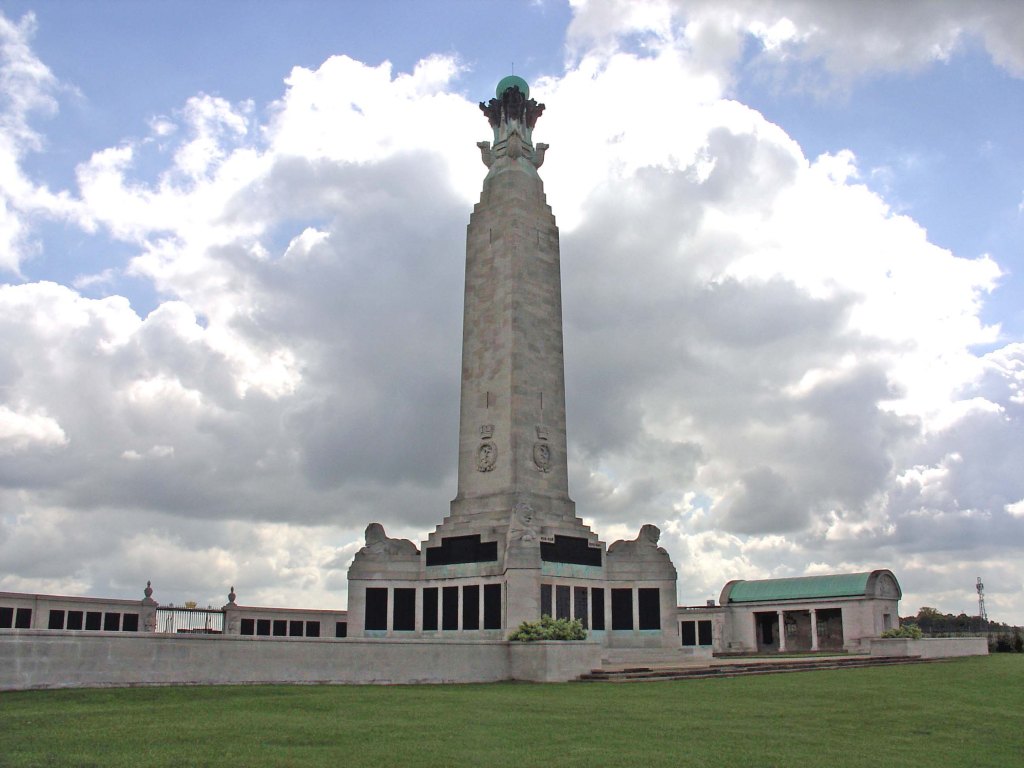
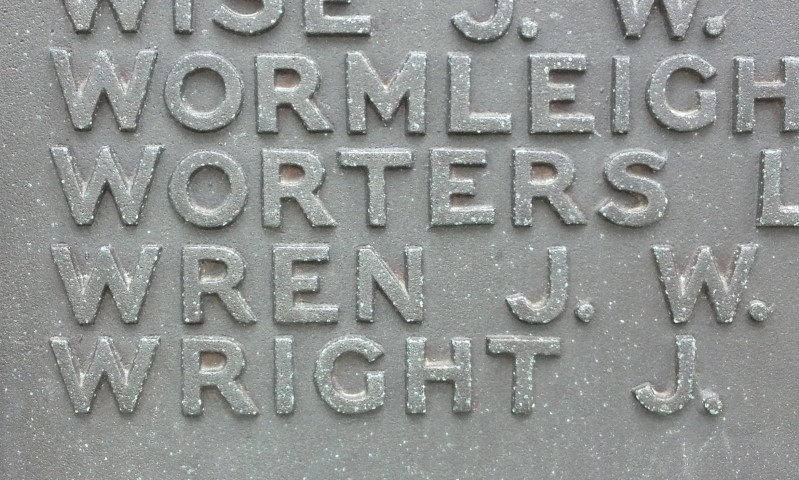
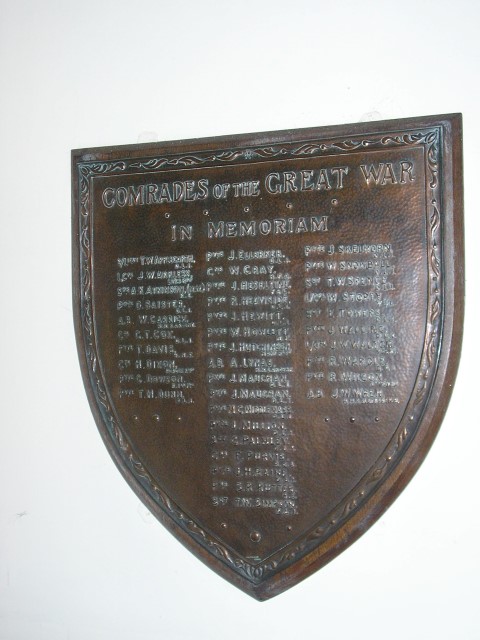
Tyneside Z/4043 Able Seaman John Wren was lost at sea 31 May 1916 when aboard H.M.S. Black Prince and is commemorated on the Chatham Naval Memorial.[1] He was 23 years old and is commemorated on the Evenwood War Memorial and the Roll of Honour, St. Paul’s Church, Evenwood.
Family Details
John Wren was born 6 February 1893[2] at Longhirst, Northumberland, the only child of John and Elizabeth Wren. By 1901, 33 year old John (born at Craghead) worked as a coal miner (hewer) and he and Elizabeth (born at Spring Gardens) lived at Copeland Row, Evenwood.[3] By 1911, the family lived at Irene Terrace, West Auckland. Both John senior and John junior worked as coal miners, John senior as a hewer and John William as a putter.[4]
Service Details
27 March 1915: John Wren enlisted and was given the service number Tyneside Z/4043. He was 5’6” tall, with auburn coloured hair and blue eyes.
30 June 1915: He joined HMS Black Prince.[5]

Above: H.M.S. Black Prince

Above: Cap ribbon for H.M.S. Black Prince
John Wren had a letter to the vicar of St. Paul’s, Evenwood published in the Parish Magazine.[6]
“Then I have had a letter from J. W. Wren of HMS Black Prince. He tells me that the Navy is a grand life but that it is tiresome waiting so long for the German Fleet coming out. “All my sailor pals are in good heart” he says “and we are all ready to chance our lives for our country. We get plenty of sport here, football, boxing, jumping, roller skating and dancing every Saturday night. The Chaplain has lantern lectures for us and they are very good and we also have concerts. We have a band on board and everything possible is done to keep us in good health and spirits. I cannot tell you where we are or what we are doing but we are all wanting a bat at the German Fleet.”
The Battle of Jutland 31 May & 1 June 1916 [7]
31 May 1916: in the morning over 250 British and German warships were steaming on convergent courses to a rendezvous unanticipated by the Germans, off the Jutland coast of Denmark.
- Admiral Sir John Jellicoe was Commander of the British Grand Fleet which consisted of 28 Dreadnoughts, 9 battle cruisers, 8 armoured cruisers, 26 light cruisers, 78 destroyers, a seaplane and a minesweeper
- Admiral Reinhard Scheer commanded the German High Seas Fleet, consisting of 16 Dreadnoughts, 6 pre-Dreadnoughts, 5 battle cruisers, 11 light cruisers and 61 destroyers.
Both sides had submarines and air ships but these did not play a part in the conflict.
HMS Black Prince was part of the 1st Cruiser Squadron along with HMS Defence, HMS Warrior and HMS Duke of Edinburgh and HMS Ardent was part of the 4th Destroyer Flotilla along with another 18 destroyers. Both ships took part in the night battle 31 May/1 June. The Germans proved to be better equipped for night fighting with better co-ordination, star shells and searchlights The British destroyers were painted black, a bad colour for night fighting and after the battle they were repainted grey like their German counterparts. Whilst they attacked bravely their tactics were poor, usually approaching too close and launching their torpedoes at the wrong angles, enabling the Germans to fire first and avoid the torpedoes.
The 4th Destroyer Flotilla encountered the German van, including the 1st Battle Squadron. Westfalen sunk HMS Tipperary, HMS Spitfire collided with Nassau and Elbing was accidentally rammed by Posen and sunk later. At 11.40pm HMS Broke challenged Rostock who opened fire causing her steering to jam and ram HMS Sparrowhawk. HMS Contest then ran into the back of HMS Sparrowhawk. Rostock was torpedoed and sunk for her troubles and Westfalen sank HMS Fortune. HMS Black Prince, which had been lost, arrived just after midnight and was blasted at close range by four battleships causing her to explode. Moments later Westfalen sank the HMS Ardent. Further engagements took place into the early hours of the morning but the German High Seas Fleet broke through and steamed for home. Jellicoe was unable to intercept the German fleet which reached port by early afternoon.
In terms of material losses, the outcome was as follows:
- British losses: 3 battle cruisers – Indefatigable, Queen Mary & Invincible; 3 armoured cruisers – Black Prince, Defence & Warrior; 8 destroyers – Ardent, Fortune, Nestor, Nomad, Shark, Sparrowhawk, Tipperary, & Turbulent.
- 6,097 British sailors lost
- German losses: 1 battle cruiser – Lutzow; 1 armoured cruiser – Pommern; 4 light cruisers – Elbing, Frauenlob, Rostock & Wiesbaden; 5 destroyers – S35, V4, V27, V29 &V48.
- 2,551 German sailors lost.
2 June 1916: the first official British statement about the Battle of Jutland was issued:
“The battle cruisers Queen Mary, Indefatigable and Invincible and the cruisers Defence and Black Prince were sunk. The Warrior was disabled and after being towed for some time had to be abandoned by her crew.
It is also known that the destroyers Tipperary, Turbulent, Fortune, Sparrowhawk and Ardent were lot and six others are not yet accounted for.”
24 June 1916: Sir John Jellicoe’s official report included the following statements:
“It is not known when Black Prince, of the same squadron, was sunk but a wireless signal was received from her between 8 and 9 pm.
“During the night the British heavy ships were not attacked but the Fourth, Eleventh and Twelfth Flotillas under Commodore Hawksley and Captains Charles J. Wintour and Anselan J. B. Stirling delivered a series of very gallant and successful attacks on the enemy causing him heavy losses.
It was during these attacks that severe losses in the Fourth Flotilla occurred including that of Tipperery with the gallant leader of the Flotilla Captain Wintour. He had brought his flotilla to a high pitch of perfection and although suffering severely from the fire of the enemy a heavy toll of enemy vessels was taken and many gallant actions were performed by the flotilla.
Two torpedoes were seen to take effect on enemy vessels as the result of the attacks of the Fourth Flotilla and being from the Spitfire and the other from either Ardent, Ambuscade or Garland.
…some survivors from the destroyers Ardent, Fortune and Tipperary were picked up and the Sparrowhawk…
Officers and men were cool and determined with a cheeriness that would have carried them through anything. The heroism of the wounded was the admiration of all.
I cannot express the pride with which the spirit of the Fleet filled me.”
The Kaiser claimed victory, known to the Germans as “the Victory of the Skaggerak.” Jutland was undoubtedly a material victory for the German High Seas Fleet whilst being a strategic victory for the British Grand Fleet. The Germans had inflicted heavier losses on the numerically superior Grand Fleet and had escaped near destruction but had failed to break the British blockade or control of the North Sea. The engagement had not altered the balance of power in any meaningful way. The relative strength of the navies was 28:16 before the battle and 24:10 afterwards – both in favour of the British Fleet.
The Kaiser would not release his High Seas Fleet to do battle since he could not risk challenging and being defeated by the British fleet so the German navy stayed in port. Submarine activity was resumed in earnest.
A German journalist described the action as follows:
“an assault on the gaoler, followed by a return to gaol.”
Ultimately, the inactivity of the sailors led to disorder beginning in August 1917 and full scale mutiny by November 1918.
H.M.S. Black Prince
HMS Black Prince had been separated from the rest of the 1st Cruiser Squadron as the Grand Fleet was deploying at 18.20. Since then she had been trying to rejoin the fleet. Now, in a sense, she repeated the mistake of her sister ships Defence and Warrior as, in all ignorance, she wandered into the path of the High Seas Fleet. Engineer Room Assistant Otto Frost was aboard a German destroyer that had taken up her natural station at the head of the line.
“Pitch dark night. The ships totally blacked out, there was only a small stern light, close to the sea. At this time, I was off watch and looking at our following fleet. There – what was that? A short flash from one of our ships. And then again shortly afterwards. Two salvos followed. The ship following us had been hit in a shower of sparks. An English vessel has closed with our fleet and in a short time it was sunk. They said it was one of the Black Prince class. Was it perhaps an error by the British ship believing he was joining his own fleet? Possibly!”
Watchmachinist Otto Frost, V1, 5th Torpedo Boat Flotilla, High Seas Fleet
Cadat Heinz Bonatz saw the debacle from the Nassau, which had been forced to reduce speed and drop out of the main battle line after the collision with the Spitfire.
“We suddenly sighted a cruiser with four funnels, HMS Black Prince. It immediately came under fire from three other ships. Within a few minutes the cruiser was a glowing wreck and sank after a mighty explosion, a horrible but imposing sight.”
Cadat Heinz Bonatz, SMS Nassau, 1 Battle Squadron, High Seas Fleet
The Black Prince was in no position to defend herself and strike back against the calibre of adversaries she had brought upon herself. The Thuringen, Ostfriiesland, Friedrich der Grosse and Nassau all joined in firing at this most helpless of targets. There was no room for sentiment.
“In a few seconds she was on fire and sunk with a terrible explosion four minutes after opening fire. The destruction of this vessel, which was so near that the crew could be seen rushing backwards and forwards on the burning deck while the searchlights disclosed the flight of the heavy projectiles till they fell and exploded, was a grand but terrible sight.”
Admiral Reinhard Scheer
Seaman Herman Meenzen had only joined the Nassau three weeks before the battle. He was not an experienced sailor. It was the first sea voyage of his entire life. He found this massacre a chilling site.
“The Black Prince was 500 metres away from the Nassau on the starboard side. I was an eyewitness from the searchlight deck to the burning of the Black Prince which was over in a few minutes. To express my feelings about the battle is very difficult. I had a very strong feeling of duty but the fire on the Black Prince left me feeling very sad and depressed.”
Seaman Hermann Meenzen, SMS Nassau, 1 Battle Squadron, High Seas Fleet
The loss of the Black Prince was another reminder of the vulnerability of the outmoded armoured cruisers and the dreadful human cost as 857 men lost their lives in an episode of staggering futility.
Two Evenwood seamen, William Carrick and Andrew Lynas were lost aboard HMS Ardent when she went down in the morning of 1 June: [8]
- J/43920 Ordinary Seaman William Carrick and he is buried at Farsund Cemetery, Norway.
- J/43919 Ordinary Seaman Andrew Lynas was lost at sea and is commemorated on the Portsmouth Naval Memorial.
Another Evenwood lad, William Purdy, aboard on HMS Maidstone, was involved in the battle but his ship was in the main fleet so their part in it was mainly the pursuit.
The July edition of the Evenwood Parish Magazine contained the following account of the battle provided by Arthur Dunn of H.M.S. Birkenhead:[9]
“Everybody who took part in the battle feels very certain that the whole of the German losses have not been published yet and when they are it will be a surprise to you all. When it began we had 4 battleships, 6 battle cruisers and 12 light cruisers which for nearly 3 hours fought the whole German fleet, we being included. How our ships got through it would be hard to say, for we were in the thick of it most of the time. We were with the “Invincible” which exploded just before the end. We had a narrow escape as a great number of shells fell between us just clear of both ships. I don’t suppose any good news will have been heard of my 3 friends, seeing that their ships were sunk. The only thing that we are sore about is that we did not meet them earlier in the day. It was just beginning to turn dark when our main fleet arrived and as usual the Germans turned tail and ran. I shall never forget the brilliant flashes and the crashing of guns caused by our ships firing salvos or broadsides. One peculiar scene was the thousands of fishes floating on the water. They were of all kinds and sizes. I think they must have been stunned by the turmoil in the sea caused by the falling shells. I cannot explain what it was like in a letter so the main facts will have to wait the telling until I see you all again. I shall never forget it and feel thankful that I got through safely.”
Report of Deaths
The Auckland Chronicle reported: [10]
“The Fallen Brave
In the North Sea naval battle Evenwood lost three of its lads. They were Wm. Carrick, son of Mr. and Mrs. Joseph Carrick, South View; Andrew Lynas, son of James Lynas Chapel St. and John W. Wren, son of Mr. and Mrs. Wren Copeland Row. John H. Raine, son of Mr. and Mrs. Frank Raine and who was killed in France on 24 May, leaves a widow and two children. In honour of the fallen ones memorial services were held at St. Paul’s Church on Sunday afternoon and at the Wesleyan Church at night. Both were overcrowded. The village band played “Lead, kindly light” and the Dead March in “Saul” and the Boy Scouts sounded the “Last Post”.”
The Memorial Service 11 June 1916
The Parish Magazine reported: [11]
“John William Wren was also a lovable lad. He was on the cruiser “Black Prince” which put up an historic fight against great odds at the beginning of the battle. She also went down at last with, I believe, all her gallant crew. We always saw John William in church when he got a few days leave. A real fine lad he was. He wrote us a letter once you will perhaps remember which duly appeared in this page. They were all fine lads, clean and wholesome in their lives and good to look at and we shall be ever so much poorer without them although happy in their memory.
Our Memorial Service for them and Lord Kitchener for great as he was, I am sure he would be proud to have his name commemorated in such company was one which was greatly appreciated. It was a wonderful service. We held it on Whit Sunday afternoon (June 11th). Every inch of room in the church was occupied. People came from far and near to do honour to the lads………very many who could not get into the building took what part they could in the enclosure outside…We shall never forget the service nor the brave gallant ones whom we commemorated in it. I doubt if our dear Church will ever see a nobler day or a greater occasion.”
Commemorations
Able Seaman J.W. Wren is commemorated on the Chatham Naval Memorial. After the First World War, an appropriate way had to be found of commemorating those members of the Royal Navy who had no known grave, the majority of deaths having occurred at sea where no permanent memorial could be provided. An Admiralty committee recommended that the three manning ports in Great Britain – Chatham, Plymouth and Portsmouth – should each have an identical memorial of unmistaken naval form, an obelisk, which would serve as a leading mark for shipping. The memorials were designed by Sir Robert Lorimer and Henry Poole. Portsmouth Naval Memorial commemorates almost 8,500 sailors of the First World War and almost 10,000 from the Second World War.
John Wren is commemorated on the Evenwood War Memorial and the Roll of Honour, St. Paul’s Church, Evenwood.
REFERENCES
[1] Commonwealth War Graves Commission
[2] Enrolment Form
[3] 1901 census
[4] 1911 census
[5] Enrolment Form
[6] Evenwood Parish Magazine August 1915
[7] Various sources including John Keegan “The First World War” p296
http://www.worldwar1.co.uk/jutland3.htm
http://www.worldwar1.co.uk/outcome.html
http://www.firstworldwar.com/source/jutland_1stbritishreport.htm
www.firstworldwar.com/source/jutland_jellicoe.htm
[8] CWGC
[9] Evenwood Parish Magazine July 1916
[10] Auckland & County Chronicle 15 June 1916
[11] Evenwood Parish Magazine July 1916
ACKNOWLEDGEMENT
When the original research was undertaken, I did not explore the relationship of John William Wren RN to existing Wren family members then living in Evenwood. I was recently contacted by Graham Wren, a resident of South Yorkshire, who explained the family connection. Many thanks Graham.
The late Norman Wren, an Evenwood character and former resident of Wellgarth was a direct relative. His father Jack was a cousin of J.W. Wren RN. The family connections are set out below.
Some Family Details [1]
To recap, John William Wren was born 6 February 1893[2] at Longhirst, Northumberland, the only child of John and Elizabeth Wren. John was born at Craghead, Co. Durham and Elizabeth was born at Spring Gardens, near West Auckland. By 1901, the family lived at Evenwood. John then aged 33, worked as a coal miner (hewer) and 8 years old John William was at school. [3] By 1911, the family lived at Irene Terrace, West Auckland. Both men worked as coal miners, John as a hewer and John William as a putter.[4]
John William Wren was the grandson of another John Wren (1842-1912) who was born at Whitehaven, Cumberland. [5] He left for County Durham to work in the pits. In November 1865, John married Mary Ann Henderson at Usworth. [6] He worked at several collieries including those at Craghead, Usworth, Philadelphia, Cassop, Coundon and Eldon, as can be seen by the birthplaces of his 8 children:[7]
- John Wren (bc1866) Craghead, County Durham
- Matthew Wren (bc1868) Ushworth, County Durham
- Mary Ann Wren (bc1870) Whitehaven, Cumberland [8]
- Thomas Wren (bc1873) Philadelphia, County Durham
- Jane Ellen Wren (bc1875) Cassop, County Durham [9]
- Hannah Wren (bc1880) Coundon, County Durham
- Elizabeth (bc1882) Eldon, County Durham
- Violet (born 1890) Evenwood [10]
The Wren family moved to Evenwood sometime between 1882 and 1890. The 1891 census records John, Mary Ann and 3 of their children, namely Thomas (aged 18), Hannah (aged 10) and Elizabeth (aged 8) lived at Evenwood. At this time, their 2 oldest sons, John and Matthew worked as coal miners at Longhirst, Northumberland and were boarders with William and Dorothy Davison. [11]
By 1901, the census informs that John, Matthew and Thomas all lived at Evenwood:
- John was married to Elizabeth who was born at Spring Gardens, near West Auckland about 1864 and they had a son, John William, who had been born at Longhirst, Northumberland about 1893. They lived at Copeland Row.
- Matthew and his wife Mary Ann lived at Stones End with their children John (bc.1896) and Wilfred (bc.1898) who were both born at Evenwood.
- Thomas and Margaret Ann lived at the Oaks, with their 4 children Arthur (aged 5), Edward (aged 3), Jonathan (aged 1) and an unnamed daughter, 1 week old (presumably Luella).
By 1911, John, now 68 years old, and Mary Ann lived at Copeland, Evenwood.[12] He still worked as a miner, a shifter. John died in 1912. With regard to his sons:
- John and his wife Elizabeth Ann, now lived at Irene Terrace, West Auckland with their son, 18 years old John William.
- Matthew and Mary Ann still lived at Stones End with their 3 children, John (aged 15), Wilfred (aged 13), and Mary Ann (aged 6)
- Thomas and Margaret Ann, lived at Rochdale Terrace (now called Rochdale Street) with their 8 children, namely Arthur (aged 15), Edward (aged 13), Jonathan (aged 11), Luella (aged 10), Thomas (aged 7), John (aged 6), Matthew (aged 3) and Christopher (aged 1).
Matthew’s son John (1896-1979) was known as Jack. He was the cousin of John William Wren RN (1893-1916). Jack Wren continued to live in Evenwood until his death in 1979. In 1919, Jack Wren married Martha Hope and they had 4 children Eva (1921-26), Norman (1922-2002), Lily (1924-2013) and Matthew (1926-1930). Many of Jack’s relatives moved elsewhere, particularly some members of the family of Thomas (1873-1926) who moved to South Yorkshire to work in the pits around Doncaster.
Thomas, Margaret Ann and Luella are buried in Evenwood Cemetery. Luella died 15 December 1917, aged 16, Thomas 10 April 1926 aged 53 and Margaret Ann 8 August 1945, aged 72.[13]
PHOTOGRAPH

Above: The headstone of Thomas, Margaret Ann & Luella Wren in Evenwood Cemetery
This headstone was recently recovered by Aline Waites and her team of helpers. Many thanks for the photo, Aline.
REFERENCES
[1] Emails from Graham Wren 16 February 2023 & 18 November 2023
[2] Enrolment Form
[3] 1901 census
[4] 1911 census
[5] 1881 census
[6] England & Wales 1837-1915 Vol.10a p.610 Chester-le-Street 1865 Q4. Actual date 6 Nov.1865
[7] It is understood that 2 other children died in infancy during the 1880s.
[8] Mary Ann had married Thomas Tyson, a miner, from Oakenshaw and was looking after her younger sister Violet.
[9] Jane Ellen was a servant at the Waterloo Inn, Evenwood.
[10] Family details provided by Graham Wren
[11] I have only followed the male line to tie up with other members of the Wren family living locally.
[12] 1911 census recorder notes families living at various properties as Copeland, Copeland Row and Copeland Lane. Given the position in the census record, it seems most likely that John and Mary Ann Wren lived in the terrace known as Copeland Row.
[13] Headstone in Evenwood Cemetery.
 EVENWOOD RAMSHAW & DISTRICT HISTORY SOCIETY