Summary
4/8777 Serjeant John William Spence, 2nd Battalion, the Durham Light Infantry died of wounds 1 December 1917 and he is buried at Ribecourt British Cemetery, France. He is commemorated on the Evenwood and Butterknowle War Memorials and the Rolls of Honour in St. Paul’s Church, Evenwood and St. John the Evangelist, Lynesack.[1] He was 27 years old, married to Ellen, having 2 children Robert and Monica.
Family Details
John William was born 1890 [2] at Staindrop the son of Joseph and Charlotte Spence. There were at least 10 children, all born at Staindrop:
- Sarah A. bc.1886
- Mary E. bc.1888
- Thomas bc.1890
- John William born 1890
- Charlotte bc.1892
- Alfred bc.1894
- Louisa bc.1897
- Elizabeth bc.1900
- Emily bc.1902
- Joseph bc.1906 [3]
John’s father, Joseph worked as a builder.[4] By 1911, Joseph and Charlotte lived at the Slack, Butterknowle where Joseph worked as a stone mason. John now aged 20 and Alfred aged 17 were coal miners (putters). [5] In 1913 John W. Spence married Ellen Wappett. [6] They lived at Bowes Close Farm with their 2 children Robert William and Monica. [7]
Military Details
10 August 1914: John Spence joined the 4th Battalion, the Durham Light Infantry and was given the regimental number 4/8777. He was 23 years 232 days old and worked as a miner. He was 5ft 8¾” tall and weighed 146 lbs. [8] The 4th (Extra Reserve) Battalion (4/DLI) was formed in August 1914 at Barnard Castle and was a depot/training unit which moved to Killingworth in December and Forest Hall in January 1915 and finally to Seaham Harbour in September 1915 as part of the Tyne Garrison. [9] The Evenwood Parish Magazine confirms that he joined 4/DLI. [10] This battalion remained in Britain throughout the war. It appears that he also served with 3/DLI for a period and this battalion also remained in the UK for the duration of the war.
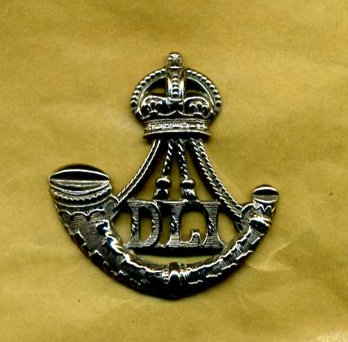
10 June 1915: He entered France[11] and he may then have been transferred to 10/DLI.[12]
8 August 1915: wounded and admitted to hospital in UK
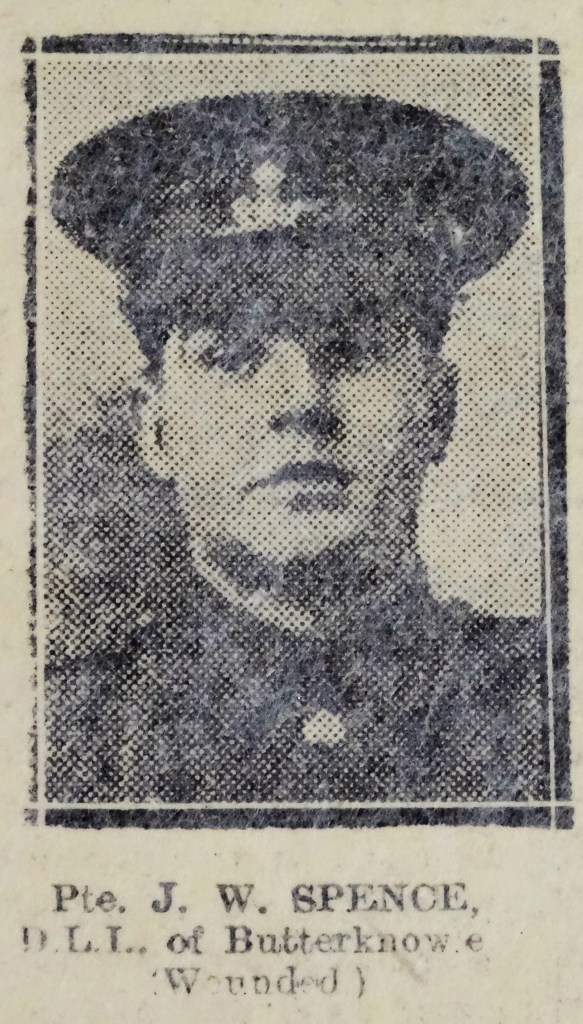
9 August 1915 to 9 May 1916: Home[13]
10 May 1916: Entered France and was transferred to 2/DLI [14]
13 November 1916: promoted to Lance Corporal
17 February 1917: Promoted to Corporal
9 April 1917 to 6 May 1917: sick [abscess] in hospital, 6th Ambulance Train
12 May 1917: joined unit in the field
18 May 1917: wounded[15]
19 June 1917: may have been promoted to Lance Serjeant
1 December 1917: Died of wounds received in action at 18 Field Ambulance serving with A Company, 2/DLI[16]
Private J.W. Spence served a total of 3 years 114 days including 2 tours overseas [France]. His service record is as follows:[17]
- Home: 10 August 1914 – 09 June 1915 – .………………304 days
- France: 10 June 1915 – 08 August 1915 – .……..………60 days
- Home: 09 August 1915 – 09 May 1916 – ………..……..274 days
- France: 10 May 1916 – 01 December 1917 – 1 yr….206 days
Total – …3yrs…114 days
Private J.W. Spence served 60 days in France between 10 June and 8 August 1915 with 10/DLI.[18] During this period 10/DLI was in Belgium around Ypres and came under the orders of the 43rd Brigade, 14th (Light) Division.[19] The 14th Division held the line across the Menin Road opposite Hooge.
16 June 1915: the 3rd Division which held the line to the south of the 14th Division attacked on the night of 15/16 June towards the hamlet of Hooge, south of Bellewaarde Lake. The second German line was reached but the attack fell away. The 42nd Brigade, 14th Division was ordered to support the 3rd Division attack but due to heavy casualties caused by heavy German shellfire, the attack fell away. Two further attempts to seize the German line were made by the 24th Division in the area of Railway Wood but broke down under heavy fire.
30 July: the 41st Brigade, 14th Division held the front at Hooge Crater which had been blown by the Germans on the night of 29/30 July and they were attacked by liquid fire (Flammenwerfer). Some trenches were lost and attempts by the 2 brigades, the 41st and 42nd of the 14th Division, to retake the lost trenches failed. Three battalions of the 43rd Brigade including 10/DLI then relieved the 41st Brigade which had taken heavy casualties. It was then decided to relieve 14th Division by the 6th Division which was a regular army division.[20] A later attack by the 18th Brigade, which included 2/DLI, was regarded as a success although 2/DLI suffered heavy casualties 9 August 1915 at Hooge.
Private J.W. Spence received wounds 8 August 1915 and was back home for treatment between 9 August 1915 and 9 May 1916. He probably served a short period with 3/DLI, another Reserve Battalion, based at South Shields.
10 May 1916: Private J.W. Spence entered France and made out his will, leaving all his possessions to his mother, Charlotte Ann Spence of 36 the Slack, Butterknowle.[21] It is assumed that he was transferred to 2/DLI at that time. He was promoted 17 February 1917 to Corporal then Lance Serjeant 19 June 1917.[22] 4/8777 Serjeant John William Spence served with 2/DLI “A” Company. [23]
2/DLI came under the orders of 18th Brigade 6th Division which landed at St. Nazaire 10 September 1914. It proceeded to the Western Front where it remained throughout the war. By 1917, the 18th Brigade comprised:
- 1st Battalion, the West Yorkshire Regiment
- 11th (Service) Battalion, the Essex joined October 1915
- 2nd Battalion, the DLI
- 14th (Service) Battalion, the DLI joined November 1915
- 18th Brigade Machine Gun Company formed February 1916
- 18th Trench Mortar Battery formed April 1916 [24]
The onset of winter, 1917 brought about another major British offensive at Cambrai.
The Battle of Cambrai: 20 November – 7 December 1917:
an overview [25]
In popular mythology, the Battle of Cambrai ranks as one of the most thrilling episodes of the whole war – at last, tanks came into their own and the notion that the Hindenburg Line was impregnable was exploded. However, the early success was not capitalised upon and the German counter attack regained much land and even captures areas previously held by the British. Cambai was an important railhead which lay at the junction of railways connecting Douai, Valenciennes and Saint-Quentin an also was located on the Saint-Quentin Canal. Also, it was an important HQ and billeting town. As a military target, its capture would deny the enemy of a key part of their communication system. As usual, the offensive was preceded by an artillery bombardment – 1000 guns and howitzers firing 900,000 rounds of shells opened up at 6.10am on the 20th November but the secret weapon was the 476 Mark IV tanks, the entire strength of the Tank Corps. On the right the 12th (Eastern) Division moved forward. The 20th (Light) Division, the 6th Division, the 51st (Highland) Division, the 62nd (2nd West Riding) Division and the 36th (Ulster) Division moved forward. The 6th Division crossed the Hindenburg Line and captured Ribecourt and fought as far as and through Marcoing. The 5th Cavalry advance through them but were repulsed at Noyelies.
27 November: the Third Army closed down offensive operations and units were ordered to consolidate. Three days later the German Army struck back. On the right flank, the break into the British positions was swift – the defending 55th (West Lancashire) Division and much of the 12th (Eastern) and 20th (Light) Divisions evaporated. By 9.00am on the 30th November, the Germans had penetrated almost 3 miles towards Havrincourt Wood and the Third Army faced disaster.
3 December: Haig ordered a retirement – the plan had failed and although some ground had been gained, a small salient remained at Flesquires in an exposed position but some ground had been lost to the advancing enemy.
Between 20 November and 8 December, British losses of dead, wounded and missing amounted to 44,207. Of these, approx. 6,000 had been taken prisoner. German losses were estimated at 45,000.
An account of the 6th Division [26]
The Divisional Diary informs:
“Nov. 15th -19th – Commenced march to Cambrai front
20th – Battle of Cambrai – 16th Infantry Brigade on right, 71st Infantry Brigade on left, 18th passed through – broke both systems of Hindenburg Line, capturing Ribecourt and Premy Chapel Ridge – first company into Marcoing – over 1,100 prisoners ans 23 guns.
All objectives gained with few casualties by 12 noon.
21st –Action of 14th D.L.I. supporting cavalry in advance to Cantaing
26th – 27th – 18th Infantry Brigade extended front to Cantaing. 1st Buffs cleared and occupied Noyelles.
30th – Enemy counter attack in force on the Third Army. 16th Infantry Brigade moved from Divisional Reserve to near Beaucamps and ordered to counter attack on Gouzeaucourt – found guards already in possession. Arranged to attack by night on La Vacquerie-Gonnelieu – attack unsuccessful. Gallant action of the 18th Infantry Brigade transport under Shea QM, 2nd D.L.I. and Paul, Transport Officer, 1st West Yorks – both died of wounds.
Night Dec. 2/3 – 16th Infantry Brigade relieved part of 29th Division north of St. Quentin Canal”
More detail is provided:
“The 18th Infantry Brigade advanced without tanks…The 18th Infantry Brigade pushed through the 71st Infantry Brigade and secured Premy Chapel Ridge in good time…The West Yorks and the 2nd D.L.I. each charged over the Premy Ridge spur and captured a battery at the point of the bayonet……On the night of the 26/27th November the 18th Infantry Brigade extended its left up to the south east edge of Cantaing….the enemy delivered a heavy counter attack on the morning of 30th November….the Germans reached Gouzeaucourt at about 9am but were stoutly opposed by transport details of the 18th Infantry Brigade…and checked the enemy in a portion of the village until it was retaken by the Guards about midday.
The 2/DLI and 14/DLI were heavily involved in this battle with the 14/DLI on the night of the 2/3 December “having stiff fighting” across and astride the canal to the east of Marcoing, an action which inflicted casualties of 15 officers and 262 other ranks, more than half being killed. Captain Lascelles gained his VC here.
10 December: the Division was withdrawn, after 3 strenuous weeks, to the Basseux area to the south west of Arras. A further report notes:
“The only other incidents of note were the repulse by the 18th Infantry Brigade of a half-hearted enemy attack on Cantaing on the 1st December and D.H.Q. being three times shelled out of its headquarters between 30th November and 9th December.”
30 November: there was heavy enemy shelling causing a number of casualties. Second Lieutenant Adlington was killed and the Germans broke through at Gouzecourt. Captain Shea was mortally wounded and 4 Other Ranks were wounded.
1 December: the enemy landed another attack at Cantaing from Lafoilie Wood and the ridge to the south of it. This was driven back.
“30 Nov: Enemy heavily shelled our line causing a number of casualties. 2 Lieut. Adlington killed.
On the enemy breaking through GOUZECOURT Captain & 2Lt. Shea organised every possible man including details (2 m.sgts. tailors, shoemakers etc) and held our important ???? south of GOUZECOURT. Until relieved by the Guards Brigade. Capt. Shea mortally wounded and 4OR wounded.
Special letter of congratulations from GOC 29th Div.
1 Dec 1917: At 1.45pm enemy launched an attack against our position at CANTAING from LAFOLIE WOOD and the ridge south of J. He was driven back by a good shrapnel barrage, Lewis gun, machine gun & rifle fire and did not repeat his offensive.
1 / 2 night: Bn. was relieved by 11th Essex Regt. and took up positions in Reserve System KAISER TRENCH L20G. Lt. Col. McCullagh returned……..” [27]
1 December 1917: 4/8777 Sergeant J.W. Spence died of wounds at 18th Field Ambulance.[28] Later research records that Second Lieutenant G.W. Adlington was killed in action and Captain J.P.L. Shea MC died of wounds and 6 Other Ranks serving with the 2/DLI were killed in action or died of wounds on this date. [29] It is reasonable to assume that Serjeant J.W. Spence was one of the 4 Other Ranks wounded as a result of enemy action on 30 November/1 December 1917.
The 6th Division suffered 1,790 casualties between 20 November and 10 December 1917 during the Battle of Cambrai. [30]
Serjeant J.W. Spence was awarded the 1914-15 Star, the British War and Victory medals.[31]

Burial
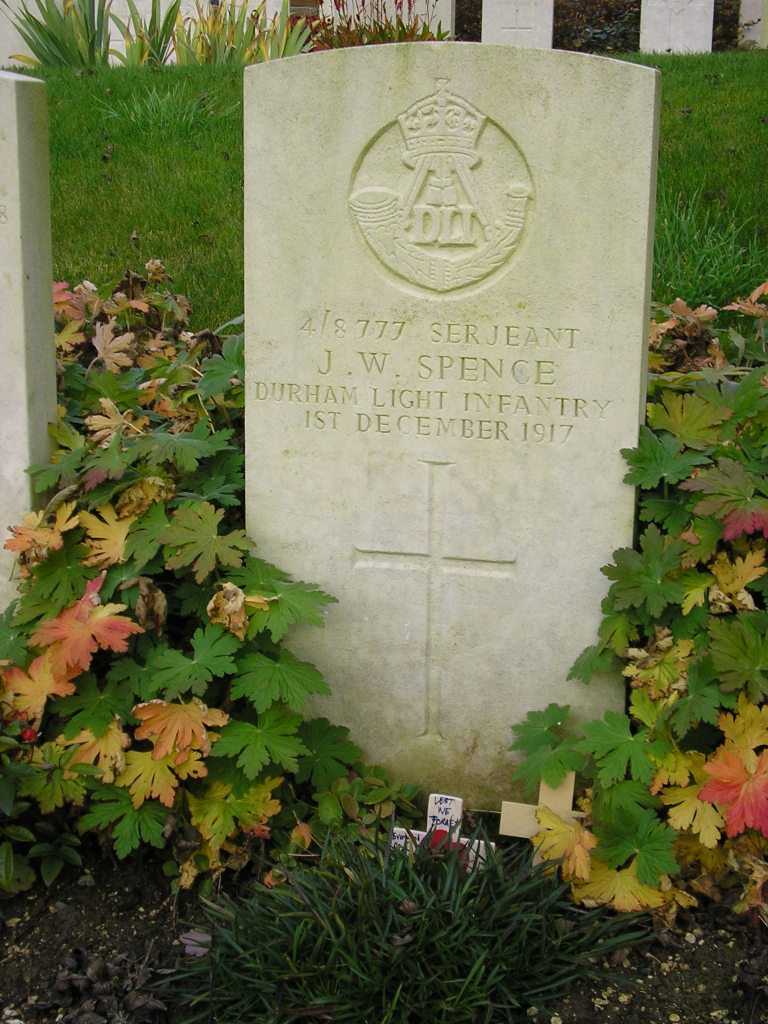
Sergeant J.W. Spence is buried at grave reference I.D.21 Ribecourt British Cemetery. Ribecourt is a village about 10km south west of Cambrai. On 20 November 1917, the 6th Division took the village at the conclusion of the Battle of Cambrai and it remained practically on the front line. The cemetery was begun by the 6th Division in November 1917 and used until March 1918 when it was recaptured during the German spring offensive. [32]
Commemorations
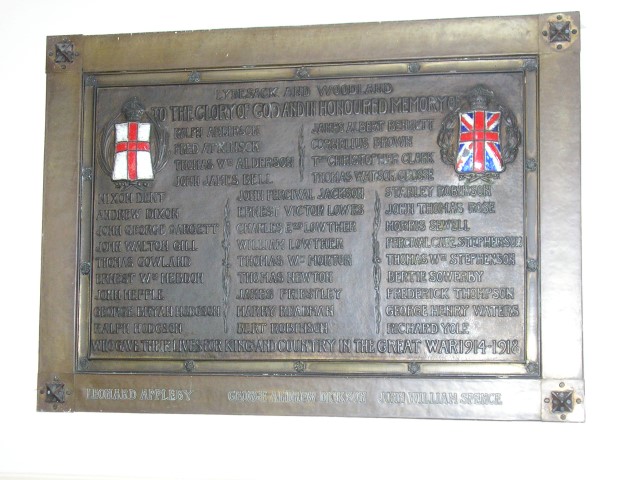
Serjeant John William Spence, 2/DLI is commemorated on the Evenwood and Butterknowle War Memorials and the Rolls of Honour in St. Paul’s Church, Evenwood and St. John the Evangelist, Lynesack.
REFERENCES
[1] Commonwealth War Graves Commission
[2] England & Wales Birth Index 1837-1915 vol.10a p.249 Auckland 1890Q2
[3] 1901 & 1911 census
[4] 1901 census
[5] 1911 census
[6] England & Wales Marriage Index 1837-1915 Vol.10a p.342 Auckland 1913Q1
[7] Army Forms B.59 & W.5080
[8] Army Form B.178 Medical History
[9] http://www.1914-1918.net/dli.htm
[10] Evenwood Parish Magazine April 1915
[11] Medal Roll
[12] Statement of Services – largely undecipherable
[13] Military History Sheet
[14] Army Form B.103 Reverse Sheet
[15] Army Form B.103 Reverse Sheet
[16] Army Form B.2090A
[17] Military History Sheet
[18] Statement of Services
[19] http://www.1914-1918.net/14div.htm
[20] Jack Cavanagh Western Front Association correspondence 9 May 2004 based on W. Miles’ book
[21] Private J.W. Spence’s will
[22] Army Form B.103 reverse side
[23] Army Form 2090A
[24] http://www.1914-1918.net/6div.htm
[25] Various sources including www.1914-1918.net/dli.htm, www.1914-1918.net/6div.htm, www.lightinfantry.org.uk/regiments/dli/durham_battlehonours.htm,
[26] “A Short History of the Sixth Division” Major General T.O. Marden Appendix 3 Diary
[27] 2/DLI War Diary
[28] Army Form B.2090A Field Service
[29] Officers & Soldiers Died in the Great War
[30] Appendix 1 of the Divisional History
[31] Medal Roll
[32] Commonwealth War Graves Commission
 EVENWOOD RAMSHAW & DISTRICT HISTORY SOCIETY