Summary
2658528 Guardsman John Edward Huntington, 1st Battalion, Coldstream Guards died 16 May 1940 aged 20. He is buried at Wilsele Churchyard [1] and commemorated on the West Auckland War Memorial.
Family Details
John Edward Huntington was born 23 May 1920 at Middridge, the son of Ada, the elder brother of Gordon, Mary, Ella and Margaret. [2]
Service Details
The service details of 2658528 Guardsman J.E. Huntington have not been researched. The following notes are derived from a number of sources.
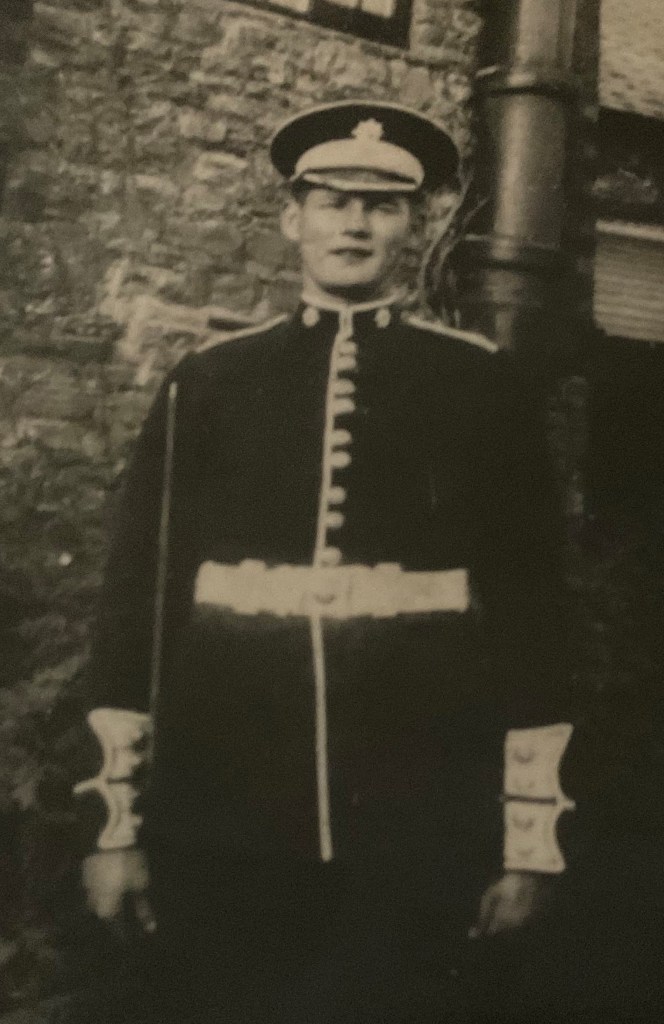
2658528 Guardsman J.E. Huntington
The 1st Battalion, Coldstream Guards was part of the 7th Guards Brigade together with the 1st & 2nd Battalion, Grenadier Guards and came under the orders of the 3rd Division [Major-General B.L. Montgomery]. On the outbreak of war, 3 September 1939, the 1 & 2 Battalions, Coldstream Guards were deployed to France with the British Expeditionary Force [BEF]. The period until May 1940 was known as “the Phoney War” where the BEF spent most of the time patrolling, digging defences and waiting for the expected German assault. The defence plan relied on the “impregnable” Maginot Line to the south along the French border with Germany.
10 May 1940: German forces invaded the Low Countries and the BEF left its prepared defences and moved into Belgium. The Germans then attacked through the Ardennes with tanks and headed towards the Channel Coast threatening to cut off the BEF. Fighting took place until 22 May when orders were given for the BEF to withdraw to Dunkirk. The1st Bn., Coldstream Guards was evacuated 1 June.
Guardsman J.E. Huntington did not make it. He was killed in action 16 May 1940. The following will provide some detail of events surrounding his death.
13 May: At 7pm, the Germans made a series of attempts to capture the city of Louvain, Belgium. The 3rd Division held the front.
14 May: The German XI Corps was in action against the 3rd Division at Louvain.
“A renewed attempt to take Louvain from the 3rd Division had started earlier, prefaced by a two-hour bombardment of the area north of the city held by the 9th Brigade and the 7th Guards Brigade. Here a tangle of railway lines and sidings, goods yards, sheds and warehouses made it a difficult area to preserve inviolate. Units of two German divisions succeeded for a time in pressing back some posts of the 2nd Royal Ulster Rifles, but a counter-attack by the 1st King’s Own Scottish Borderers restored the position and drove the enemy out of the railway yards. North of Louvain the 1st Coldstream Guard were heavily attacked and their right company was for a time forced back. But here too a counter-attack in which light tanks of the 5th Royal Inniskilling Dragoon Guards took part drove the enemy out and completely re-established the front. All other assaults were successfully driven off. The German Sixth Army reported to Army Group B that they had not succeeded in penetrating the Dyle defences at any point.” [3]
16 May: Fighting continued:
“Only at Louvain, which the enemy made further and equally unsuccessful attempts to capture, was the British front seriously tested on the 16th. Again the 3rd Division’s Louvain sector was heavily and continuously shelled. Again it was on the 2nd Royal Ulster Rifles and the 1st Coldstream Guards that the main attack fell, though this time the Belgian troops on our left were also involved and were forced back. But again the British position was held intact till withdrawal to the Senne line began that night.”[4]
Guardsman J.E. Huntington was killed in action 16 May 1940.
Burial, Wilsele Churchyard
2658528 Guardsman John Edward Huntington is buried at grave reference Row A Grave 21, Wilsele Churchyard.[5] The cemetery contains 26 Coldstream Guardsmen:
- 2654747 Simpson date of death 13 May
- 2654403 Farmery 15 May
- 2658528 Huntington 16 May
- 2655779 Maycock 16 May
- 2658998 Saunders 16 May
- 2654246 Tenney 16 May
- 2658794 Woodward 16 May
- 2654717 Baine 17 May
- 2658629 Burlinson 21 May
- 2654180 Williams 21 May.
- There are another 16 Coldstream Guardsmen buried here who died between 22 and 25 May 1940.[6]
- The cross on the photo below gives the date of death as 25.5.40. However, the CWGC details record 16 May 1940 as the date of Guardsman J.E. Huntington’s death.
The BEF suffered many casualties in covering the withdrawal to Dunkirk. Commonwealth forces did not return until September 1944 but in the intervening years, many airmen were shot down or crashed in raids on strategic objectives in Belgium, or while returning from missions over Germany. Wilsele Churchyard contains a group of 45 burials of the Second World War, three of them unidentified.
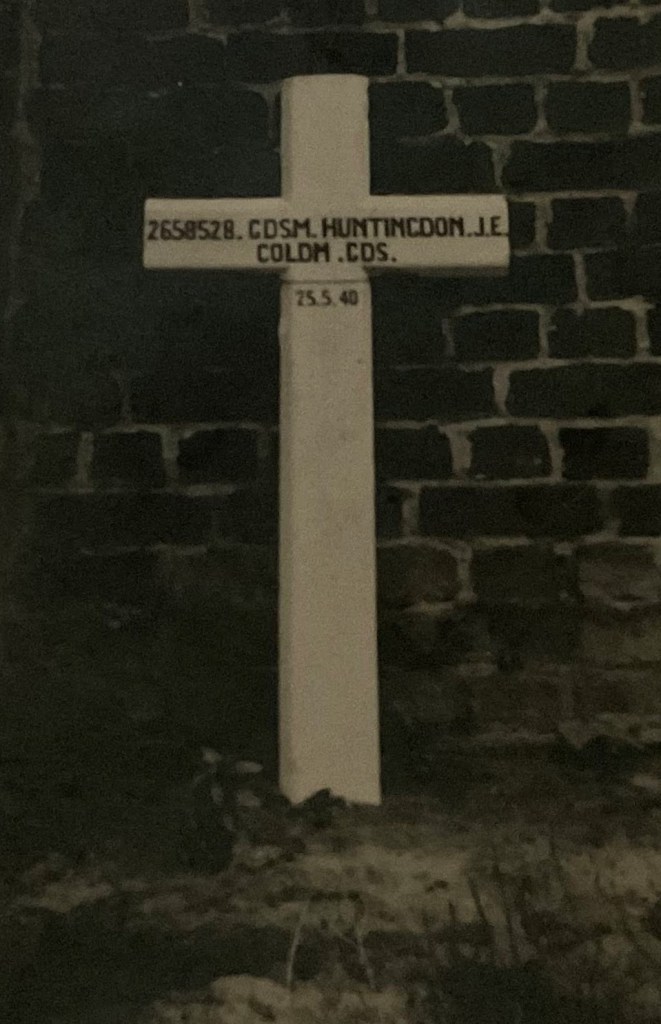
Guardsman J.E. Huntington, Wilsele Churchyard
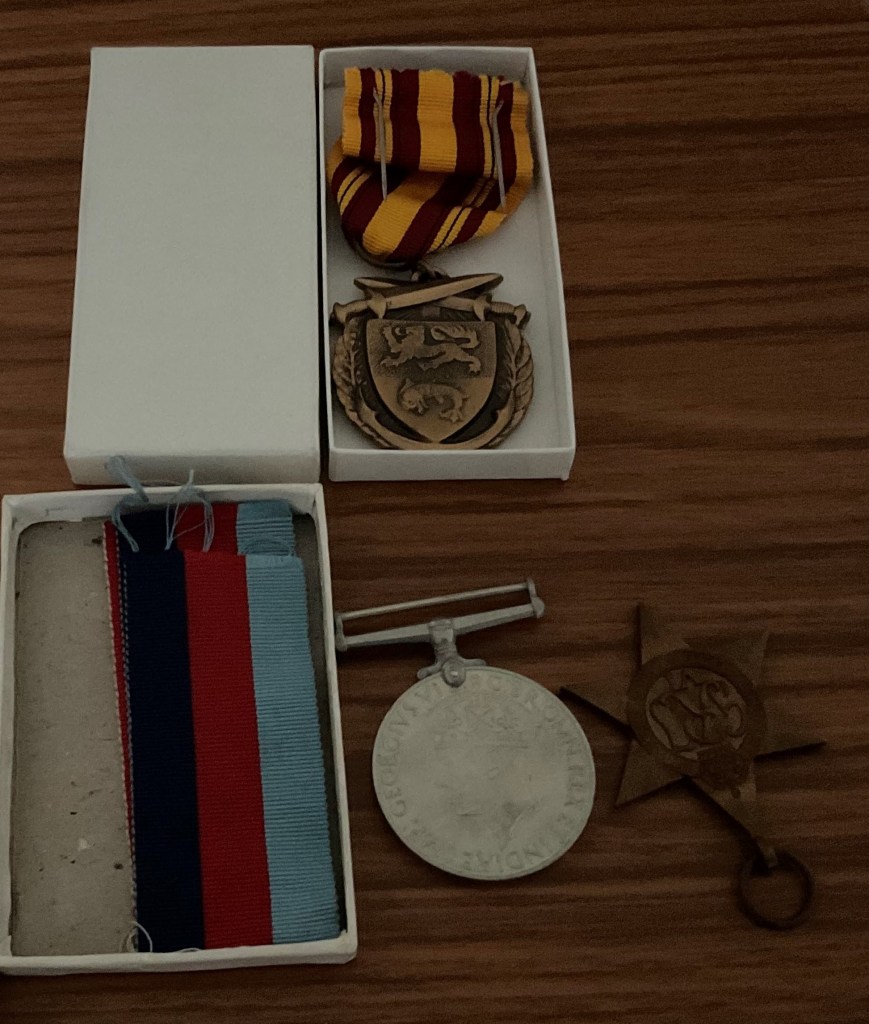
2658528 Guardsman J.E. Huntington’s medals, the 1939-45 Star, the War Medal 1939-45 and the Dunkirk Commemorative Medal awarded by the Mayor of Dunkerque
A LETTER FROM WILLIAM S. RUTTER (JOHN’S TEACHER)
Hipswell House
Middridge
Shildon
20 June 1940
Dear Mrs. Dickinson
I am very distressed to hear the sad news about John Edward. Will you all please accept my deepest sympathy in your great loss and I pray God will comfort and help you.
It seems but a short time since Joh was under my care in school here. What happy times we had! Now we have only pleasant and fragrant memories of our hero which will help me over the rough places that still lie ahead.
“He died to set the world free from oppression and tyranny – he died that we might live!”
My kindest regards to you all (Dorothy & Jim too if at West Auckland)
Yours Sincerely
Will. S. Rutter (John’s teacher)
Commemoration
2658528 Guardsman John Edward Huntington is commemorated on the West Auckland War Memorial and a memorial in St. Helen’s Church.
ACKNOWLEDGEMENT
Anne Caygill.
REFERENCES
[1] Commonwealth War Graves Commission
[2] Family details
[3] The War in France and Flanders 1939-1940 Major L.F. Ellis p.46 – 49
[4] The War in France and Flanders 1939-1940 Major L.F. Ellis p.61-67 Both from http://www.ibiblio.org/hyperwar/UN/UK/UK-NWE-Flanders/UK-NWE-Flanders-3.html
[5] CWGC
[6] http://ww2talk.com/index.php?threads/1st-battalion-coldstream-guards-belgium-may-1940.34306/
 EVENWOOD RAMSHAW & DISTRICT HISTORY SOCIETY