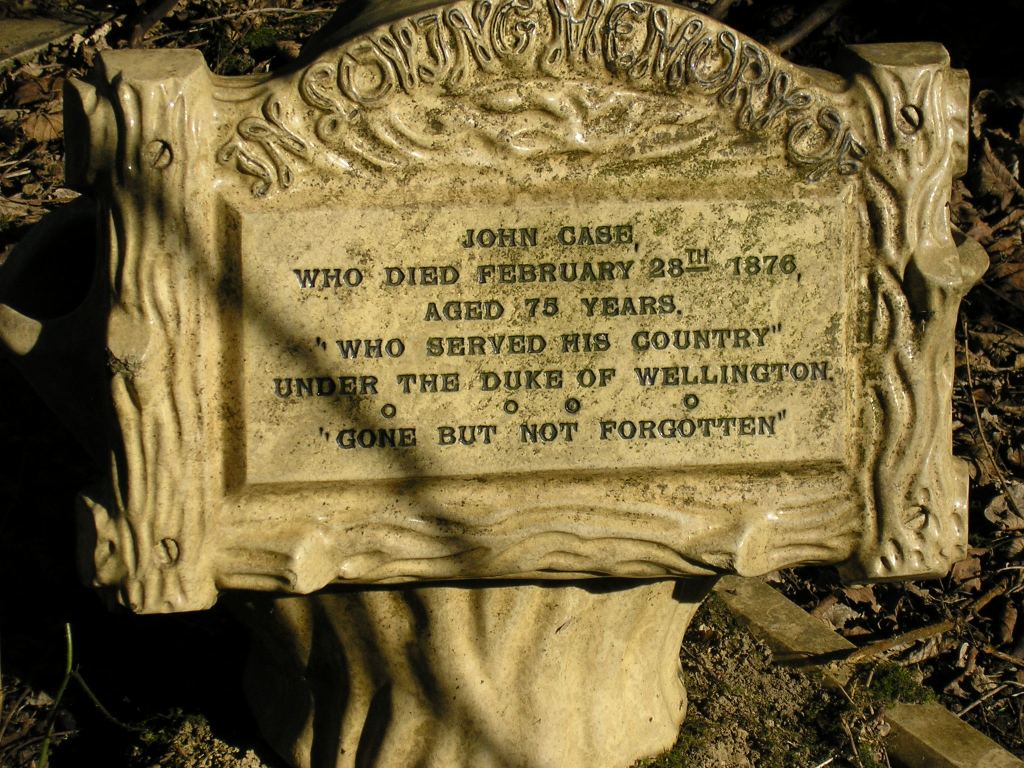
John Case (1801-1876) was born at Yarmouth, Norfolk, served almost 21 years in the British Army (1826-1847) seeing overseas service in Portugal and modern day Australia and India. On returning to civilian life, he was employed as a carter. In 1848, he married Louisa Harvey (1823-c.1870) and they had 8 children, 6 sons and 2 daughters. Initially, the family lived at Suffolk, then Norfolk before moving north sometime after 1866. Louisa died possibly in 1870. In 1871, John Case, now a widower, and his children lived at Etherley Lane, Bishop Auckland. By 1876, John lived with his son William at Lands Bank where William worked as a miner. In 1876, John Case died aged 75 at Lands Bank and is buried in Evenwood Cemetery.
FAMILY DETAILS
John Case was born at Yarmouth, Norfolk in 1801. In November 1826, aged 21, he joined the 4th Regiment of Foot and about 21 years later in 1847 (see below), he returned to civilian life. Prior to joining the Army, he worked as an “iron founder.” In 1848, John married Louisa Harvey at Ipswich, Suffolk. She was about 25 years old (born c.1823) and they had at least 6 sons and 2 daughters:[1]
- William born about 1851 at Ipswich, Suffolk
- John bc. 1854 at Felmingham, Norfolk
- Alfred bc. 1856 at Felmingham, Norfolk
- Thomas bc. 1858 at Swanton Abbott, Norfolk
- Francis bc. 1859 ditto
- Charles bc.1861 ditto
- Louisa bc. 1864 ditto
- Anna bc.1866 ditto (she was recorded as blind.)
In 1851, John and Louisa Case lived at Great Yarmouth, Norfolk with their newly born son, William. John is recorded as a, “Chelsea Pensioner.”.[2]
In 1861, the family lived at Low Common, Swanton Abbotts, Norfolk where 52 years old John worked as a, “Carter.” Louisa was then aged 38 and they had 6 children, the youngest Francis was 9 months old.[3] Louisa Case died sometime between 1866 and 1871, possibly 1870.[4]
In 1871, the family lived at Cross Row, Etherley Lane, Bishop Auckland. John was recorded as a, “widower” and a “Pensioner in Army.” His age is undecipherable although he was probably 70 years old at the time. His housekeeper was his sister-in-law, 30 years old Sarah Harvey (a widow). The oldest 5 sons all worked as coal miners.[5]


25 February 1876, John Case died of “exhaustion” aged 75. His death certificate described his rank or profession as, “Pensioner 4th King’s Own Regiment”, his son William was present and he lived at Lands Bank.[6]

MILITARY SERVICE [7]
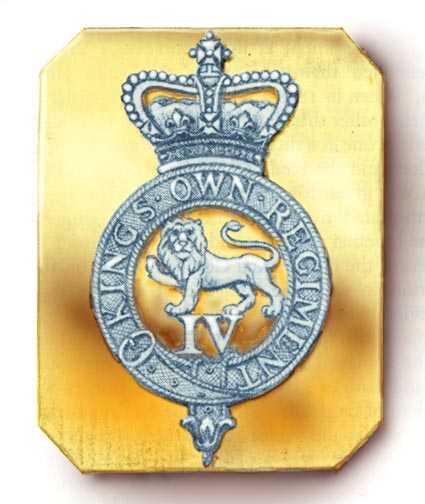
16 November 1826, aged 21, John Case attested at Ipswich, Suffolk into the 4th King’s Own Regiment of Foot and was given the regimental number 418. In total, he served 20 years 332 days, from 16 November 1826 to 12 October 1847.
He was promoted:
- 8 April 1841: to Corporal
- 12 May 1842: to Serjeant [8]
John Case’s record confirms that he served 16 years 2 months overseas at:
- Portugal for 1 year 3 months,
- New South Wales for 6 years 5 months
- The East Indies for 8 years 6 months.
12 October 1847, aged 42, Serjeant John Case was discharged from the Army. There are corrections made to his service record but it seems that he was finally discharged this date. He was considered to be “unfit for further service.” The first reason cannot be deciphered but a second reason states that he suffered from a hernia on the right side.
The period from 1815 to 1854 from the end of the Napoleonic Wars to the Crimean War is known as “The Long Peace.” There was no major conflict during this time. John Case’s headstone states that he “served his country under the Duke of Wellington.” The Duke of Wellington’s military career spanned 65 years from 1787 until his death in 1852. Wellington is, of course, a British military icon having defeated France led by Napoleon at the the Battle of Waterloo in 1815. He was Commander in Chief of the British Army between 1842 and 1852 therefore, John Case did indeed serve under the Duke of Wellington for about 5 years between 1842 and 1847.
The typical recruit of the day was an unskilled labourer in civilian life, probably unemployed, broke and keen on his drink, uneducated, Irish, Scots or Welsh, most under the age of 20 and by modern standards underweight (well under 10 stones) and not very tall, about 5ft 6ins. He was snared by the Recruiting Serjeant’s promises, his red coat and medals. He would be single and would not marry during his service. Drunkenness, desertion and insubordination were common and some soldiers would sell their equipment for the price of a pint. He spent much of his time cleaning his kit and his barrack room and at drill. Discipline was stern and his conduct would be rated as, “Fair.” Training and discipline would make him a very brave soldier intensely loyal to his new family, the Regiment. [9] This description should not to be construed to be the case for John Case. In fact, he rose to the rank of Serjeant and his conduct was recorded as, “Very Good.”[10]
The King’s Own Regiment served in Portugal between 1827 and 1828, New South Wales (now part of Australia) from 1831 to 1837 and Madras (now part of India) from 1837 to 1848. [11] A timeline up to 1839 is provided by Richard Cannon.[12]
PORTUGAL 1827-1828
1826: The Portuguese government being an old ally of Britain, asked for assistance to counter the menace from Spain. Six companies of the King’s Own Regiment formed part of a force of 5,000 men, some of whom embarked 15 December at Portsmouth bound for Lisbon, arriving 1 January 1827.
1827: The King’s Own landed 1 January and occupied barracks of Valle de Pereiro. The regiment formed part of a brigade together with the 10th, 23rd and the 1st Battalion of the 60th Rifles. It advanced up country to Coimbra. The King’s Own was billeted at the St. Bernard’s convent. The Spaniards withdrew from the frontier and declared a friendly disposition towards the Portuguese government. The British then marched back to Lisbon, arriving 12 July and occupied barracks of La Lippe at Belen. Three companies of the regiment were stationed at Oeries and 3 at Feitovia barracks near Fort St. Julian. A mutiny in the Portuguese Army was suppressed. The King’s Own remained in the Feitovia barracks until the Spring when they were withdrawn.
Private J. Case spent 1 year and 3 months in Portugal. His service record includes no dates but assuming that he was with the first detachment, he would have returned to Great Britain about April 1828.
GREAT BRITAIN & IRELAND [13] 1828-1832
1828: On arrival at Portsmouth, they were ordered to proceed to Scotland, landing at Leith between 26 and 29 April before proceeding to Edinburgh Castle. In July, the regiment marched to Glasgow where it received new regimental colours.
1829-1831: From August 1829, the regiment was stationed at Newry in Ireland then from September 1830 it occupied the Richmond Barracks in Dublin. From there, the regiment returned to England to Stockport via Manchester, Bolton and Oldham, where it arrived 18 September.
1831: in January, the HQ was at Ashton-under-Lyne, at Northampton in March and at Chatham in April. Part of the regiment embarked for New South Wales, as guards to convict ships.
NEW SOUTH WALES [14] 1832-1837/38
Between 1788 and 1868, Britain sent 162,000 convicts to Australia by using 608 “convict ships.” A convict ship was any ship engaged on a voyage to carry convicted felons under sentence of penal transportation from their place of conviction to their place of exile.[15]
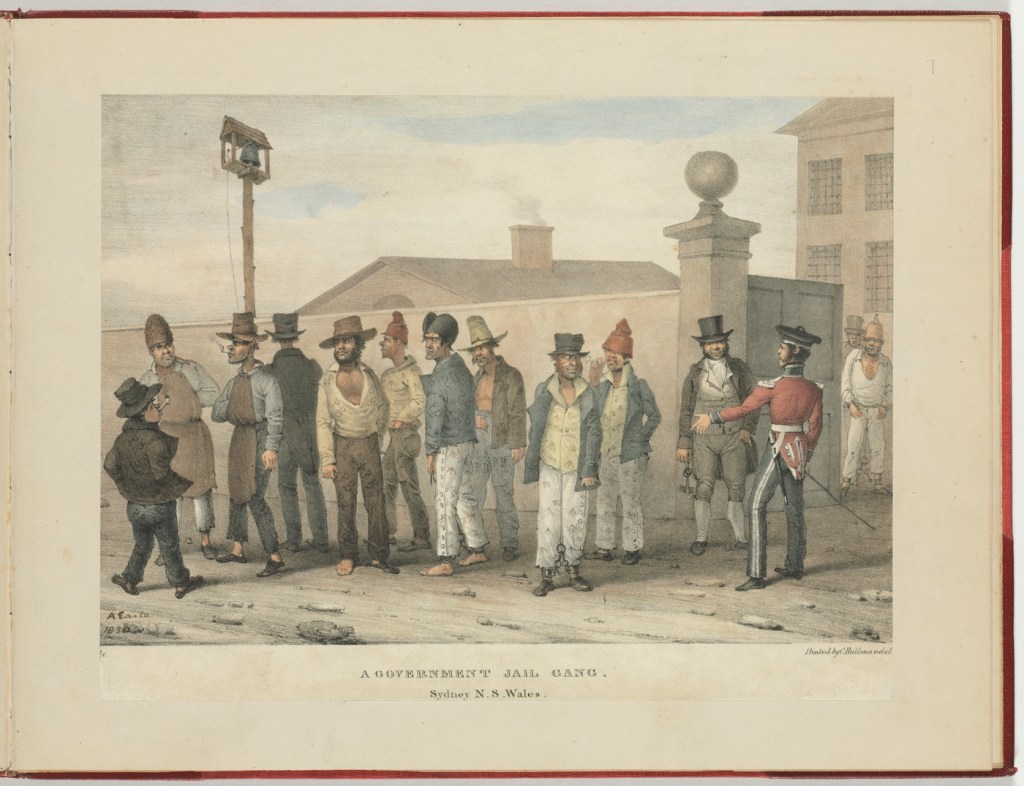
1832-34: The HQ, under the command of Lieut.-Colonel McKenzie, embarked from Deptford 14 April bound for NSW, on board “Clyde,” arriving 30 August. The “Clyde” was a merchant ship built at Greenock, Scotland in 1820. She made 2 voyages for the British East India Company in 1820/21 and 1825/26 and 3 voyages transporting convicts from England and Ireland to Australia in 1830, 1832 and 1838. Her second voyage was under the command of Daniel Munro and surgeon George Fairfowl. She departed Portsmouth 9 May 1832 and arrived on 27 August. Two hundred male convicts had embarked and there was 1 death en route.[16] The regiment remained at NSW for 5 years, its HQ was at Parramatta until June 1833 when they were moved to Sydney. The regiment returned to Parramatta in June 1834 where they remained for 20 months.

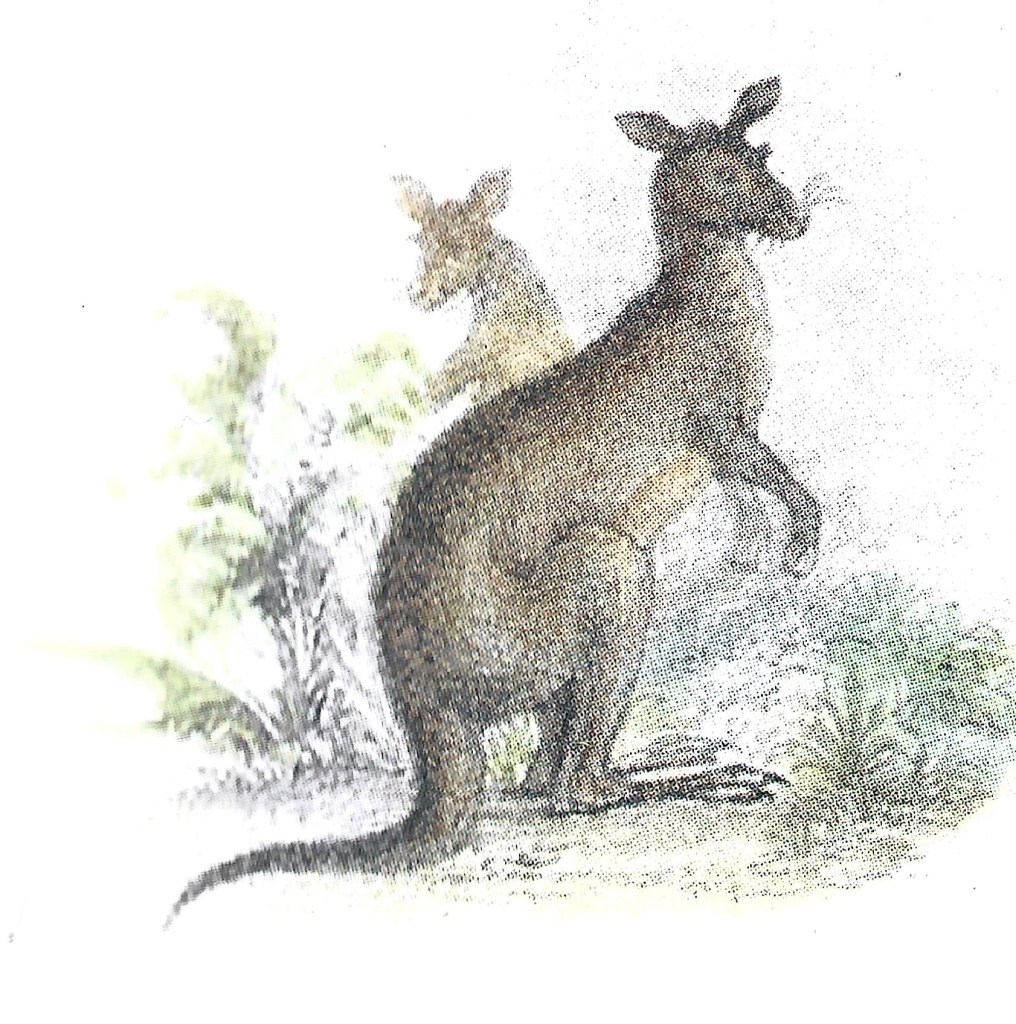
Above: Two contemporary illustrations showing the aboriginal indigenous people and the iconic symbol of Australia, the kangaroo
In January 1834, soldiers of the 4th Regiment of Foot garrisoned at Norfolk Island [17] and led by Captain Foster Fyans, were ordered to suppress a major convict uprising. In the conflict that followed, 5 convicts and 1 soldier were killed. The superintendent of the penal colony, Colonel James Morisset, allowed Fyans to torture and subject the surviving ringleaders to harsh punishment which earned him the name of “Flogger Fyans”. Later, 14 convicts were sentenced to death and hanged. [18] Norfolk Island went through periods of unrest with convicts staging a number of uprisings and mutinies between 1826 and 1846, all of which failed. The British government began to wind down the penal settlement after 1847, and the last convicts were removed to Tasmania in May 1855. The island was abandoned because transportation from Great Britain to Van Diemen’s Land (Tasmania) ceased in 1853, to be replaced by penal servitude in the UK.[19] Whether or not Private John Case served at Norfolk Island has not been researched.
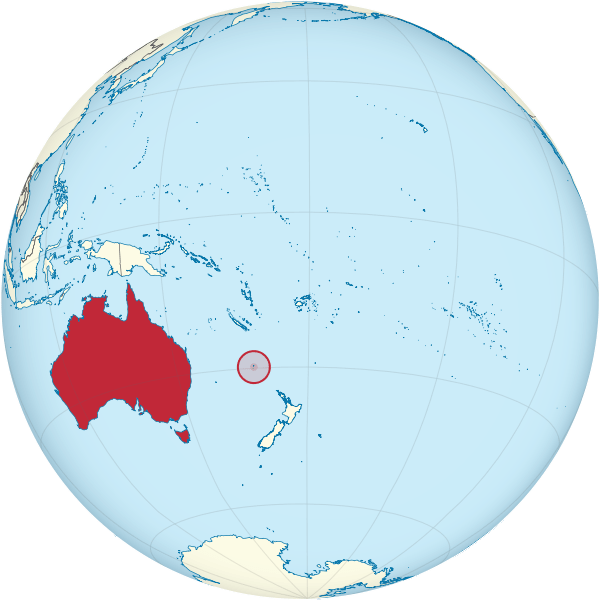
Above: Norfolk Island is between Australia and New Zealand
1835: General, the Earl of Chatham died and the colonelcy of the King’s Own was conferred on Lieut.-General John Hodgson by commission dated 30 September 1835.
1836: The HQ was moved to Sydney in March.
Further details of the assignment to NSW is provided by the Biographical Database of Australia (BDA).[20]
27 August 1832, the convict transport “Clyde” docked at Sydney carrying the regiment’s new commander Major J.K. Mackenzie and his family, Quartermaster W. Hanna and his family, 33 soldiers, 7 wives and 10 children.
1836: Captain W. Lonsdale sailed from Sydney to the new settlement of Port Philip to take up a civil post as Police Magistrate. He was supported by Ensign G. King and a detachment of 30 ranks from the regiment. They were tasked with taking control of the unofficial settlement established by John Batman, John Pascoe Fawkner and others at what later became the city of Melbourne. Over the next few years, successive contingents of officers and men were sent to the colony as guards on convict transports. They served in the settled areas of Tasmania, Norfolk Island, Port Philip and at a range of depots in NSW including Sydney, Parramatta, Emu Plains, Bong, Mount Victoria, Cox’s River, Maitland, Newcastle, Port Macquarie and Moreton Bay (now in Queensland but then in NSW.)
Like all regiments, the 4th had a large musical band which participated in the cultural life of the colony – balls, concerts, horseracing and other public gatherings.
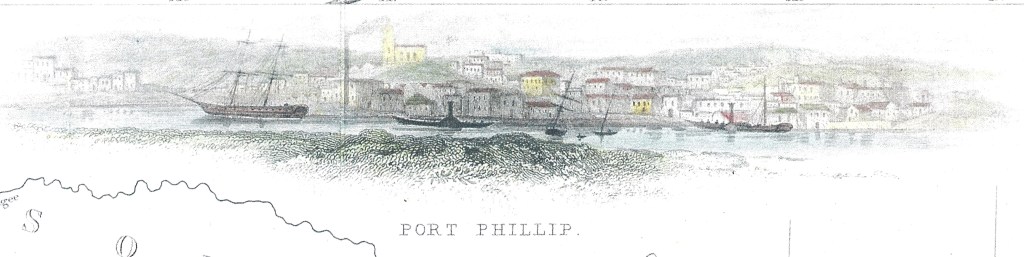
Above: 1850 Sketch of Port Phillip, by which time John Case was back in Britain
Private J. Case spent 6 years 5 months in NSW. His service record includes no dates but this period probably includes the 4 months spent at sea getting from England to NSW. He probably left NSW in September 1838 after most of the regiment had left the colony for Madras.

THE EAST INDIES, MADRAS [21] 1837-1848
1837: In August, 2 divisions embarked for the East Indies, comprising the HQ and over 450 men under the command of Major J. England. Two ships left Sydney and landed at Madras 30 September 1837. The HQ was stationed at Fort St. George. The last division embarked from NSW 26 December 1837, arriving at Madras 9 April 1838. Some members of the regiment remained in NSW.
Private J. Case spent 8 years and 6 months in the East Indies. His service record includes no dates but should Private John Case been amongst the last contingent to travel to Madras, say September 1838 then he would not have returned to Great Britain until March 1847.[22]
8 April 1841: Private John Case was promoted to Corporal and to Serjeant 12 May 1842.
Between 1845 and 1847, the King’s Own was stationed at Kamptee,[23] in the district of Nagpur, in the state of Maharashtra. The town was founded in 1821 when the British established a military cantonment on the banks of the river Kanhan.[24] Serjeant John Case was stationed at Kamptee in September 1846. (see below).

Serjeant John Case’s Discharge from the Army.
This was not a straightforward arrangement. The front page of his Army Form records the place of his discharge as Kamptee, East India, the date being 30 September 1846 and on the back page, “Final Description,” his age was recorded as 40 years 10 months. The “Final Description” details were amended to read as follows:
- the place of discharge, Chatham,
- date, August 1847
- age, 42 years.
Another page gives his discharge date as 12 October 1847 and his period of service is recorded as 20 years 332 days. It appears that he was allowed to serve for a further 1 year and 12 days beyond this second date of discharge.

DEATH
1876, 25 February,[25] John Case’s death was recorded in Auckland, [26] he died at Lands Bank and he is buried at Evenwood Cemetery. John Case’s family remained in the area for the immediate future. The 1881 census records his children John (aged 27), Alfred (25), Thomas (23), Charles (19) and Ann (16) living at Jacksons Houses, Etherley Lane, Bishop Auckland. John was the head of household and all 4 brothers worked as coal miners. Also living with them was 72 years old Susan Kirby who was the housekeeper.
ACKNOWLEDGEMENT
Aline Waites for researching family details
REFERENCES
[1] 1871 census Note: the hand writing is difficult to decipher so the place names may be different.
[2] 1851 census Note: The census actually records Louisa as Elisa and William as Walter but it is clearly the correct family.
[3] 1861 census
[4] 21 January 1870 Death Certificate, Wrekenton, Gateshead – possible
[5] 1871 census
[6] Death Certificate registered 28 February 1876
[7] Army Record for 418 Serjeant John Case
[8] The Army Form spells the rank as Serjeant rather than the modern way, Sergeant
[9] Display Board, King’s Own Scottish Borderers Museum, Berwick
[10] Army Record for 418 Serjeant John Case
[11] https://www.britishempire.co.uk/forces/armyunits/britishinfantry/4thkingsown.htm
[12] “Historical Record of the Fourth, or King’s Own Regiment of Foot containing an account of the formation of the regiment in 1680 and of its subsequent services to 1839” Richard Cannon 1839 p.139
[13] At this time Ireland was part of Great Britain.
[14] Australia was not yet a country as such, it was a collection of colonies and part of the British Empire.
[15] https://en.wikipedia.org/wiki/Convict_ship
[16] https://en.wikipedia.org/wiki/Clyde_(1820_ship)
[17] Note: Norfolk Island is located in the Pacific Ocean between Australia and New Zealand, some 877 miles east of Australia.
[18] https://en.wikipedia.org/wiki/British_Army_in_Australia#1840s
[19] https://en.wikipedia.org/wiki/Norfolk_Island
[20] “4th Regiment of Foot (King’s Own) 1831-1837” Biographical Database of Australia Researched by K.A. Johnson, M.R. Sainty & M. Flynn
[21] India was not a separate country. Its regions were regarded as colonies and part of the British Empire. Madras is now called Chennai.
[22] Note: Richard Cannon’s history concludes in 1839.
[23] http://rampais.com/genelogy/india/kamptee/britregt.htm
[24] https://en.wikipedia.org/wiki/Kamptee
[25] Note: His death certificate records 25 February 1876 and his headstone records 28 February 1876 as the date of his death.
[26] England & Wales Death Index 1837-1915 1876 Q1 Auckland Vol.10a p.129
 EVENWOOD RAMSHAW & DISTRICT HISTORY SOCIETY