Hugh Dalton was MP for Bishop Auckland in 2 terms – 1929 – 31 & 1935 – 59. Dalton was one of “the Big Five”, of the post war Labour government, the others being Atlee, Bevin, Cripps and Morrison.
The following account is taken from, “The Political Diary of Hugh Dalton 1918 – 40 & 1945 – 60” 1986 Ben Pimlott 1986. It will comprise of selected extracts of a local nature, specific to the Bishop Auckland constituency. There are some explanatory notes. References are not quoted here but are available upon request.
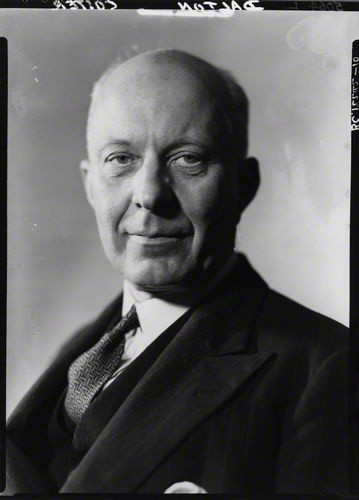
Below: Hugh Dalton
POLITICAL CAREER
6 October 1928: Dalton was selected as a candidate for the Durham mining seat of Bishop Auckland.
22 December 1928: Ben Spoor MP for Bishop Auckland died suddenly. Dalton was MP for Peckham and could not stand in the by-election. The Bishop Auckland Labour Party suggested that his wife Ruth Dalton should stand and hold the seat for her husband, until the forthcoming general election.
8 February 1928: Ruth Dalton was elected with a majority of 7,072. The following year, the general election took place and Hugh Dalton stood for Bishop Auckland.
30 May 1929: Hugh Dalton was elected MP for Bishop Auckland and the second Labour Government came into office and was in power between 1929 and 1931.
11 June 1929: Hugh Dalton was appointed Parliamentary Under Secretary of State for Foreign Affairs to the new Foreign Secretary, Arthur Henderson.
11 October 1929: Dalton travelled to Bishop Auckland and back. His schedule was:
- 10: leave Kings Cross
- 3.38: arrive B/A motor with Bull to Town Hall;
- 4: receive deputation of unemployed
- 4.15: conference on relief scheme with Urban District Council
- 5.30: similar conference with Rural District Council
- 6.45: tea with Mrs. Bull
- 7.30: motor to Town Hall; receive deputation from British Legion
- 7.45 – 9.15: lecture with C. Curry in the chair. “Impressions of an Eye Witness at Geneva” jointly for League of Nations Union, Wesley Guild and Dramatic Society. Talk to constituents after meeting.
- 9.45: supper with Mrs. Brown
- 11.25: catch train from B/A station
- 5.15am: [12th] arrive Kings Cross
23/24 November 1929: Called at Ruskin to see Maddison. This was probably Jack Maddison from Bishop Auckland who was studying at Ruskin. Later he and his wife ran a centre for the unemployed at Spennymoor, Co. Durham. Dalton commented that he was, “very radiant and absorbing new ideas.”
14 & 15 February 1930: Bishop Auckland:
“Some improvement in employment and trade. People wonderfully patient and easily satisfied. Only persistent demand is for better pensions for old people, especially in the mining industry. Stay Friday night with Hodgson (Rev. William Hodgson, Secretary of the Bishop Auckland Constituency Labour Party). Meetings at Coundon, New Shildon and West Auckland on Friday and Bishop Auckland on Saturday. All about half full. Not bad for this dreary interim.”
25 July 1931: At Durham for the Miners’ Gala. Maxton and Cook the chief speakers. A downpour of rain but crowds stood patiently, with or without umbrellas listening for hours.
2 October 1931: MacDonald announced the dissolution of Parliament. Preparations for an election in which “National” Labour and Liberal candidates were protected by party arrangements.
12 October 1931: “arrive at Bishop Auckland…Brian Bell as agent…from the beginning I am unhappy and uncomfortable…I miss Ruth very much.”
28 October 1931: Election result, Curry (Liberal National) was elected at Bishop Auckland.
The defeat was not an isolated event. Labour reduced from 288 to 52 seats. The Great Depression plunged the government into a terminal crisis. The Cabinet agreed that it was essential to maintain the Gold Standard and that the Budget needed to be balanced, but were divided over reducing unemployment benefits by 10%. The financial crisis across Europe was worsening and Britain’s gold reserves were at high risk. New York banks provided an emergency loan but additional money was needed and to get it, the budget had to be balanced. MacDonald and Chancellor of the Exchequer Philip Snowden proposed cuts in unemployment benefits. The Labour Cabinet decided to resign. The King implored MacDonald to remain and form an all-party National Government that would make the budget cuts. MacDonald agreed on 24 August 1931 and formed an emergency National Government, with members from all parties. The new cabinet had four Labourites (now called the “National Labour Party”) who stood with Macdonald, plus four Conservatives and two Liberals. Labour unions were strongly opposed and the Labour Party officially repudiated the new National Government. It expelled MacDonald and his supporters from the party. Henderson led the Labour Party into the general election on 27 October 1931 against the cross-party National coalition. It was a disastrous result for Labour, which was reduced to a small minority of 52. MacDonald won the largest landslide in British electoral history.
12-14 February 1932: Dalton was unanimously readopted. He stayed with Will Davis – W.N. Davis, a teacher and Secretary of the Bishop Auckland Divisional Labour Party who was Dalton’s closest friend and ally in the constituency.
28 October 1935: Dalton was adopted for Bishop Auckland again.
3 November 1935:
“after a meeting at Coundon Picture Palace, I go to see Will’s Black Doctor Cherry. He says I have sciatica and a touch of lumbago…motor to Gateshead.”
Dr Cherry’s son Gerry played cricket for Evenwood in the late 1960s/early 70s. Another son, Cecil worked at Sedgefield RDC and was a good friend of the author of these notes.
15 November 1935: General election, Dalton won with a majority of 8,086. However, the National Government obtained a majority, although Labour got 37.9% of the vote but only 154 seats.
1939 – 1945: WW2 – Dalton’s war is covered by a separate book. He was heavily involved with the war time government.
26 July 1945: The first post war election and Dalton won Bishop Auckland again with an 8,860 majority. The result was delayed – having to wait for the votes of servicemen stationed abroad. It was a Labour landslide with clean sweep in Durham.
“In my own division everything went quite well. Maurice Mason proved a very …competent agent…Will Davis…was more than ever a tower of strength…there is just enough to show now, in the way of new factories etc. to make an impression, though there is some agitation against the Jews [at least 2 owners of the new factories on the trading estates in Dalton’s constituency were Jewish businessmen who had fled from Germany] and it is most important that we should have only Gentiles now, in addition to the three pioneering firms at St. Helens and not too many Jews on the new Estate at Shildon. The switch over of Spennymoor and Aycliffe from R.O.F.s [Royal Ordnance Factories] to Trading Estates for peace production seems [to be] going pretty well and after a month or two of transition, I hope that there will be very little unemployment in the area, especially as West Tool should have got going by then.
28 July 1945: “The King hadn’t much to say, but seemed quite resigned.”
“You’ve had a revolution.” President Truman to the King. “Oh no! we don’t have those here.”
15 August 1945: VJ Day
12 November 1947: Dalton resigned as Chancellor of the Exchequer.
Hugh Dalton, the Chancellor, revealed key budget details to the Star, a now defunct evening paper, which were published before Dalton began his speech. That leak led to Dalton’s resignation a day later and established an informal Whitehall rule that no unauthorised domestic policy revelation was more serious than a budget leak.
The Dalton leak came when he was on his way into the Commons chamber before the budget, indiscreetly told the Star’s John Carvel:
“No more on tobacco; a penny on beer; something on dogs and pools but not on horses; increase in purchase tax, but only on articles now taxable; profits tax doubled.”
Carvel’s story, with its market-sensitive information, was on the streets approximately 20 minutes before Dalton began speaking in the Commons. Initially, it looked as if Dalton would not suffer for his indiscretion, though he immediately offered his resignation to the prime minister at the time, Clement Attlee. Attlee, who rarely gave interviews and never briefed the press, was astounded at what had happened. “Talked to the press?”, he said when his adviser Francis Williams explained the facts to him. “Why on Earth did he want to talk to the press?”
On the day after the budget, Dalton apologised to the Commons for his “grave indiscretion”. Winston Churchill, then leader of the opposition, offered him sympathy and commended Dalton’s “very frank manner”. Later in the evening, however, Dalton offered his resignation again, and this time Attlee accepted it. Dalton was replaced by Sir Stafford Cripps.
In his retirement, Attlee was more forthcoming about the incident. “Perfect ass,” he said of Dalton in a Granada TV interview. “His trouble was that he would talk. He always liked to have a secret to confide to somebody else to please him. He did it once too often.”
The Dalton leak would probably never have happened but for two unusual factors. The first was that MPs were still sitting in the House of Lords chamber in 1947 because the House of Commons, badly bombed in the wartime blitz, was still being rebuilt. As a result, the chancellor had to walk past lobby journalists on the way to the Lords. The second was that Dalton’s political minder Douglas Jay, who would normally have been on hand to fend off the journalist, had been sent on ahead to check that there was a glass of water at the dispatch box for Dalton during his speech.
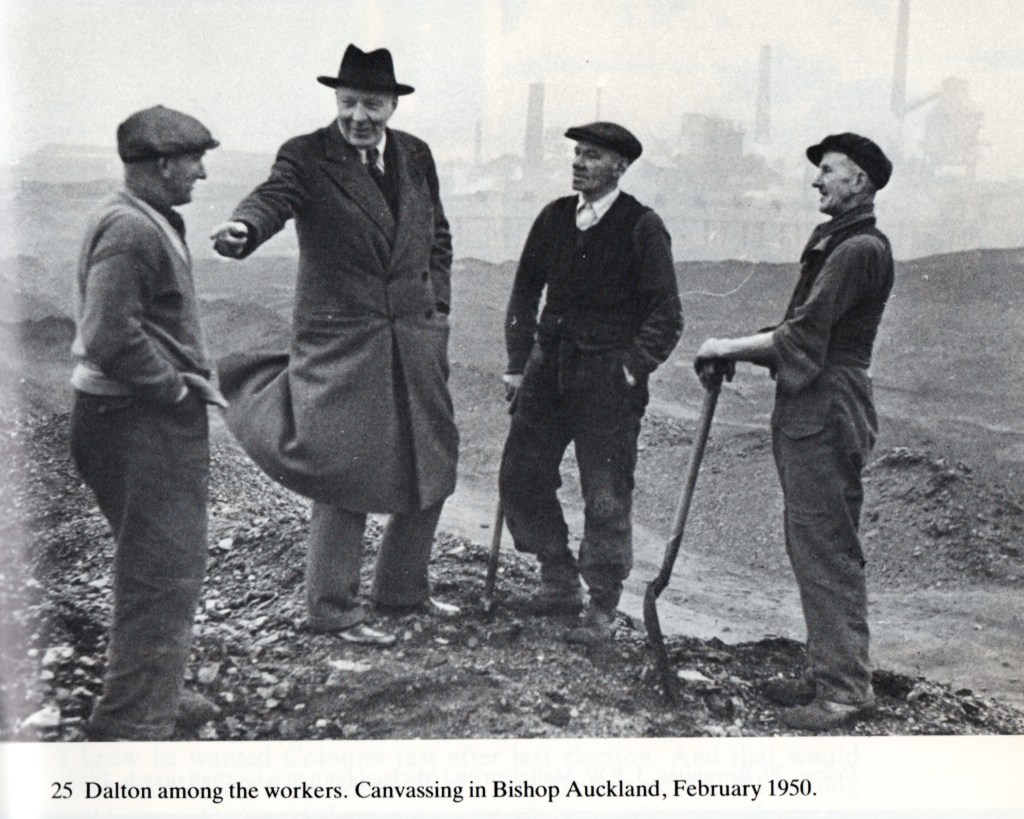
23 February 1950: Labour won the election with a majority of 5 despite apparently adverse boundary changes and the national swing against Labour. The result in Bishop Auckland was Dalton’s best ever in a parliamentary contest. He received 25,039 votes, with a majority of 11,370 over his conservative opponent [Lord Lambton], the Liberal losing his deposit.
2 June 1951: Dalton stayed at Evenwood with the Bells [Jack Bell and his wife]
25 October 1951: Polling Day
“Weather very fine. Drive round all day, starting at 9am with an hours break at lunch and ¼ hour for tea, till 8.30pm. Visit every polling station except Hamsterley and Cockton Hill. Then on wireless with Will [Davis]. Florrie and dogs have gone to bed at 10pm [Florence Davis, Will’s wife]. Our vote maintained, many seats hold which I feared might go and very few losses. Though Darlington is one.”
Dalton was returned with a majority of 8,986 in a straight fight. Nationally, Labour lost seats. The Conservatives increased their total to 321, compared with Labour’s 295 with 6 Liberals & 3 Irish Nationalists. Atlee resigned and Churchill became PM for a second time.
28 June 1952: “At West Leaze [his home] fuming over German Rearmament and failure of poor Tom Anderson [full time secretary/agent for the Bishop Auckland Constituency Labour Party 1949-54] to keep Guthrie [Harold Guthrie, Bishop Auckland teacher and left-wing activist, later constituency party secretary] and one or two troublemakers at Bishop Auckland in order.”
9-12 July 1954: In the constituency. Harold Guthrie informed Dalton of financial problems, Anderson didn’t warn him of 6 month’s rent owing and made a mess of a joint draw with Darlington CLP. Dalton didn’t want to contribute since the debt could be cleared with the sale of a house, NUM contributions, NUR affiliation if secured and members subscriptions. Dalton pointed out that they had not started a general election fund which would involve him in heavy expenditure. He didn’t trust Guthrie and didn’t want him as his election agent. He wanted a “Cell” of loyal supporters to include Will Davis, Will Longworth Secretary of Brussleton Miners’ Lodge and Jack Race.
17 July 1954: To Durham Gala, arriving about 9.45. Big crowds, bigger than ever. Much cheered, especially in last stages of the march down to the bank on the big field.
8 – 26 September 1954: Bishop Auckland, addressing women on International Affairs including German Rearmament, having dined well with the Kendalls the previous night on arrival. [Frederick & Ann Kendall. He was a German born manufacturer who had established a button factory in Dalton’s constituency before the war.]
26 May 1955: General Election: The Conservatives increased their 1951 majority of 17 to 59. In Bishop Auckland, Dalton’s majority fell to 5,845 in a straight fight with a Conservative. Dalton decided that this was to be his last Parliament and that he would stand down from the Shadow Cabinet.
1 June 1955: Dalton wrote to Atlee declaring he would not himself stand again for the Parliamentary Committee and urged that all others over 65 should follow his example.
21 July 1957:
“The Gala being over, I saw Sam Watson [1898-1967 Secretary of the Durham Miners’ Association 1936-63, Member of Labour Party NEC] and told him I would not stand again…nodding his head understandingly when I explained that on question of youth and age…” “With a bad candidate” he said “that seat might easily be lost”. Dalton replied, “my successor should be young, able and acceptable; also should be loyal to Hugh [Gaistkell] and not any sort of Bevanite. I said I would have been very happy to be succeeded by a young miner but that I was afraid that there was no one remotely suitable…I said that I would also be quite happy if there was a young Trade Unionist from some other Union who could make the grade but here again I do not think that any local personality would do…I had no name to suggest…When I related all this to Ruth, she said, quite truly, that one reason why there was such a lack of good young local possibles, was the heavy emigration of all the best talent in the area during the 1920s and 1930s. This is certainly true.”
October 1957: Dalton told the Bishop Auckland Labour Party GMC that he would not stand again.
25 March 1959: Dalton suffered a mild stroke.
8 October 1959: General Election, Conservatives increased their majority to 100 seats. The result in Bishop Auckland was a Labour victory with the new candidate, Jim Boyden securing an 8,329 majority in a 3-way fight.
In summary, Hugh Dalton’s government responsibilities were:
- 1929 – 31: Parliamentary Under Secretary of State for Foreign Affairs
- 1940 – 42: Minister of Economic Warfare
- 1942 – 45: President of the Board of Trade
- 1945 – 47: Chancellor of the Exchequer
- 1948 – 50: Chancellor of the Duchy of Lancaster
- 1950 – 51: Minister of Town & Country Planning
- 1951: Minister of Local Government & Planning
1960: Hugh Dalton was made a Life Peer, Baron Dalton of Forest and Frith in the County Palatine of Durham.
12 February 1962: Hugh Dalton died at St. Pancras Hospital.
HUGH DALTON IN EVENWOOD
Hugh Dalton was a regular visitor to Evenwood with Jack Bell (Alexandra Terrace and Wellgarth) being his local contact. He enjoyed strong links to the NUM Randolph Lodge.
Below: c.1938: Evenwood Labour Party Women’s Section. The photo includes Mrs. Friend, Mrs. Brownless, Mrs. Clarkson, Hugh Dalton, Mrs. Robson, Mrs. Peddelty, Mrs. Bell and Miss Clarkson.

Below: c.1948: Jack Bell and Hugh Dalton in front of the Randolph banner at the Durham Miners’ Gala.

Below: February 1950: Dalton among the workers. Canvassing in Bishop Auckland. Taken on Thrushwood pitheap, Randolph & Copeland Row in the background, with George Peddelty, Tuss Purdy & William Bell.
Below: May 1954: Seen here after the unfurling ceremony are from left to right: Lodge Secretary and Checkweighman, Eddie Banks; Hugh Dalton; retired Checkweighman Jack Bell and Lodge Chairman Tommy Clarkson. Portraits of Hugh Dalton and the Labour leader, Clement Atlee were painted on the banner.

Below: May 1954: Probably the Queens Head, the Centre, Evenwood after the unfurling of the NUM Randolph banner. Tommy Clarkson, Hugh Dalton, Eddie Banks and Jack Bell.

FAMILY DETAILS
Edward Hugh John Neal Dalton was born 16 August 1887, the son of John Neal and Katherine Alicia Dalton at Neath Glamorgan, Wales. In 1881, John and Katherine lived at the Upper Cloister, New Windsor where John was recorded as the, “Clerk in Holy Orders” (clergy). By 1901, 13 years old Hugh Dalton was a boarder at Summer Fields, an Oxford prep. school. Hugh Dalton’s father was a former tutor to the young sons of the Prince of Wales, one of whom reigned during the middle years of Hugh’s life, as George V. He grew up in the world of St. George’s Chapel, Windsor overshadowed by the royal castle. He was educated at St. George’s Choir School, Summerfields, Eton and King’s College, Cambridge where he read mathematics and then economics. He was taught by Pigou and Keynes then studied at London School of Economics for a doctorate on the inequality of incomes which he later published as a book.
1911: Hugh Dalton lived at Brick Court, Temple, London. He was 23 years old and recorded as an economist and law student.
28 May 1914: Hugh Dalton married Ruth Hamilton Fox (1890-1966). She shared his Fabian commitment.
1915: Hugh Dalton enlisted, obtained a commission and joined the Army Service Corps.
1916: He was posted to France.
1917: Dalton was transferred at his own request to the Royal Artillery and was sent to Palmanova in the Italian Alps.
17 January 1918: Their daughter Helen was born.
1919: His book, “With British Guns in Italy: a tribute to Italian Achievement” was published.
1922: Helen Dalton died.
Ruth Dalton held the Bishop Auckland seat between February and May 1929. She occupied the following roles:
- 1918 – 19: WEA Assistant Secretary
- 1925 – 31: Member of London County Council [Alderman 1936-42 & 1946-52]
- 1941 – 44: Ministry of Supply Liaison Officer Manchester
- 1944 – 45: UN Relief & Rehabilitation Administration
- 1957 – 62: Member of the Arts Council
12 February 1962: Hugh Dalton died at St. Pancras Hospital. His remains were interred at Golders Green Crematorium, Barnet, Greater London.
Hugh Dalton left his effects amounting to £26,966 to The Public Trustee Sir Robert Brown Frazer Knight and Charles Anthony Raven Crossland MP. (About £736,000 today).
SOURCES
“The Political Diary of Hugh Dalton 1918 – 40 & 1945 – 60” 1986 Ben Pimlott.
 EVENWOOD RAMSHAW & DISTRICT HISTORY SOCIETY