The Angles and Saxons from northern Germany and southern Denmark began their occupation of the south east from about 306AD and by 593AD had settled in large areas of modern day East Anglia. Eventually, what we now call England, was divided into two distinct areas:
- A “British” west, forming part of a Christian Celtic world around the Irish Sea.
- An Anglo-Saxon east, forming a pagan North Sea world. The term Anglo-Saxon is commonly used to relate to all or any of the German peoples who settled in Britain. Later, they were to be called English.
All British kings were Christian and all Anglo-Saxon kings were pagan until St. Augustine’s mission of 597 led to their conversion. Two priests, Gildas in his work, “On the Fall of Britain” about 550 and Bede’s, “Ecclesiastical History of the English People” of 731 offer their views on the period. Bede’s other major work was, “Lives of the Abbots.” [2] Bede provides a list of some powerful Anglo-Saxons kings:
- Aelle of Sussex, late 5th century?
- Caewlin of Wessex c.560-591
- Aethelbert of Kent 560-616
- Redwald of East Anglia c.616-627
- Edwin of Northumbria 616-633
- Oswald of Northumbria 634-642
- Oswy of Northumbria 642-670
Christianity became the religion for the masses from around 600. Rome established a church at Canterbury in 597. Missionaries from Iona, an Irish foundation off the west coast of Scotland, were given Lindisfarne in 635. The Roman and Irish churches brought their own traditions and beliefs to the Anglo-Saxon kingdoms which were converted to one or the other forms of Christianity.
The people of Bernicia and Deira united to form Northumbria. Known settlements in North East England, to the north of the River Tees are Jarrow, Monkwearmouth, Hexham, Yeavering, Bamburgh, Lindisfarne, Norham, Corbridge, Bywell and Ebchester.[3]
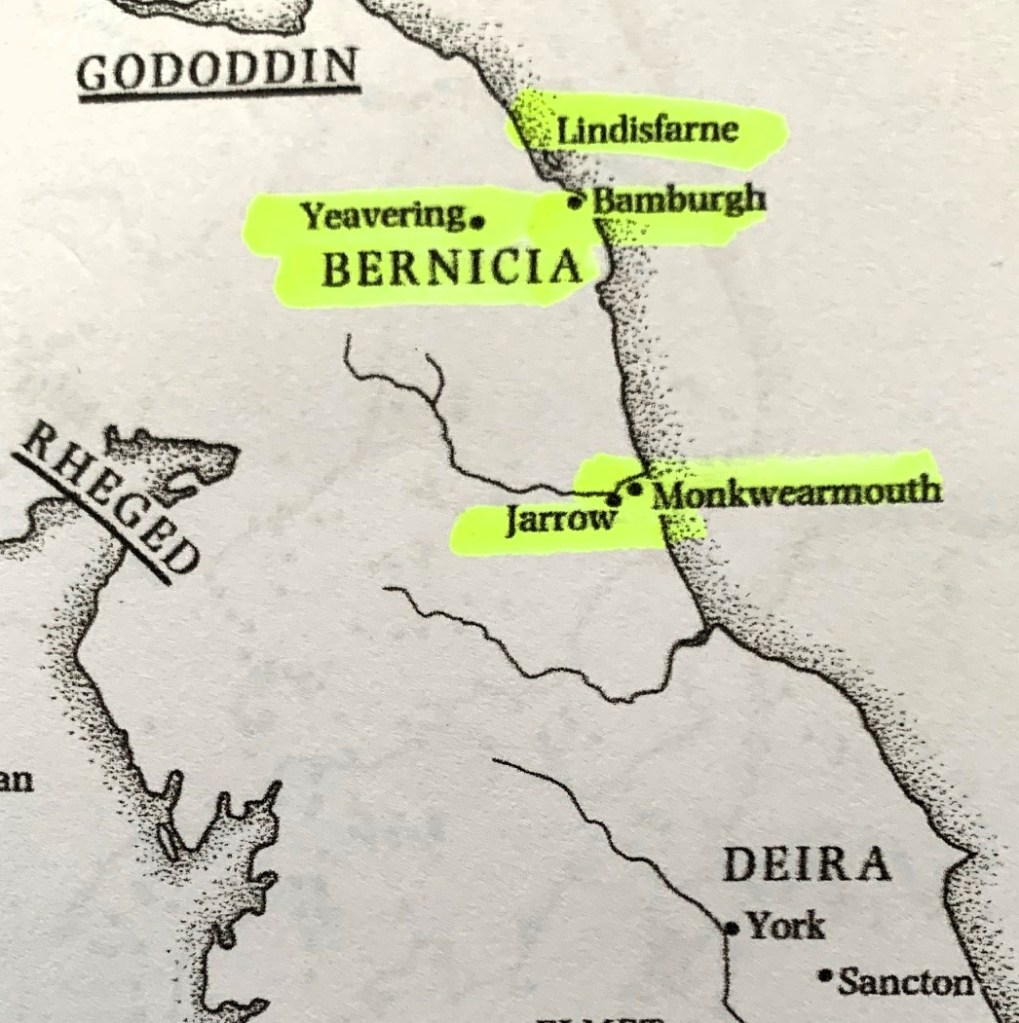
Above: c.600: Important Northumbrian centres.
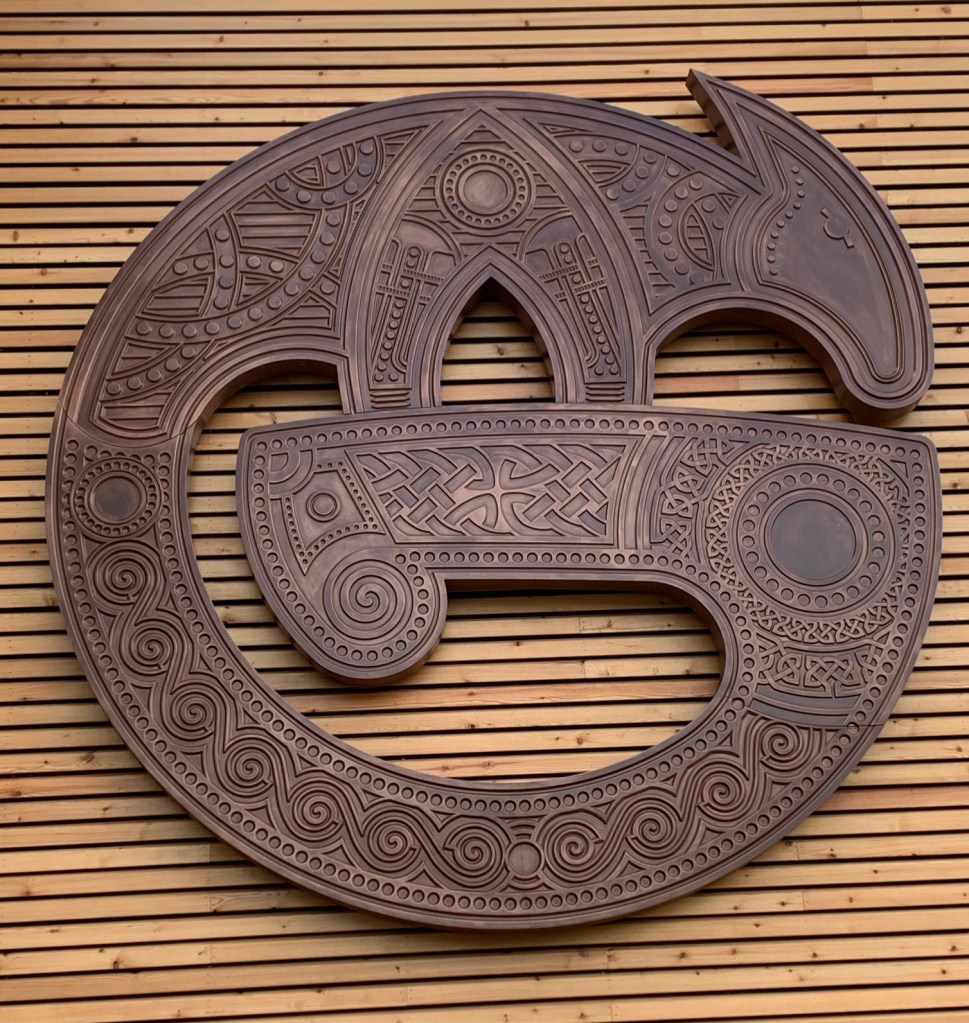
Above: The modern day logo of Ad Gefrin, Yeavering and Wooler, Northumberland (Courtesy of The Gefrin Trust)
In 548AD, an Anglo-Saxon family established a royal dynasty, founded on military conquest, in Bernicia (north Northumberland) and made the centre of their kingdom at Bamburgh. Its kings were Aethelfrith, Edwin, Aethelburga, Oswald and Oswy. For over a century, these kings ruled from Bamburgh with a summer royal palace at Ad Gefrin (Yeavering). By 700AD, it is understood that the once extensive settlement at Yeavering lay deserted.[4]
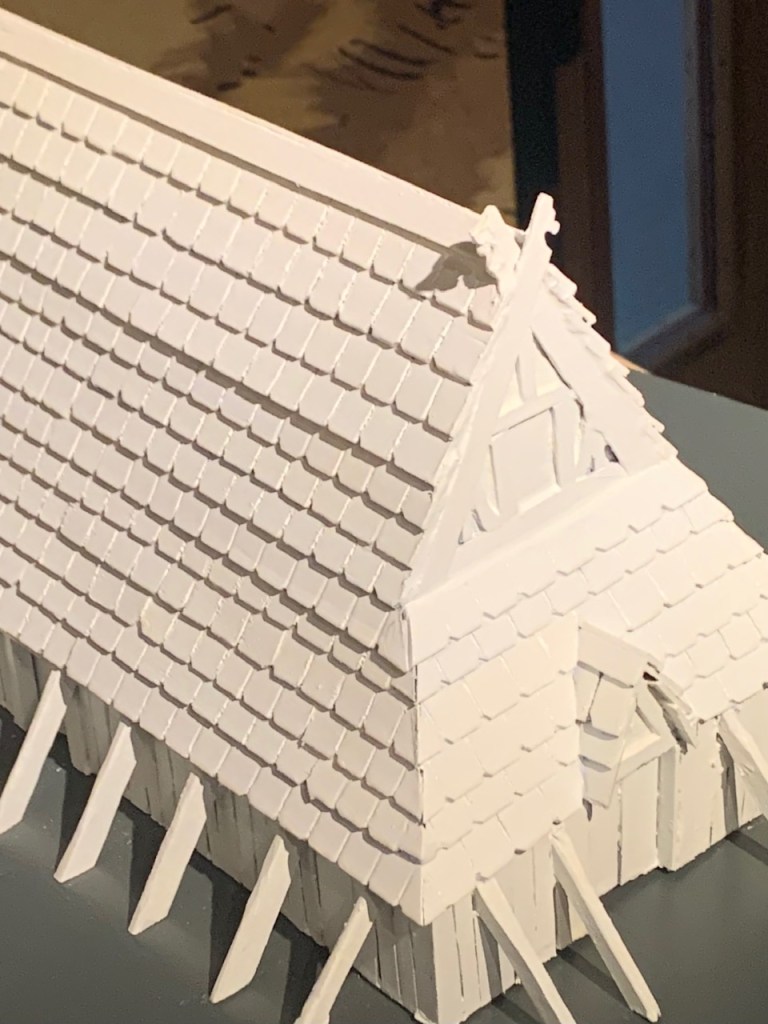
Above: A model of the Great Hall at Yeavering: This building was the focus for gatherings, feasts and story-telling, central to the royal power on the 7th century. (The Gefrin Trust)

Above: A reproduction of the thrones within the Great Hall. (The Gefrin Trust)
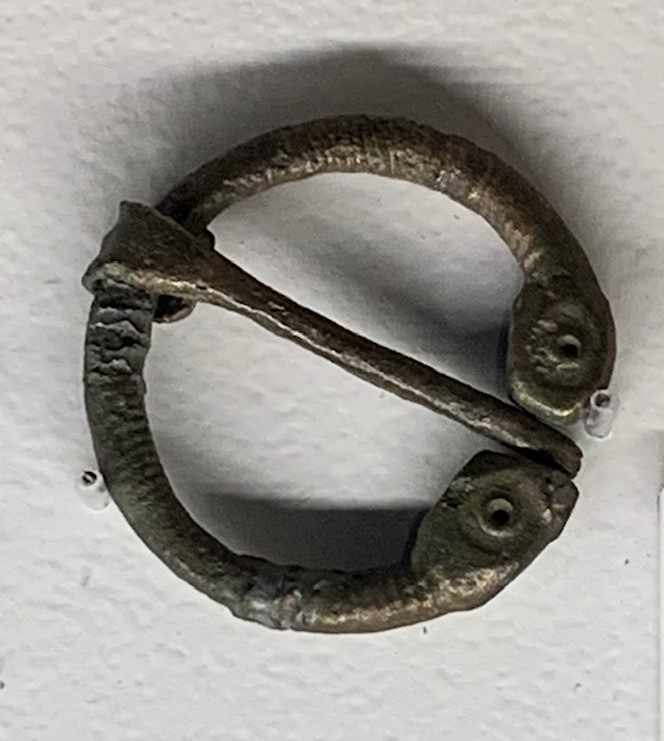
Above: 6th or 7th century, a circular brooch, a traditional Celtic fastening for clothing found at Wooler, Northumberland. (The Gefrin Trust)

Above: 7th century sword pommel mount found in Northumberland. Swords were the sign of an elite Anglo-Saxon warrior. The gilded garnet set pieces of this pyramid mount would have decorated the end of a sword grip, called the pommel. (The Gefrin Trust)

Above: A glass claw beaker found at Castle Eden, Co. Durham and held in the British Museum. This vessel was imported to Northumbria from modern day Germany and would have been the height of sophistication at an Anglo-Saxon feast. The blue and green vessel came from recycling rare Roman glass. (The Gefrin Trust)
Lindisfarne became an influential community allied to the Bernician kings of Northumbria based at Bamburgh. Northumbria had a central role in the birth of English Christianity and was home to 2 influential Christian figures, Cuthbert (c.635-687) and Bede (690-735AD):
- Cuthbert entered monastic life in his teens at Melrose. In 664, he was made Prior of Lindisfarne, becoming Bishop in 685. (When was he made a saint?)
- Bede spent his life at monasteries at Jarrow and Monkwearmouth and introduced the concept of time before and after the life of Christ. He was responsible for writing an English history.
An enduring symbol of Northumbrian influence are the Lindisfarne Gospels which were created about 700, almost certainly by Eadfrith who was Bishop of Lindisfarne from 698 to 722. They are dedicated to the glory of God and St. Cuthbert. [5]
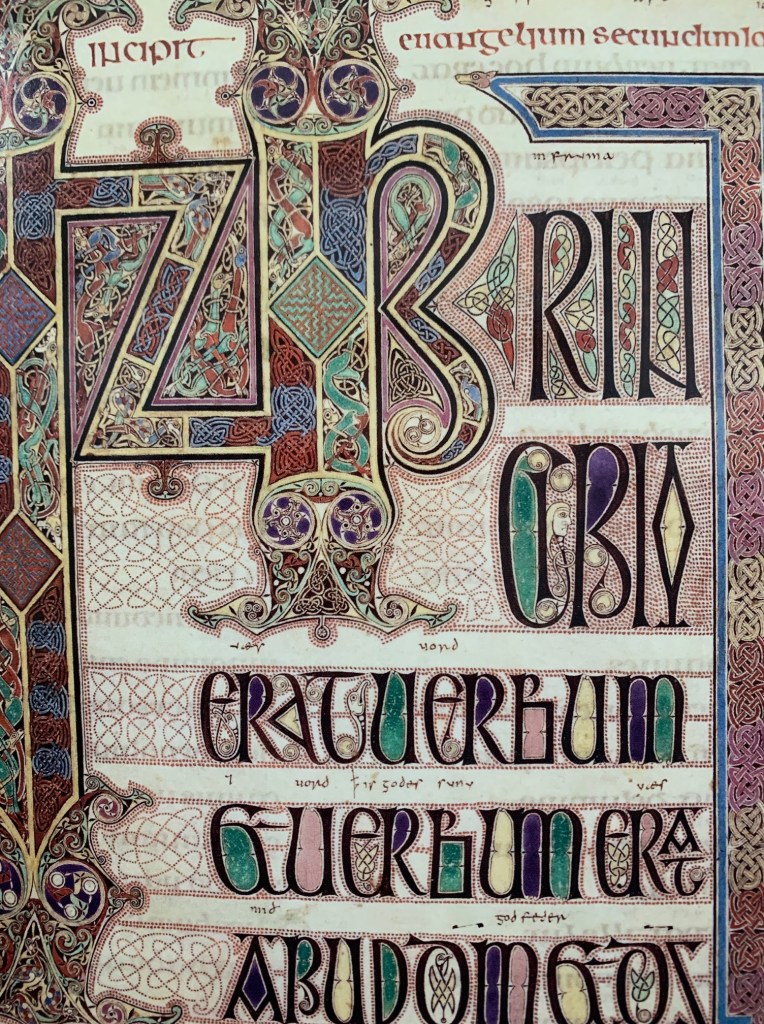
Above: A detail from Luke Incipit Page, the Lindisfarne Gospels (British Library Board)

Above: St. Cuthbert in prayer (British Library Board)
The plan below shows diocesan boundaries. In Northumbria, Hexham was the centre (known as an “Episcopal See”). About 672-674AD, the Northumbrian Queen Etheldreda granted Bishop Wilfrid the lands of Hexhamshire to build a new Benedictine monastery and by 678, Wilfrid’s priory church of St. Andrew was completed. The original Saxon crypt is still in use today.[6]

Above: Early dioceses and ministers to about 850AD
In 1832, a major find was unearthed at Hexham Abbey near the abbey wall – a bronze bucket which contained about 8,000 Northumbrian 9th century coins (stycas), now housed in the British Museum (but apparently not on public display). There were more Anglo-Saxons coins in this find than have survived from the whole of southern England before 900.[7]

Above: The bronze Hexham bucket
The nearest known evidence of Anglo-Saxon occupation to Evenwood are the following:
Escomb – The evidence is compelling. The tiny Anglo-Saxon church (nave 24ft 6in x 14ft 6 in) is almost certainly 7th or 8th Century, some believe it dates from 670AD.[8] It could well have been a private church. Bede records that two Northumbrian noblemen built private churches on their estates,[9] evidently not specifying names or location.
Above: 1897 OS plan showing St. John’s Church, Escomb – the Saxon Church
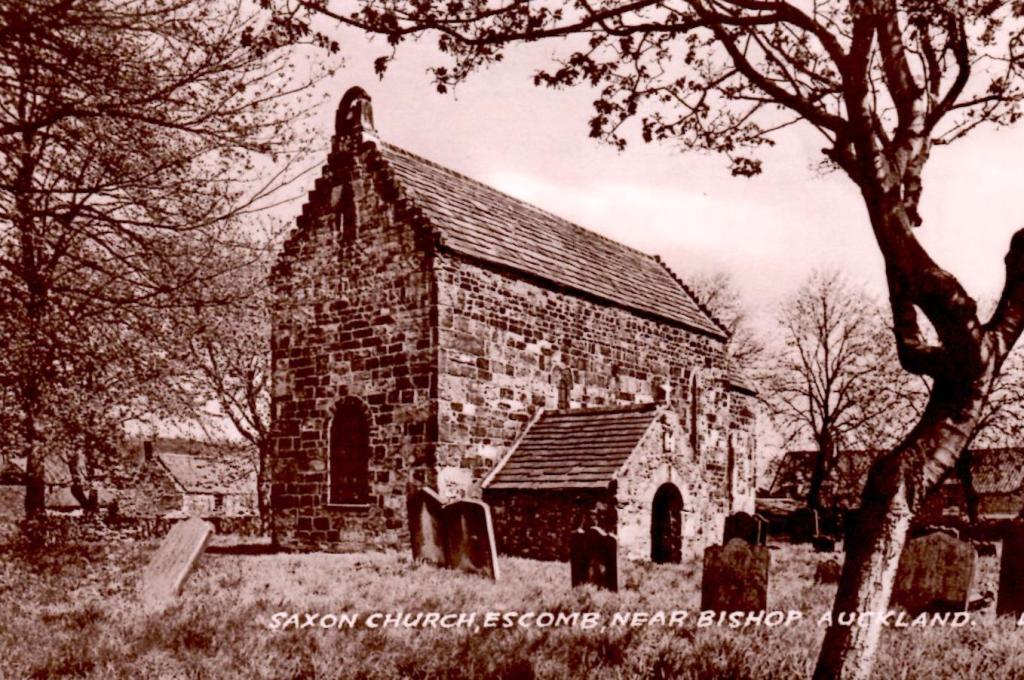
Above: A postcard image of the Saxon Church at Escomb
St. Andrew’s Church: There may have been a second settlement, perhaps a monastery near St. Andrews Church (located at South Church, Bishop Auckland). There are fragments of a 9th Century cross (perhaps earlier). There is an unknown monastery described in a poem by Aethelwulf which could be this site. [10]
Legs Cross, Bolam: This monument includes a mid-9th century cross which is situated in a field to the west of the roman road known as Dere Street (B6275) and about 50m south of the crossroads with a minor road, one spur of which leads to the village of Bolam. It is composed of sandstone and stands 2.6m high. The cross reuses the position of a Roman milestone, the foundation of which is no longer evident. The cross is listed Grade II*. [11]
Anglo-Saxon Place Names [12]
The Anglo-Saxons left their mark in the names of villages. The word “ley” meant a clearing, therefore:
- Copley was the clearing on the peaked hill
- Morley was the clearing on the moor
- Etherley was the clearing that belongs to Eadred
Other local village names are believed to be:
- Cockfield was the field belonging to an Anglo-Saxon called Cocca
- Butterknowle was a hill that had rich pasture, so the Anglo-Saxon cows produced good butter
- Evenwood was the wood on flat ground
- Wackerfield the watch-field
- Wham was (and still is) a hamlet
Did Evenwood exist at this time?
Evenwood as a settlement probably did not exist since there is no archaeological evidence – there are no Anglo-Saxon burials and no coin finds. At Cockfield Fell, there are enclosures which are thought to be of prehistoric or Romano-British origin. It is understood that no archaeological excavation has taken place so speculation remains.
[1] “The Anglo-Saxons” 1982 J. Campbell, E. John & P. Wormald edited by J. Campbell
[2] “The Venerable Bede” 1955 C.J.Stranks
[3] Campbell p.71 map figure 72
[4] Yeavering – Rediscovering the Landscape of the Northumbrian Kings” 2009 The Gefrin Trust. The museum at Wooler and the site at Yeavering are highly recommended and worth a visit.
[5] Lindisfarne Gospels Exhibition Guide 2013
[6] https://www.hexhamabbey.org.uk/heritage/timeline.htm#c845-860
[7] Campbell p.138 and https://en.wikipedia.org/wiki/Hexham_Hoard
[8] Simpson p.46
[9] Campbell p.88
[10] Campbell p.112 & 113
[11] https://historicengland.org.uk/listing/the-list/list-entry/1018638?section=official-list-entry
[12] https://www.thenorthernecho.co.uk/news/8233368.cockfield-fell-12-000-years-history/
 EVENWOOD RAMSHAW & DISTRICT HISTORY SOCIETY