The good folks of Evenwood opened up their homes to the children of Tyneside, particularly those from Hebburn. The industrial areas of Britain were subject to bombing raids from the German air force, the Luftwaffe and the British Government enforced a policy to remove children from this danger. They were moved to the rural areas where it was thought to be safer and free from attack. Evenwood families offered to help. There are 3 stories from Evenwood evacuees – Helen Smith, Ted Wilson and Jimmy Walton from Hebburn and another from Jim Atkinson who came up from Edmonton, Greater London to stay with relatives at Butterknowle.
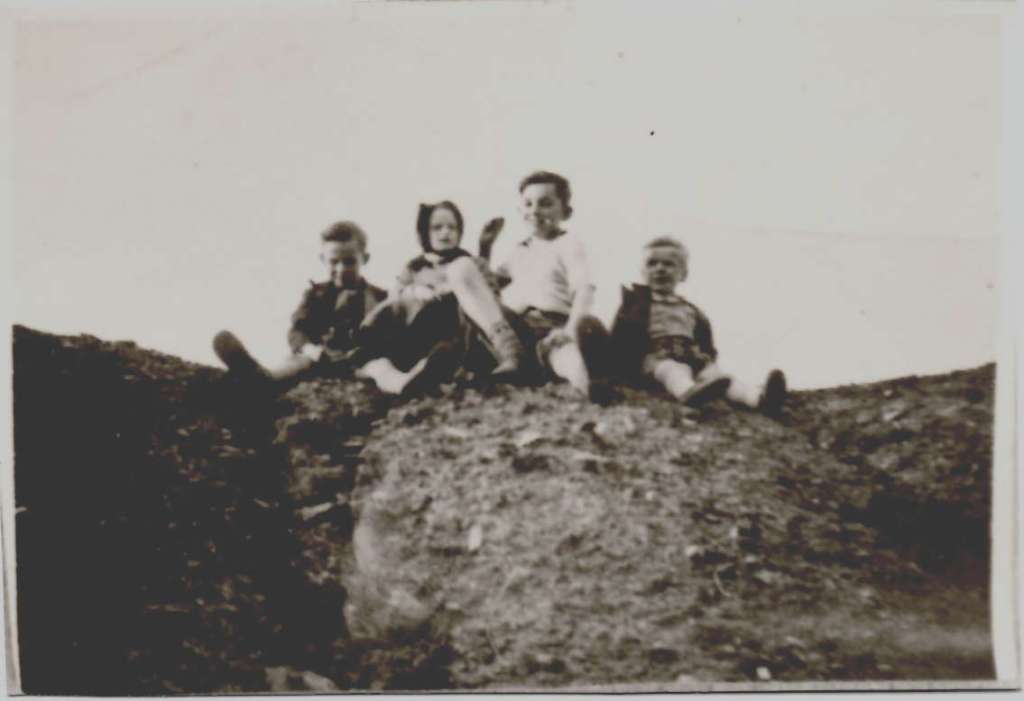
Above: Ian Brown from Copeland Row on the pitheaps with some children who were evacuees.
FROM HEBBURN TO EVENWOOD
“Then one night the noise from the bombers was unbearable even with our ear plugs in and there was a tremendous explosion. We knew there had been a direct hit but it wasn’t until next morning when the all clear sounded and we came out of the shelter it was revealed that the house at the end of our street had been bombed out. Thankfully the family had been in the air raid shelter. By this time, I had shelter cough and my hair was getting thin. Children from Jarrow, Hebburn and Newcastle had already been evacuated to the country and one day my mam said to me that she was taking me to Evenwood.”
Helen Smith, from Hebburn, stayed with the Clarkson family
MY LITTLE EVACUEES
“I really liked Evenwood in the winter months, sledging down the hills. One particular winter, 1940 I think, the snow had fallen and it was about 4 feet deep. We had to shovel our way out of the back door to get to the back yard toilet, which I had never seen the likes of before as they are also used for household ashes. The council workers came once a week, opened a door from outside and with big shovels cleaned them out. The first time it happened when I was sitting there – I felt a very cold draft and got the shock of my life when I realised!
After the war, Mr and Mrs Collinson came to stay with us for a few days. When she saw us she said, “You are my little evacuees.” They had one son, Maurice, who was in the forces, aged about 20-25…we met Maurice on one occasion when he came home on leave. Sorry to say he was killed a while later on duty.”
Ted Wilson from Hebburn, stayed with the Collinson family. The full article was originally on a BBC People’s War website but has been discontinued. ER&DHS has a transcript if anyone is interested in reading it.
Private Maurice Collinson, 2nd Battalion, Parachute Regiment was killed in action 14 July 1943 aged 20. He was the son of Robert and Alice Collinson.
AN EVACUEE’S STORY
“Just before my 18th birthday and when I was still living with Mr. and Mrs. Hutchinson, (who had by now another son called Arthur, this little boy died when he was only 9 years old), I received my call-up papers for the Army. Before I was sent off to do my training, I was drafted to go down the pit as a Bevin Boy. The name Bevin comes from the Minister of Labour and National Service, at the time, who was called Ernest Bevin. Coal was in great demand. It was needed to help with the war effort and lots of boys were sent down the mines to work instead of going into the Armed Forces. People came from all over the country to work at Randolph Colliery and at its height, it had over 2,000 people working there. Even when the war was over, I continued working at the pit. I liked the area very much and had made lots of new friends.
I decided to stay and not return to my home in Hebburn. Many evacuees did return home at the end of the war and some returned home before the war ended when they had left school. They went to look for work nearer home because very often it was better paid and there were more jobs to choose from.
In 1952, I married my wife Doris, who I had met a few years earlier, so now was well and truly settled.

It was now that I left the home of Mr. and Mrs. Hutchinson, who by this time had a little girl called Joyce. I lived with them for 13 years. For a little while I lived at Cockfield then I came back to live in Evenwood.
I had quite a number of accidents while at work including a broken leg, a crushed hand and back injuries. In 1954, I was transferred to another local pit called Staindrop Field House. This was situated between Evenwood Gate and West Auckland. Here, I was given a job above ground. This was also the year my son Alan was born. I continued to work at Staindrop Field House until 1967 when the pit was closed and I was made redundant.
I then went to work at Bishop Auckland Grammar School as a groundsman. Here, I stayed for 12 years when I was forced to retire due toil health.
Now at the age of 71, I live in Fairfield, enjoying retirement with my wife and family, gaining great pleasure from my 2 grandsons.”
Mr. James Walton, written by Joanne Maddison as told by my father Alan Walton.
A LONDON BOY IN BUTTONHOLE (BUTTERKNOWLE)
“I remember it was difficult trying to find something to do all day as we had to play out. I used to dig paths in the fresh snow in the adjacent field. I don’t think I’ll ever forget how cold it was. I sometimes used to wander up to the next farm who kept cows to help him clean the cow sheds out, I learned a valuable lesson one day, after cleaning out I saw a cow lift its tail I quickly put a shovel underneath, big mistake! I won’t go into the result only that I was in trouble when I got home. When we could get into the village, I used to spend hours sledging I enjoyed that.”
Jim Atkinson from Edmonton, Greater London related to the Parmley & Close families and stayed at Butterknowle or Buttonhole as he remembers it.
 EVENWOOD RAMSHAW & DISTRICT HISTORY SOCIETY