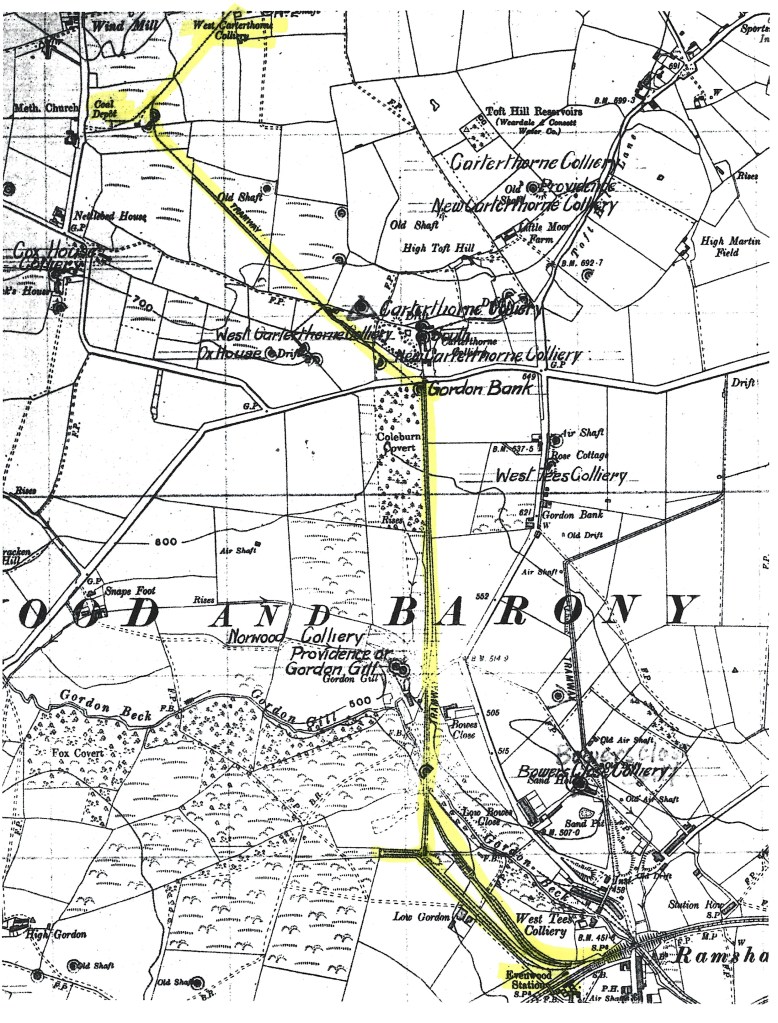
To the east of Evenwood Station there was a junction which connected a tramway from Carterthorne and West Carterthorne Collieries to the NER Bishop Auckland to Barnard Castle line. The area around Toft Hill Hall, Wind Mill and Cock’s House had been worked for coal for many years by small scale concerns but it seems that once Andrew Mein and George Bradford got involved then mining expanded to a more intensive, commercial level. Andrew Mein (1831-1905) and his son, Henry Johnson Mein (1854-1920) developed Carterthorne Colliery. West Carterthorne Colliery was operated by George Bradford (1845-1918) and his son Thomas A. Bradford (1886-1966). Both enterprises were worked during the late 1890’s and into the 1920’s. The tramways serving these collieries ran alongside each other. Both were closed by about 1927.
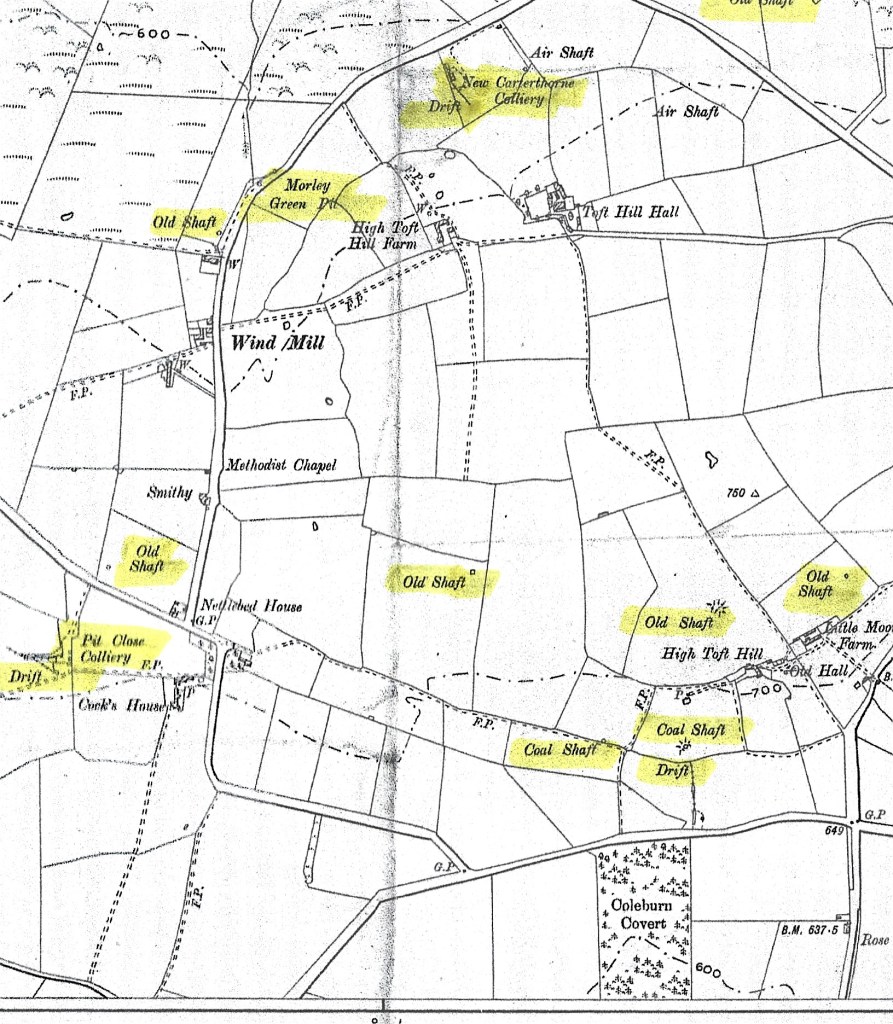
Comparison of the 2 maps below clearly indicates that both collieries were developed over the period, 1898 to 1924.
Below: about 1898 (surveyed 1856, revised 1896, published 1898) A plan to show coal workings in the area.
Below: about 1924: A plan to show the tramways from West Carterthorne and Carterthorne Collieries to the junction with the NER Bishop Auckland to Barnard Castle Line, near Evenwood Station.
Below: about 1924, the tramway is to the right of the photo, behind the platform.

CARTERTHORNE COLLIERY AND THE MEIN FAMILY
This section will look at the 2 Mein family members who were influential in this, namely Andrew Mein (1831-1905) and his son, Henry Johnson Mein (1854-1920). Both were Northumberland men born into coal mining and both moved south to County Durham to further their careers.
Andrew Mein was born at Blyth, Northumberland. In 1853, he married Ann Brown at Tynemouth and they had 7 children. Andrew was a coal miner who progressed to be an “Overman”. He moved to south west Durham and by 1882, was manager at Shildon Colliery for the Shildon Coal Co. Between 1883 and 1890, he was manager at Morley Colliery with James Mein, his son, as under manager. In 1891, Andrew and his family lived at Morley. He was recorded as, “Colliery Owner and farmer”. At this time, Morley Colliery was worked by a drift, yielding 30,000 tons pa and employing 40 men and boys. In November 1893, it closed when the Brockwell seam was abandoned.
Below: Andrew Mein

Andrew’s wife, Ann died 1 January 1897, aged 66. By 1901, 69 years old Andrew was a boarder at the Clarenden boarding house, Ventnor, Isle of Wight, perhaps on holiday. His regular abode was Hartford House, Witton-le-Wear. Andrew died 8 June 1905, aged 73 and is buried in St. Cuthbert’s Churchyard, Etherley, Bishop Auckland.
Andrew’s oldest son, Henry Johnson Mein (1854-1920), was born at Seaton Deleval, Northumberland and he followed his father into colliery management, being “certified” as a mining engineer in 1877. He also moved to County Durham and in 1882, was employed as the manager at Middle Bitchburn Colliery at North Bitchburn. Between 1888 and 1890, his brother Andrew Mein junior was under manager. In 1891, both Henry and Andrew (junior) lived at Howden-le-Wear, near to the colliery. In 1896, Henry Mein was employed as manager at Coppy Crooks, Etherley Grange and Woodhouses Collieries in the Bishop Auckland area. By 1901, he had moved to Toft Hill and in 1902, he was recorded as the manager at Carterthorne and Coppy Crooks Collieries. When his father died in 1905, he succeeded him as director of the Carterthorne Colliery Company and the South Normanton Coal Company Limited with interests in Derbyshire.
Below: South Normanton Colliery Owners: Left to right: Andrew Main senior, unknown, Andrew Mein Junior, unknown, unknown, James; Henry Johnson Mein; unknown; William Harford Mein.

For the next 16 years, he held positions as either agent or colliery manager for Carterthorne Colliery Co. Ltd., West Durham Wallsend Coal Co. Ltd. and the Spoor Bros. Colliery Ltd. at their Carterthorne, Adelaide and Coppy Crooks Collieries.
In 1911, 56 years old Henry Mein and his wife Annie lived at The Hall, Toft Hill with 6 of their children:
- Elizabeth, aged 28, born at Howden-le-Wear
- Annie aged 25, born at Hamsterley
- Florrie aged 24, born at Howden-le-Wear
- Dora aged 22 born, at Howden-le-Wear
- Henry J. (junior) aged 20 born, at Howden-le-Wear, a mining student
- Maggie aged 12, born at Toft Hill
Henry and Annie suffered personal tragedy when 2 of their daughters died – Florence 18 September 1914 and Dora, 13 March 1915. Henry Mein retired in 1916 and was succeeded by George Daykin.
Below: Henry J. Mein

Below: 1921 (Revised 1915) Carterthorne Colliery

WEST CARTERTHORNE COLLIERY AND THE BRADFORD FAMILY
George Bradford (1845-1918) was born at Chirnside, 7 miles west of Berwick-on-Tweed, the youngest of 3 brothers, born into an agricultural family. George was educated at Houghton-le-Spring Grammar School and served his mining apprenticeship in the Earl of Durham’s Lambton Collieries. In 1873, George Bradford was awarded his Managers Certificate while working at Newbottle Colliery. In 1875, he was appointed by Stobart’s as colliery manager at Etherley Jane and George Collieries at Witton Park and Escomb. He was promoted to be the company’s agent, responsible for the company’s collieries at Etherley George North & South, Etherley Jane, Lands, Morley Green, Newton Cap A & B, and Railey Fell. In 1885, at the age of 40, George Bradford married 26 years old Amy Andrews (1859-1951). She came from Kent and they made their home at Carwood House, Witton Park. A son Thomas Andrews Bradford was born, March 1886, followed by 3 brothers, namely George Nicholson April 1887, James Barker December 1889 and Roland Boys February 1892. In 1894, the family moved to Morton Palms Farm, Darlington.
Below: 1885, George and Amy Bradford

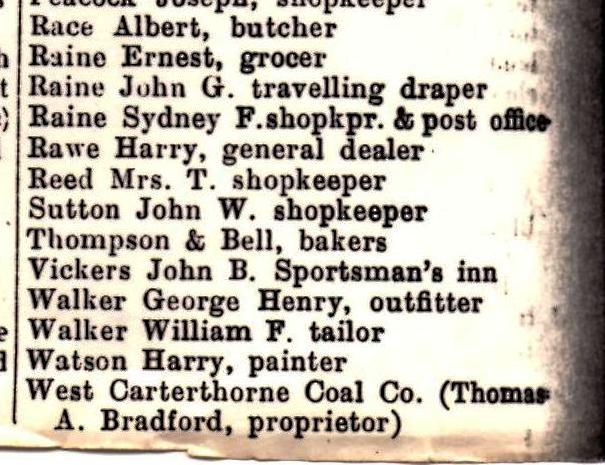
By 1900, George Bradford was manager at West Carterthorne Coal Company, a position he held until, at least 1910. In 1914, his son Thomas A. Bradford was recorded as proprietor of the West Carterthorne Colliery Co.
Below: 1914, Extract from Kelly’s Directory
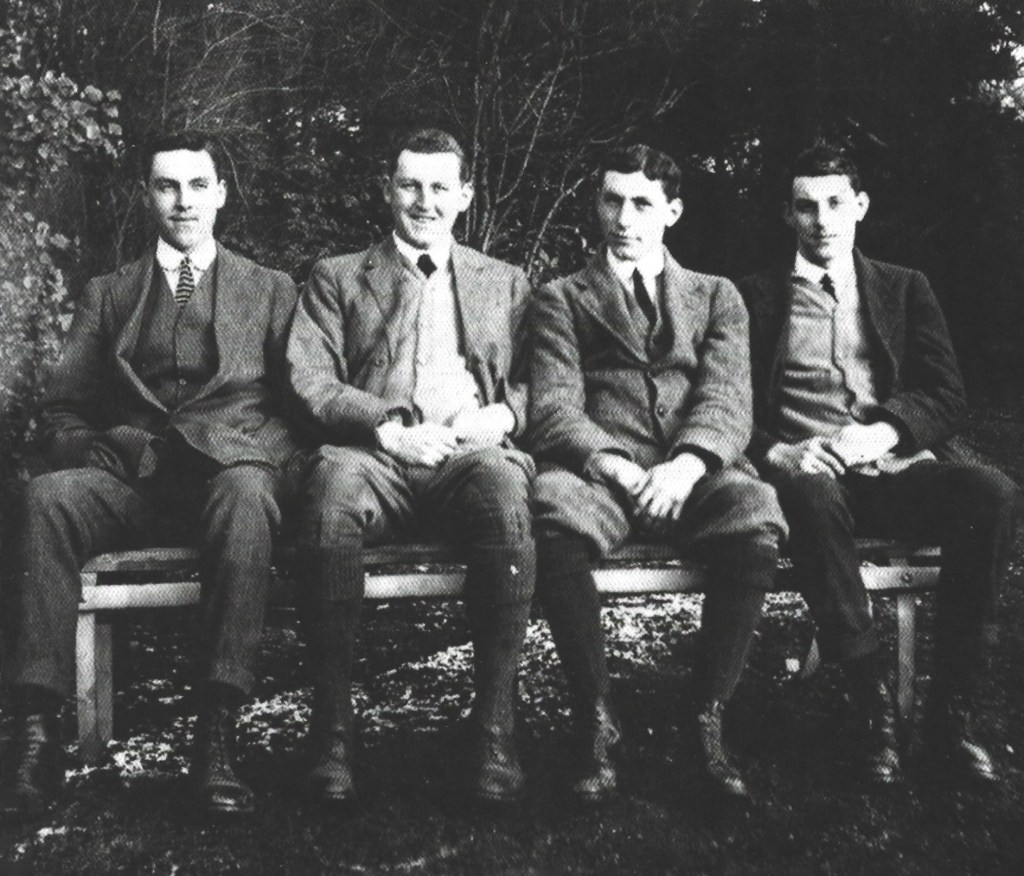
Below: 1914 Roland, Thomas, George and James Bradford at Milbanke House, Darlington
By 1914, G.G. Robson was the manager at West Carterthorne. He had previously worked for the Consett Iron Co. Ltd.’s Westwood Colliery and the Butterknowle Colliery Co. Ltd.’s 8 pits to the west of the area. By 1914, West Carterthorne Colliery employed 62 men underground and 16 above. By 1919, S.T. Brass was manager.
With the international situation worsening, those in the Territorial Forces, such as Thomas Bradford, concentrated their efforts on military affairs and his role with the West Carterthorne Coal Co. probably diminished and others such as G.G. Robson were engaged to look after their mining interests. Thomas Bradford had joined the 4th Volunteer Battalion, the Durham Light Infantry (DLI) and received a commission as a Second Lieutenant in 1906, being promoted to First Lieutenant that year. Under the army reforms of 1908, the battalion became the 8th Battalion, DLI (Territorial Force). He was promoted to Captain in 1910 and commanded “D” Company. At the outbreak of war, Thomas being a captain with 8/DLI, was mobilised as part of the Durham Brigade, the Northumbrian Infantry Division (later 151 Brigade, 50th Northumbrian Division). The Division left for France 19 April 1915 and saw action at the Second Battle of Ypres and various positions on the Ypres Salient. By 1916, Thomas had already been awarded the Distinguished Service Order for service in the field and been Mentioned in Despatches on 2 separate occasions. Whilst on leave, in 1916, Thomas Bradford married Rebe Blackett. The 4 Bradford brothers found themselves in the most ferocious battles of World War One – Ypres, the Somme, Zeebrugge. They served with exceptional heroism in the DLI and the Royal Navy. Between them, they were awarded 2 Military Crosses and a DSO, and George and Roland were the only brothers in WW1 to receive the Victoria Cross. Within a year, three of them were dead. Only Thomas survived the war. Lest we Forget.
Below: Captain T.A. Bradford

Below: 1921 (Revised 1915) West Carterthorne Colliery and tramway to Carterthorne Colliery.

Post War
After the war, Carterthorne and West Carterthorne Collieries continued working but they appear to have closed in 1927. The Five Quarter and Brockwell seams were abandoned at Carterthorne. These seams together with the Main coal seam were abandoned at this time at West Carterthorne Colliery.
Aged 66, Henry J. Mein died 7 November 1920 and he is buried in St. Cuthbert’s Churchyard, Etherley. He left his estate, worth about £23,920, to his widow Annie, William Hartford Mein (colliery secretary) and Hugh Roddam (solicitor). His personal interests revolved around his faith – he was a Primitive Methodist lay preacher, steward of the West Auckland circuit and held every official position open to laymen. He was also a justice of the peace and, from May 1912, a county judge. About a month later, 20 December 1920, his son, Henry Johnson Mein (the younger) of Hartford House, Witton-le-Wear, died at the Hall, Toft Hill. His effects, about £3,688 were left to his widow Mary Constance Mein. Henry’s widow, Annie Mein died 18 October 1924. It appears that after the death of senior members of the Mein family namely Andrew (senior), Henry (senior), Henry (the younger) and Annie, together with the closure of Carterthorne Colliery in 1927, the surviving members settled in Derbyshire and concentrated their commercial interests on the South Normanton Coal Company Limited. Evidence of this may be that when the above mentioned William Hartford Mein died 14 February 1946, he lived at Storthfield South, Normanton near Alfreton, Derbyshire. His estate, about £27,376, was left to his widow Barbara Jane Mein, Henry Jameson Mein (colliery secretary) and 2 others.
Thomas Bradford most likely kept his commercial interest in the West Carterthorne Colliery until its closure. His major commercial interest was his directorship with Charlow and Sacriston Collieries. Thomas unsuccessfully entered politics. He stood as a Conservative, suffering defeats at the 1922 and 1923 elections. In 1939, he was knighted and in 1942, he served as High Sheriff for County Durham. Thomas held many other civil and military positions in the county. He died, aged 80 in 1966.
By 1939, little was left of the extensive tramway and its junction near Evenwood Station.
Below: 1939: Evenwood Station and area to the north over which ran the tramways.

Acknowledgements
“The Fighting Bradfords, Northern Heroes of World War One.” 2003 Harry Moses
Durham Mining Museum website
Ancestry family tree for the Mein family
 EVENWOOD RAMSHAW & DISTRICT HISTORY SOCIETY