Munitions factories relied heavily on women. For instance, Royal Ordnance Factory (ROF) Aycliffe was built at Heighington Lane, Aycliffe, County Durham during the early 1940’s. It opened as ROF 59 (Filling Factory 8) in the spring of 1941. It operated 24 hours a day, employing some 17,000 workers in three shift groups and was operational for just over 4 years until the end of World War II in 1945, by which point it had produced some 700 million bullets and countless other munitions. The factory was designated as a “Top Secret” installation and surrounded by high fences with barbed wire. During its existence, the factory produced millions of finished munitions including bullets, shells and mines. 17,000 women came from the surrounding towns and villages to work at the factory, filling shells and bullets and assembling detonators and fuses for the war effort. Workers were transported from surrounding areas onto the factory site by bus and train, with the most local workers arriving on foot or by bicycle.
The workers were mainly women and became known as the “Aycliffe Angels”. The name comes from William Joyce, known as Lord Haw Haw who was an American traitor working for the Nazis during World War II. Joyce broadcast Nazi propaganda over medium and short wave radio to Britain and the United States. In numerous broadcasts he had said, “The little angels of Aycliffe won’t get away with it” and promising that the Luftwaffe would bomb them into submission.
By its nature the work was very dangerous and many workers were killed and injured during the manufacturing process however due to the secrecy surrounding the factory and its workers, many incidents went unrecorded and unreported in the news.
Below are 3 stories about the Aycliffe Munitions Factory
“I was the youngest Aycliffe Angel” by Eric Welsh
My claim to fame is that I was the youngest Aycliffe Angel. In 1944, aged 14, I left Ramshaw School and my mam, Eva, got me a job at the Munitions Factory at Aycliffe. I worked in the entertainments department as the messenger boy and helped the E.N.S.A. staff (Entertainments National Service Association). I used to help with the props and might have been called a “stage-hand” if I was in Hollywood.
One day, I was given the job of opening and closing the stage curtains. Apparently the rope and pulley mechanism was broken and the curtains had to be dragged together to close them. At the end of the performance, I took one curtain and Olive Graham the other. The audience applauded wildly as we walked behind the curtains and met in the middle of the stage.
Olive walked off.
Expecting to be told to open the curtains again for the encore, I waited.
Suddenly, the curtains opened. Miraculously, the pulleys worked.
There I was, centre stage receiving the applause of the whole canteen.
“Give us a song Eric” shouted the girls.
Highly embarrassed, 14 years old Eric slunk off – “Exit, Stage Right!”
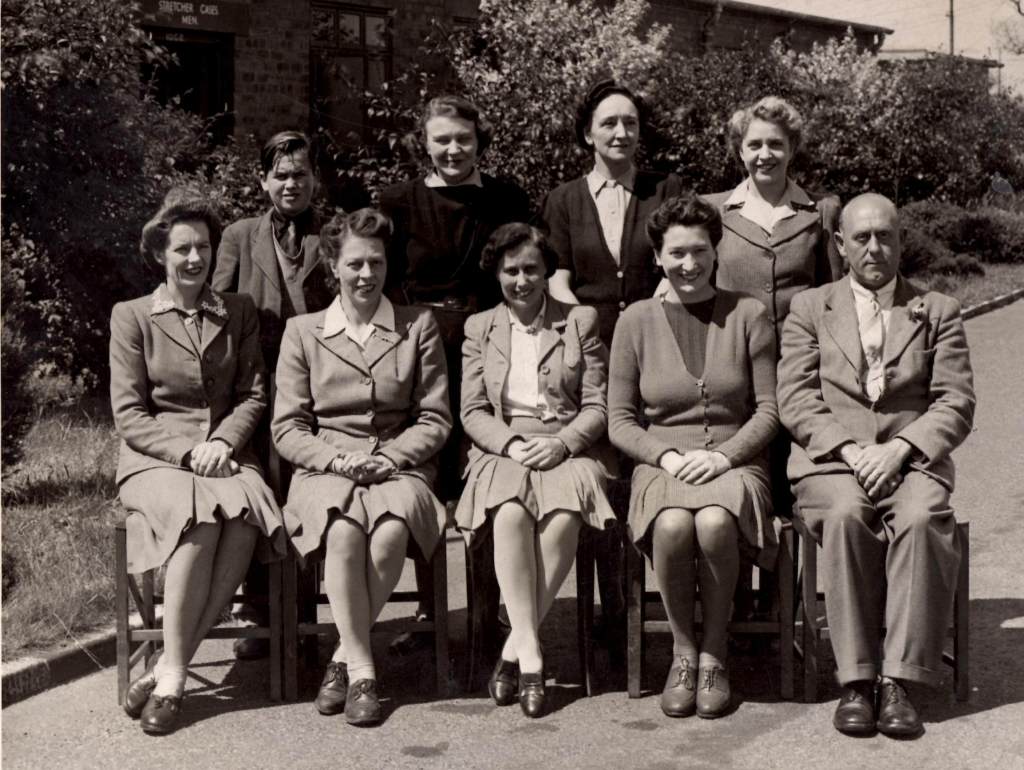
Above: Back row, far left Eric Welsh
An Aycliffe Angel (1941-45) by Nancy Horsman (nee Brown)
From the age of 18, I worked at Aycliffe Munitions Factory. My mother didn’t like me working there. I got my “non-schooling” education there! Woman and girls came from all over. Those lasses from West Hartlepool taught me a lot – I said nothing, just listened. I learnt an awful lot from them. Surely they exaggerated!
I asked my mam a question about miscarriage.
To which she answered:
“Is that all you buggers talk about at Aycliffe?”
She wasn’t happy.
I didn’t dare tell her the rest!
Nancy’s brother Private Raymond Brown, 10/DLI was killed in action, May 1940, aged 19.

Photo: Nancy Brown is third row, far right
An Aycliffe Angel by Doris Kay [nee Vickers]
I worked at Aycliffe for 18 months. I was lucky, I had an easy job – I checked over the ammunition. I suppose now it would be called “Quality Control”.
I worked with women and girls from Middlesbrough. They worked with the explosive materials and their complexions were yellow. They worked for the good money, their beer money. They were quite jolly, enjoyed singing while they worked. There were some rough diamonds among them but they were no bother really. They just enjoyed themselves.
At the end of the war, the Aycliffe Angels were presented with a certificate. This one , below, was presented to Ann Alderson who later married Fred Laverick.

 EVENWOOD RAMSHAW & DISTRICT HISTORY SOCIETY