Arthur Henderson was MP for Barnard Castle from 1903 to 1918. At the time, the constituency included Evenwood. Henderson was born in Glasgow and was one of the first working class MPs. He held the office of Secretary of the Labour Party for nearly 25 years. A key minister in the first two Labour governments, Henderson became Foreign Secretary in 1929. He served as leader of the Labour Party on 3 separate occasions in 3 different decades. He was popular among his colleagues, known as, “Uncle Arthur”, acknowledged for his integrity and devotion to the cause. Arthur Henderson was awarded the Nobel Peace Prize in 1934 for his dedication as President of the World Disarmament Conference.
Below: 1910: Arthur Henderson MP

POLITICAL CAREER
Poverty made it impossible for him to complete elementary education but thanks to his trade union commitment and work in the Methodist chapels, he qualified himself in a political career, beginning with union representation. His step father moved to Newcastle to seek employment and at the age of 12, the young Henderson was apprenticed as an iron moulder, first at Clarke’s then the renowned works of Robert Stephenson and Son.
- 1883: Joined the Friendly Society of Iron Founders.
- 1892: Elected onto Newcastle City Council.
- 1895: Agent of Sir Joseph Pease, Liberal MP for Barnard Castle.
- 1897: Elected onto Durham County Council.
- 1898: Elected onto Darlington Council.
- 1900: Henderson was one of the 129 trade union and socialist delegates who passed Keir Hardie’s motion to create the Labour Representation Committee (LCR).
- 1903: He was Major of Darlington and also elected MP for Barnard Castle at a by-election.
- 1904: Elected treasurer of the LCR.
- 1906: The LCR changed its name to the Labour Party and won 29 seats at the general election including Barnard Castle by an increased majority.
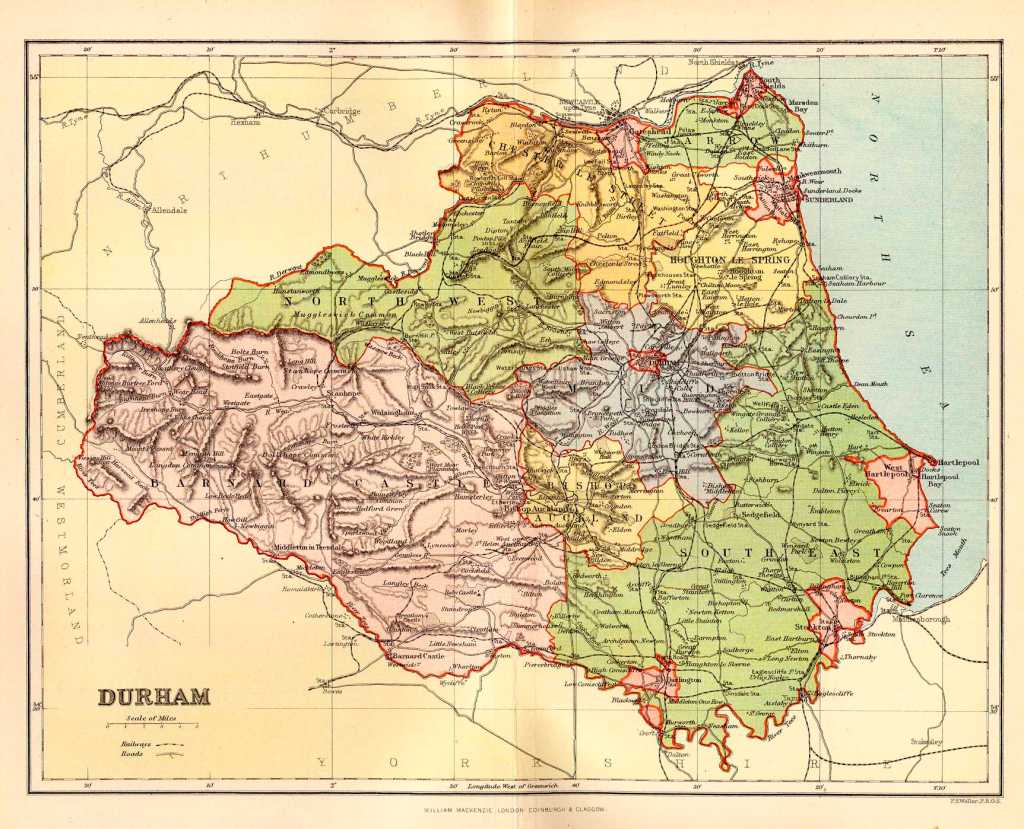
Below: Map to show the Parliamentary Constituencies in County Durham. The Barnard Castle constituency covered a huge area of west Durham including the Parish of Evenwood & Barony.
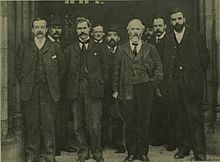
Below: 1906: Arthur Henderson with leading Labour figures, Ramsay MacDonald and Keir Hardie.
- 1908: Keir Hardie resigned as Leader of the Labour Party, Henderson was elected to replace him.
- 1910: Henderson resigned as Leader.
- 1914: When the Great War broke out, Ramsay MacDonald resigned as Leader of the Labour Party, in protest and Henderson was elected to replace him.
- 1915: PM Herbert Asquith decided to form a coalition government. Henderson was invited to be a member of the War Cabinet with the position of Minister without Portfolio.
- 1917: Henderson resigned after his suggestion for an international conference on the war was rejected by the rest of the Cabinet. He turned his attention to building a constituency based network for the Labour Party with Ramsay MacDonald and Sidney Webb.
- 1918: The Barnard Castle seat was divided into two. At the general election, Arthur Henderson stood at East Ham South and lost.
- 1919: Henderson won the Widnes by-election.
- 1922: He lost Widnes at the general election.
- 1923: Henderson won Newcastle East by-election in January but lost it in the October general election.
- 1923: Won the Burnley by-election.
- 1931: Elected Leader of the Labour Party, a position he held briefly.
- 1934: Awarded the Nobel Peace Prize
The inter-war years were turbulent in terms of the economy, industrial relations, nationalism, fascism and the rise of Italy and Germany which witnessed the Wall Street crash, much unemployment, poverty and culminated with the Second World War. Henderson served in the fledgling Labour governments as Home Secretary and Foreign Secretary. He was a strong supporter of the League of Nations and was one of the principle architects behind the organisation’s disarmament conference. He was elected to chair the conference and managed to keep negotiations going despite opposition from the great powers and from his own government.
HENDERSON IN EVENWOOD
With the rising influence of trade unions, the Independent Labour Party (ILP) formed in 1893 began to attract local support. In 1898, the representatives of the Miners Lodges of Randolph, Norwood, Railey Fell and Storey Lodge collieries supported the candidature of David Carrick in the interests of Labour for the seat on the Auckland Rural District Council. David Carrick was a Primitive Methodist preacher and not without influence. Following the death of the local Member of Parliament, Sir Joseph Whitwell Pease in 1903, a by-election was called for the Barnard Castle constituency. The constituency covered a huge area of west Durham including Weardale, Teesdale, the Gaunless Valley and the coal mining districts of Tow Law and Crook. This was to be the battleground for “associations” that represented the interests of “labour”. Arthur Henderson was put forward as a candidate for the election. He stood as an Independent. The Barnard Castle Labour and Progressive Association was formed to specifically to back his campaign. It consisted of disaffected Liberals, miners’ representatives and ILP members. All 3 sitting ILP MPs, Kier Hardie, Shackleton and Crooks visited the constituency to support Henderson and they spoke to enthusiastic crowds.
24 November 1903: Henderson won the by-election by just 47 votes from Vane, the Conservative. Following this landmark victory, Henderson addressed a “labour” meeting in Evenwood. Given that there were 9,502 votes cast in the election and there were about 3,700 miners working in the Gaunless Valley area (not all would have the vote) it is fair to assume that the majority put their weight behind Henderson and were largely responsible for his narrow victory. He needed to thank them. At this time, there were only 4 MPs with any “labour” interests.
1906: Henderson was re-elected and increased his majority to 1605. He held the seat until 1918 when the constituency was divided into two.
12 June 1909: Henderson was invited to Evenwood for the unveiling of the Randolph Durham Miners Union Lodge Banner. The unfurling ceremony took place on the village green outside the Miners’ Institute. Other dignitaries present were Alderman William House JP and President of the Durham Miners Association, Mr. Thomas Summerbell MP for Sunderland and Mr. James Robson County Councillor for Bear Park. William House came from West Auckland just down the road where he had worked at the Town End Pit and was a union official. He had risen to be an influential figure in the politics of the County. A public meeting was held in the evening and the question of relations with Germany was on the minds of many. The Auckland Chronicle, Thursday 17 June 1909, reported as follows:
“Answering the question as to why the members of the Labour Party visited Germany, Mr. Henderson said it was because of the ideals they held and the desires that actuated them….They went right through Germany and into the great centres and found that German people were not represented by the statements published in some newspapers of this country but that they were anxious to maintain those friendly relationships existing between two great countries…It appeared to him that if they only talked long enough about a war with Germany they would get it. He wanted them to talk long enough about peace and they would keep peace. (Applause.)
Below: June 1909: Evenwood, in front of the Randolph Miners’ Institute, the unfurling of the Randolph DMA banner. Arthur Henderson MP is seated 2nd from the left, under the banner.

Below: 17 June 1909 Auckland Chronicle press article relating to the unfurling of the Randolph DMA banner.

Five years later, communities across Europe and the wider world took part in the industrial slaughter that would become known as the Great War. Arthur Henderson would have been willing to “talk long enough about peace” in order to achieve peace. Evidently, others did not. Did Henderson support the war?
Yes.
Why? F.M. Leventhal provided the following reason:
“Stirred by the violation of Belgian neutrality, he accepted Grey’s rationalisations for British intervention. Despite his own pronouncements about Britain not being implicated in European quarrels, he could feel that the honour of the nation was involved in defending innocent Belgium. Whatever he had said in the past, there was now a higher duty as a British citizen which he could not evade. Nor was he surprised when his 3 sons joined the Honourable Artillery Company in September 1914.”
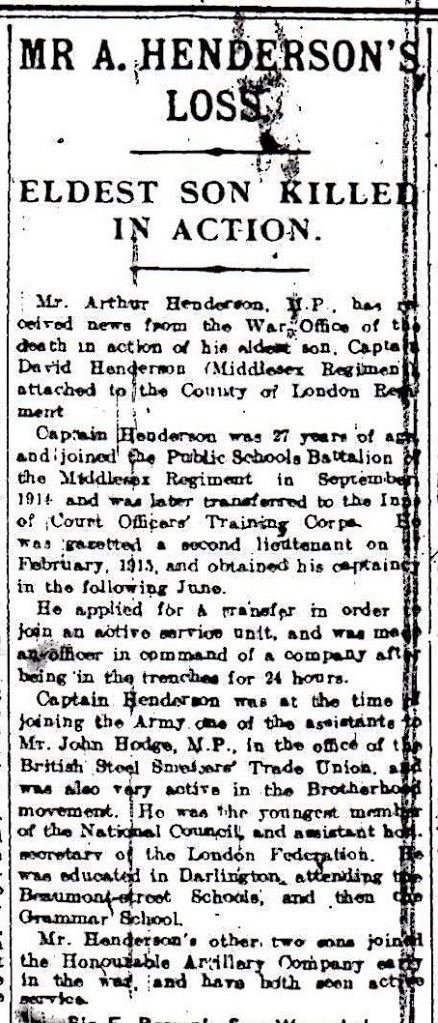
In fact, Arthur Henderson served in the War Cabinet and his 27 years old son, serving as Captain David Henderson, 8th Battalion, The Middlesex Regiment was killed in action 15 September 1916, on the Somme, France.
Below: Press article announcing the death of Arthur Henderson’s son, Captain David Henderson, 8/Middlesex.
FAMILY DETAILS
Arthur Henderson was born 13 September 1863 at Anderston, Glasgow, the son of Agnes Henderson. By 181, Agnes and her husband Robert Heath, a Yorkshireman from Ripon, lived at Elswick, Newcastle-upon-Tyne with 17 years old Arthur and 15 years old Agnes. Robert was employed as a labourer and Arthur as a, “moulder’s apprentice”.
1899: Arthur Henderson married Eleanor Watson (1865-1940). By 1891, Arthur and Eleanor lived at Arthur’s Hill, Newcastle-upon-Tyne with their 1 years old son, David. Arthur was recorded as being employed as a, “Iron Founder”. Eventually, Arthur and Eleanor had 4 children David (1889-1916), William (1891-1984), Arthur (1893-1968) and Eleanor (1896-1979). Eleanor and all the 4 children were born at Newcastle-upon-Tyne.
By 1901, the family lived at Windsor Terrace, Darlington. Arthur was 37 years old and his occupation was recorded as Magistrate (ruled out) and Political Registration Agent. By 1911, the family lived at Rodenhurst Road, Clapham Park, London. Arthur Henderson was employed as a “Parliamentary Representative & Trade Union Organiser”.
1935, October 20: Arthur Henderson died aged 72, at Marylebone, Middlesex, London. His ashes are laid to rest at Golders Green Crematorium, Barnet, Greater London. His home address was Victoria Street, Westminster, London and his effects were left to his son William (£23,927 which is over £2M today).
His 2 sons, William and Arthur followed him into politics.
Below: Commemoration to members of the Henderson family.

SOURCES
https://en.wikipedia.org/wiki/Arthur_Henderson
https://www.nobelprize.org/prizes/peace/1934/henderson/facts/
“Arthur Henderson” 1989 F.M. Leventhal
“Evenwood Remembers” 2009 K. Richardson
Find a Grave website
 EVENWOOD RAMSHAW & DISTRICT HISTORY SOCIETY