During the Great War, Britain was bombed from the air. Zeppelins wreaked terror across the coastal towns of the east and south east. Likewise, during the Spanish Civil War, the German Luftwaffe conducted air raids on Spanish towns. The British government saw the danger and prepared the nation for ordeals to come. Protective measures had to be taken including simple precautions. Important buildings were sandbagged and barrage balloons were introduced over built up areas and military installations.
Air Raid Precautions was an organisation dedicated to the protection of civilians from the danger of air-raids. It was originally created in 1924 as a response to fears about the growing threat from the development of bomber aircraft. In September 1935, the British Prime Minister, Stanley Baldwin, published a circular entitled, “Air Raid Precautions” which invited local authorities to make plans to protect their people in the event of a war. Some councils responded by arranging the building of public air raid shelters. These shelters were built of brick with roofs of reinforced concrete. However, some local authorities ignored the circular and in April 1937 the government decided to create an Air Raid Wardens’ Service and during the next year recruited around 200,000 volunteers.
Ultimately, there were around 1.4 million ARP wardens in Britain during the war, almost all unpaid part-time volunteers, who also held day-time jobs. They had a basic uniform consisting of a set of overalls and an armlet, along with a black steel helmet. The steel helmet had W for Warden in bold white writing across it, except for Chief Wardens who wore white helmets with black lettering.
The ARP was responsible for:
- sounding the air raid sirens
- the handing out of gas masks,
- distribution of pre-fabricated air-raid shelters (such as Anderson shelters, as well as Morrison shelters) for family use
- the upkeep of local public shelters
- the maintenance of the blackout
- assistance with the rescue of victims of bombing
Wardens were responsible for the sounding of air raid sirens. The Evenwood air raid siren was at Randolph Colliery. People were now expected to immediately take cover before the raid actually started. But where? Under the stairs or some people had an Anderson Shelter in the garden. There was a shelter at Ramshaw School. Were there any other air raid shelters?
Another siren was played to announce that it was safe to leave the air raid shelters.

Back Row: left to right: Jim McDonald (the undertaker) 5 unknown then John Bainbridge
Front Row: left to right: Rowland Nixon (bus driver) Tommy Bussey; unknown; Nora Welsh; Isaac Parkin; unknown; Mr. Daniel (the hairdresser).
Any help with names for the unknown people would be appreciated.
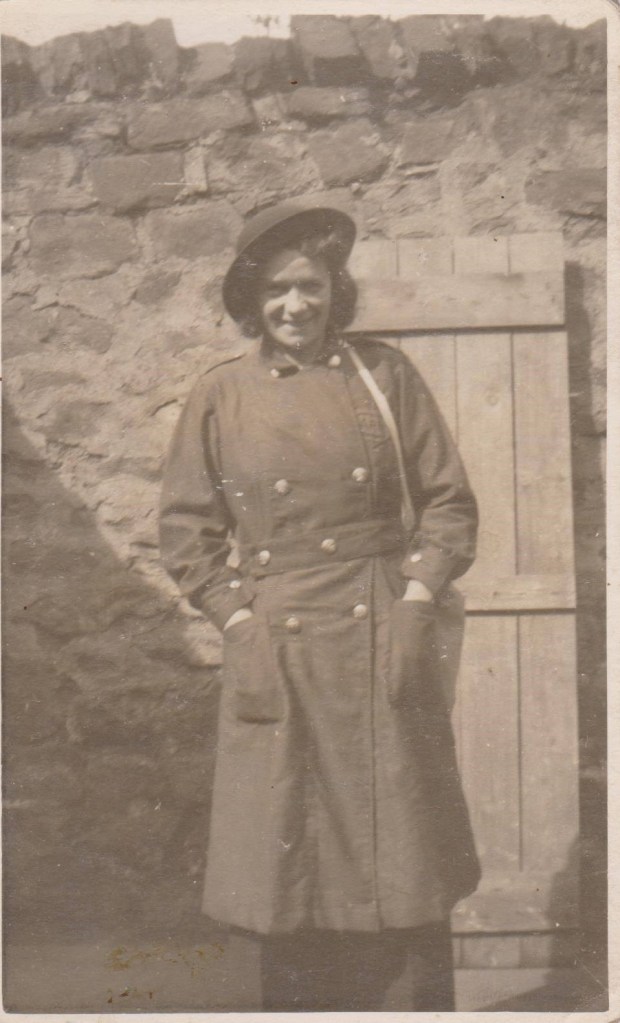
Above: Nora Welsh ARP.
Nora also worked at the Aycliffe ordnance factory, an “Aycliffe Angel.”
Sounding Air Raid Sirens
Wardens were responsible for the sounding of air raid sirens. People were now expected to immediately take cover before the raid actually started. Another siren was played to announce that it was safe to leave the air raid shelters.
Public Air Raid Shelters
As a first response to the threat of bombing in the late summer of 1939, trenches were dug around schools and factories for children and workers to take cover during the confidently expected air raids. As the Phoney War lengthened into autumn and winter however, proper air raid shelters were issued to the population to supplement the public and institutional shelters that were replacing trenches as places of shelter around the county.
Public air raid shelters were built: For example, in Newcastle it was announced that:
“arrangements had been made for substantial shelter to be available for many thousands of people who may be in the streets when an air raid occurs. Business firms, offices and other interests have co-operated with the City Engineers Department to make this practicable.”
and:
“Two principal shelters in the official list are as follows:
1: Victoria Tunnel – This shelter has accommodation for 1,000 people with entrances in Claremont Road, Spital Tongues and Ouse Street, off City Road.
2: The Ouseburn Culvert – will give first-class shelter to some 500 people”.
Air Raid Shelters
Anderson Shelters were issued to householders in the more vulnerable areas such London. However, many people constructed their own “refuge rooms” or when the bombing commenced in May 1940 they took shelter under the stairs or in their cellars.
Maintenance of the Blackout
The ARP had to enforce the “Blackout” which was intended to prevent streetlights, light from windows etc. providing German night bombers with visual navigation aids. No lights were allowed at night. People went to great lengths to completely blackout their homes. Those who transgressed would hear the Warden’s words “Put that light out” and repeat offenders would find themselves in front of the local magistrates. Fines or even imprisonment were the penalties for breaches in the regulations.
A report on the North East provides the following account:
“Day 36: All times British Standard Time. Blackout ends: 07.20, begins: 18.27.
The effectiveness of the blackout for Sunday, 8th October 1939 stated that in the Northern Region reports were not very encouraging. At 02.00 on September 4th the RAF reported that all towns in the Tyne and Tees areas had odd lights visible and that Newcastle was clearly visible as a town area, between 21.45 and 22.00 on September 14th. A lot of blue mercury lights on railway sidings were also spotted. Things improved with police warnings to offenders and on September 24th, when Squadron Leader Smith of 607 Squadron overflew the area at 6000′ from 21.45 to 22.15, the report stated that the blackout was very effective and the only lights seen were four welding flashes. Continuous vigilance was essential however, and a report following a flight on the evening of October 2nd stated that a few isolated lights were again visible in Newcastle, the Pelton Coke Ovens were clearly visible and the shape of a large building at Birtley could be clearly discerned because of dim lights visible through the roof. On the following evening the report stated that (1) Several railway yards were distinctly visible, (2) Several moving points of light (cars) were seen, (3) At the coke ovens, Axwell Park, there was a “red glow against clouds of steam”. Although attempts were made to minimise the problems presented by coke ovens and, even more so, by steel works such as those at Consett, there was little that could be done short of closing them down.”
Assistance to the victims
The ARP also helped rescue people after air raids and other attacks. Duties included helping to police areas suffering bomb damage and helping householders. ARP wardens were trained in fire-fighting and first aid and could keep an emergency situation under control until official help arrived. Some women became ARP Ambulance Attendants whose job was to help administer first aid to casualties, search for survivors and, in many grim instances, help to recover bodies, sometimes those of their own colleagues.
Gas Masks
The British government believed that some form of poison gas would be used on the civilian population during the war. It was therefore decided to issue gas masks to everyone living in Britain. By 1940 the government had issued 38 million gas masks. The government threatened to punish people not carrying gas masks. However, a study at the beginning of the war suggested that only about 75 per cent of people in London were obeying this rule. By the beginning of 1940 almost no one bothered to carry their gas mask with them. The government now announced that Air Raid Wardens would be carrying out monthly inspections of gas masks. If a person was found to have lost the gas mask, they were forced to pay for its replacement.

Above: Children trying their gas masks
Unexploded Bombs
The ARP had the problem of dealing with unexploded bombs. It is estimated that one in ten of the bombs dropped on Britain did not explode. Wardens would arrange for all premises to be evacuated and all roads within a 600 yard radius of the unexploded bomb. At the beginning of the war these bombs were not too difficult to deal with. The ARP would inform the Bomb Disposal Unit (BDU) and skilled men would be sent to remove the fuse of the bomb. However, in 1940 the German manufacturers began to build in anti-handling devices. The bombs were now designed to explode if anyone attempted to remove the fuse. Members of the BDU therefore had the more difficult task of cutting a hole in the casting and removing the explosive contents.
Fire Guard Messengers
Many councils appointed children volunteers aged between 14 and 18 as messengers or runners. These Fire Guard Messengers would run or cycle through the night raids ferrying messages between ARPs and the fire department units and incendiary volunteers with their buckets of sand.
Evacuation of Children
Many children were evacuated from urban areas to the countryside. For example, about 44,000 Newcastle children were evacuated to places in Northumberland, Cumberland and Yorkshire. By 21 October 1939, 11,000 had returned to the city. Some, if not all, of the pupils from Cowgate School went to the Hexham area; Canning Street went to the Carlisle area; Richardson Dees School at Wallsend went to the Ponteland area and Rutherford College went to the Carlisle area.
Miscellaneous Measures
Other miscellaneous measures included:
- The Government ordered that cinemas, theatres and public places are to be closed.
- The drivers of horse drawn vehicles (milkmen, coalmen etc.) were ordered to tether their horses to the nearest lamp post or tree and all traffic was to stop when an alert was sounded.
- The BBC closed all radio stations except the Home Service.
In December 1941 Parliament passed the National Service Act, which called up unmarried women between 20 and 30 years old to join one of the auxiliary services. These were the Auxiliary Territorial Service (ATS), the Women’s Royal Naval Service (WRNS), the Women’s Auxiliary Air Force (WAAF) and the Women’s Transport Service. Married women were also later called up, although pregnant women and those with young children were exempt.
Other options under the Act included joining the Women’s Voluntary Service (WVS), which supplemented the emergency services at home or the Women’s Land Army (WLA) helping on farms.
There was also provision made in the Act for objection to service on moral grounds, as about a third of those on the conscientious objectors list were women. A number of women were prosecuted as a result of the Act, some even being imprisoned. Despite this, by 1943 about 9 out of 10 women were taking an active part in the war effort.
 EVENWOOD RAMSHAW & DISTRICT HISTORY SOCIETY