A report dated 14 JUNE 1873 from the NEWCASTLE WEEKLY CHRONICLE
This article is written in the style of the day which, on occasions, does not make for easy reading. We have not altered the text. In order to make locations in the account more recognisable, we have inserted some explanatory notes, photos and maps. If you wish to read this account without our notes, then there is a separate post.
OUR COLLIERY VILLAGES – XXXIII – EVENWOOD
“Evenwood is the throned Queen of the Gaunless Valley and, has for its liege courtiers, half a dozen hamlets, sub-chapelries or pit villages. Its name stands in railway guides for a wide district, while its station, such as it is, poor thing, has to do duty for a great and growing population.
It may also serve a handy term to any landscape painter in search of a good bit of colouring and hill outline. Providing he arrives exactly at the advertised train time, he will in all railway probability have abundant leisure to transfer the whole panorama to his sketch book before the train draws up. It is a single line, and unless its busy habits improve, it is to be hoped it will keep single, for a lot of branches as ill-behaved as itself would be a decided nuisance in the locality. Not having palette, brush and colour flask with us, we must content ourselves and our readers with pencilling a scrap or two of the interesting picture laid out before the waiting traveller.”
The correspondent entered “Evenwood” having travelled along the high line, the Bishop Auckland to Barnard Castle Branch Line, opened in 1863. In 1873, the station was a “halt”, sited near to the terrace of houses now called Station View. The station platform, buildings and station house, on the western side of Ramshaw, was opened about 1884. In 1873, the railway line was single track. It was doubled much later, about 1904.
Below: A map to show Evenwood Station.

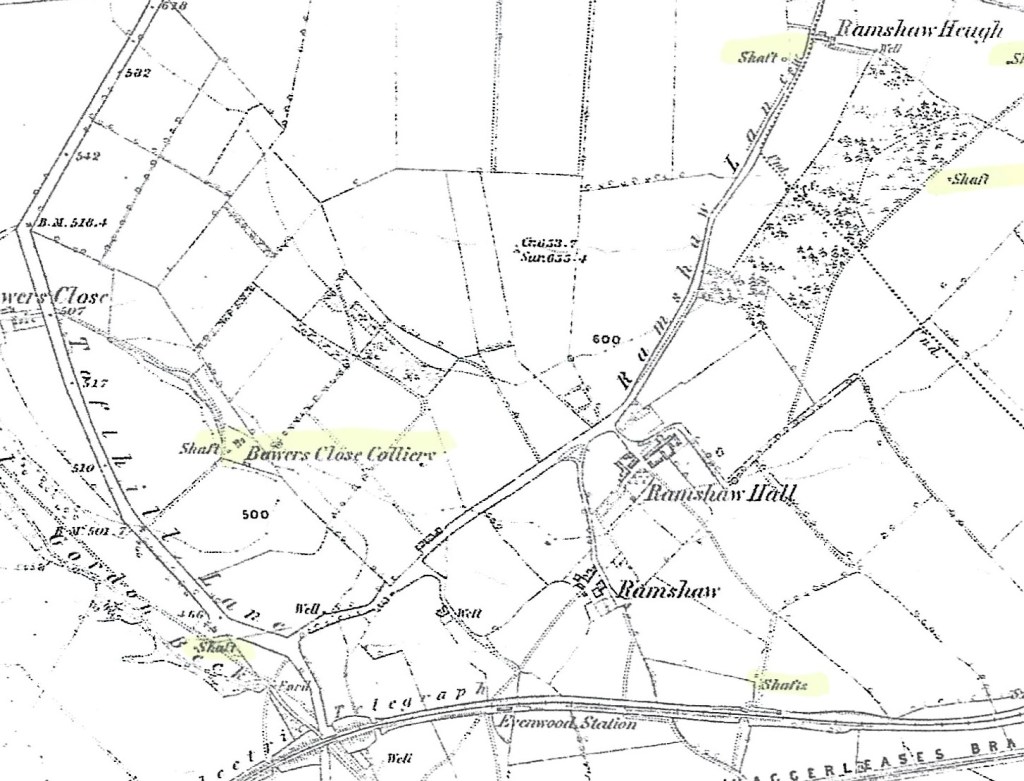
“Looking northward, we have a village, a cultivated fell and a fair sprinkling of trees, called generally Railey Fell and Toft Hill – a stretch of country on which may be seen many groups of colliery cottages of an excellent type.”
Below: The map shows part of the land referred to as Railey Fell. This part is now, more commonly, known as Ramshaw Heugh.
Below: The photo shows this area from the south of the River Gaunless, near Delaware Avenue.

“Looking west, we catch far-off glimpses of Teesdale and a striking view of red tiled Cockfield, from which the eye travels slowly in a stately direction, over a smoke-canopied valley and well wooded heights, broken only by colliery heaps and columns of smoke thereto pertaining, until the village of the Oaks arrests the gaze, while above it, at the distance of a field or two, stands Evenwood, properly so called and to the left or East, the new clump of pitmen’s houses called Tees-Hetton Row.”
Below: The photo shows the view up to Cockfield and beyond. Details for the Oaks and Tees-Hetton Row will follow later.

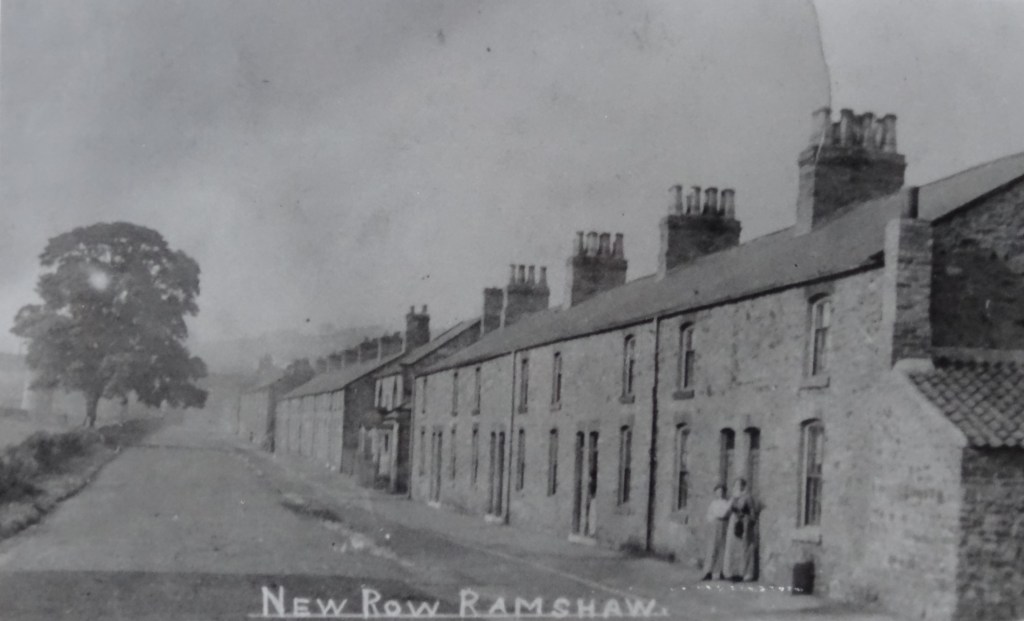
“Narrowing the range of vision, we get at our very feet, Railey Fell Colliery and three villages all in a row, one of which is called Ramshaw and another New Row or New Moor Row, and the middle one doubtless has a name, although it is but a so-so “pit raw” squeezed in between the other two. The whole used to be called Barony. But it will be more business like to step down from our elevation and take a stroll up and down and all around.
Before getting fairly into the inhabited region we have to cross a tramway and a brook. The former serves the colliery of Railey Fell as a tributary to the old Haggerleases railway and the latter does excellent service to the triple village on the other side. For the stream is intercepted and diverted through the valley as a drain-washer. On the east of the rivulet – on the bank side is a slowly dripping well, which contributes to the sole water supply of the 500 people living close by. It is an admirable school for training human nature to patience. Once fairly in the village, we observe that all the houses are good, those nearest the railway and the newest being far above the average of colliery dwellings. The middle row looks inferior to New Row but they are very comfortable houses and have an advantage of gardens which the other two thirds of the row or street lack. There is a Primitive Methodist chapel, also a neat public house.”
Below: A view of Gordon Lane and Ramshaw Primitive Chapel.
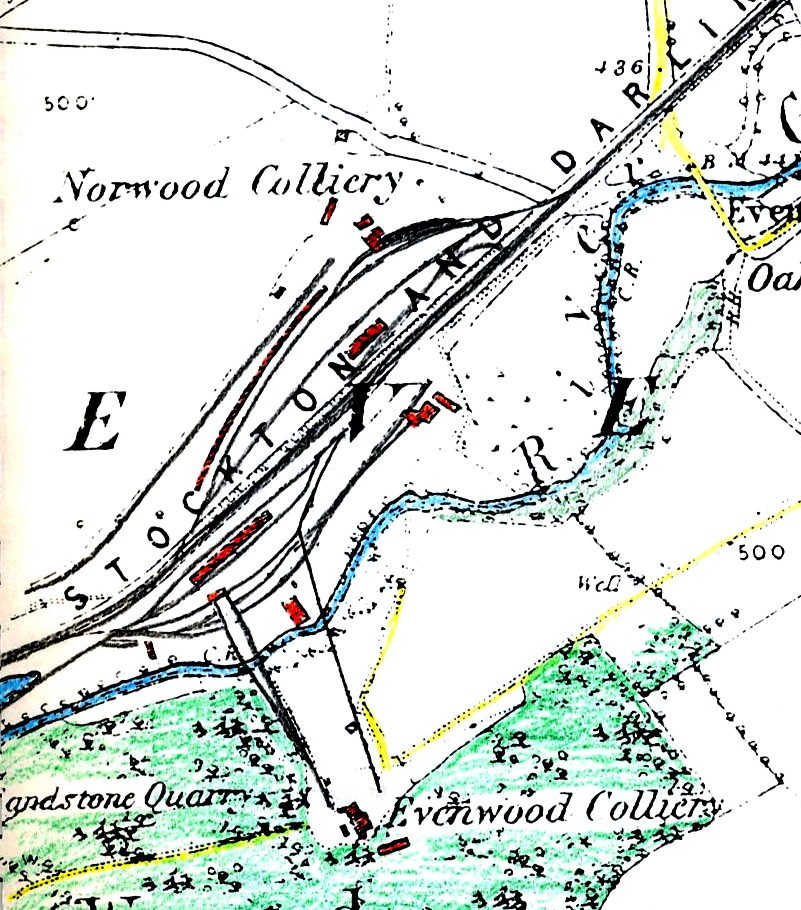
“Then we cross the old railway and rejoice to find it a much better railway than the more pretentious affair by which we travelled. It serves the two collieries of Norwood and Evenwood, the former of which has associated with it a considerable number of coke ovens.”
Below: A map of Norwood and Evenwood Collieries.
“Presently, we come to the bridge across the Gaunless. Just now there is no Gaunless to speak of except a narrow mill-race which takes all the water the aged parent river has about her. In winter, however, the Gaunless can brawl with the best of them and breaks bounds very often.”
Below: A view of Evenwood Bridge over the River Gaunless.

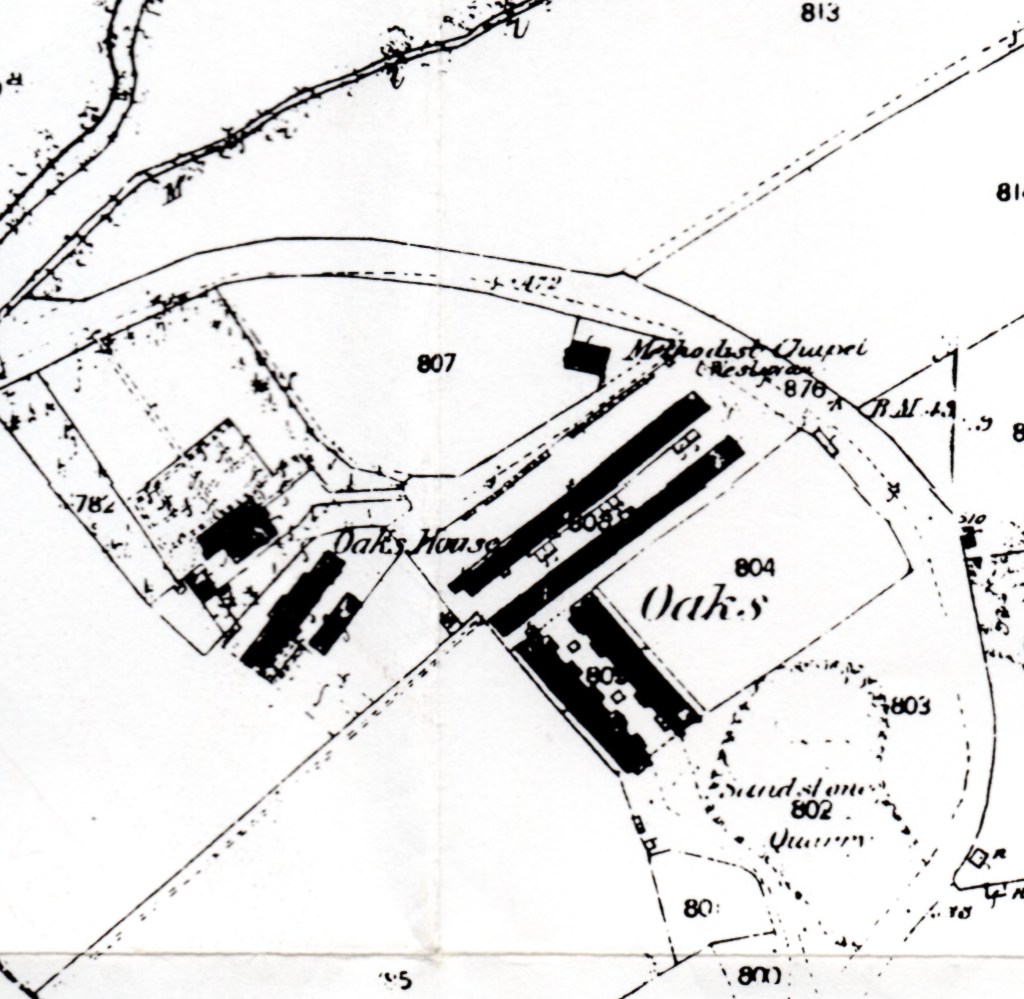
“By keeping to the roads instead of taking to the fields we get an easier ascent and a better opportunity of visiting the village or hamlet called Oaks. This is a genuine pit village of the ordinary pattern and accommodates indifferently well a large proportion of the six or seven hundred hands employed in the two collieries of Norwood and Evenwood. There is a Wesleyan Methodist Chapel which does duty – more or less effective and acceptable – for such of the persuasion as dwell within eye-range including Evenwood itself.”
Below: A map of the Oaks and the Wesleyan Chapel.
“To the left or east, we observe an extensive cemetery consisting of gates, a wall, some acres of turf and a couple or so of gravestones. There is no mortuary chapel. It is perhaps superfluous to say that this is the fault of the Bishop of Durham. His lordship must have a weakness for nice smooth turf and objects to interments which require the turf to be broken up into mounds. He and the Burial Board are at loggerheads. The Act of Parliament does not compel the Board to erect a chapel, seeing that the parish church is less than a quarter of a mile away. The Bishop won’t consecrate the Episcopalian acres until a chapel is erected. The Board very obligingly consent to build a chapel provided their doing so shall not increase the rates; but to build two would greatly add to the local burdens. His lordship insists on a chapel which shall be available only for corpses of Episcopalian proclivities. The Dissenters of the neighbourhood will not hear of such a thing, unless they have one also. The upshot of the whole business is that when a conscientious Church body requires burial, it has to go all the way to St. Helen’s Auckland, for all its privileges; whereas the dissenting body quietly lies down on the hill side in ground that is duly consecrated by the dews and sunbeams of Heaven. Whether the Bishop is acting legally or not we cannot say; but in respect of the same ancient barony, his lordship’s predecessors are said to have “enjoyed all manner of privileges, royalties, franchises and immunities” by virtue of the jura regalia which King Canute conferred on the church when once upon a time he paid a visit of pilgrimage to the shrine of St. Cuthbert. Could there not be a compromise? By breaking down the eastern wall of the cemetery, communication might be easily established with a shell of a building – whether a ruin or an unfinished edifice we know not – which at small expense would serve both Dissenters and Churchmen. The taller half would be good enough for the heretics. Yes, depend upon it, the way out of the difficulties is the way through the wall.
The Church is, as intimated, at no great distance from the cemetery. It is a handsome structure and can boast of a bit of churchyard, which however, is not available for burials. Internally, there is a neat and commodious place of worship, with a very handsomely upholstered communion table. The lancet windows at the west end were blown out by a fierce gale some time ago and the glass has been replaced by brick – by no means a change for the better so far as appearances go.
Not far away to the east is the vicarage. Like so many of the recently erected houses of the clergy it is a word too big for the stipend. It is nearly all window and chimney. There must be more than a score of rooms in it. Its occupier ought to have £1,000 a year or be allowed to keep an inn. The resent tenant of the living is the sort of man who would decidedly object to the latter alternative. He has not been long in the place but he draws and gets a good word even from those who grudge him, as they put it, his 19s 6d a day, and do not use his church.”
Below: An image to show St. Paul’s Church with the vicarage to the left (east). The Waterloo public house is opposite the church, to the left.

“To the north of the church and not a great way from it stands the National School. It is a good building and when it has undergone the colour-washing and soda-washing now impending, it will be a very nice school and it has an energetic go-ahead master.
Close abutting on the church is the Primitive Methodist Chapel – an unpretending structure, well attended but in need of roof repairs, whitewash and paint.”
Below: The foundation stone of the Primitive Methodist Jubilee Chapel 1860.

Below: c.1991, the Primitive Methodist Chapel prior to demolition, most recently occupied by the Cornerstone Christian Fellowship.
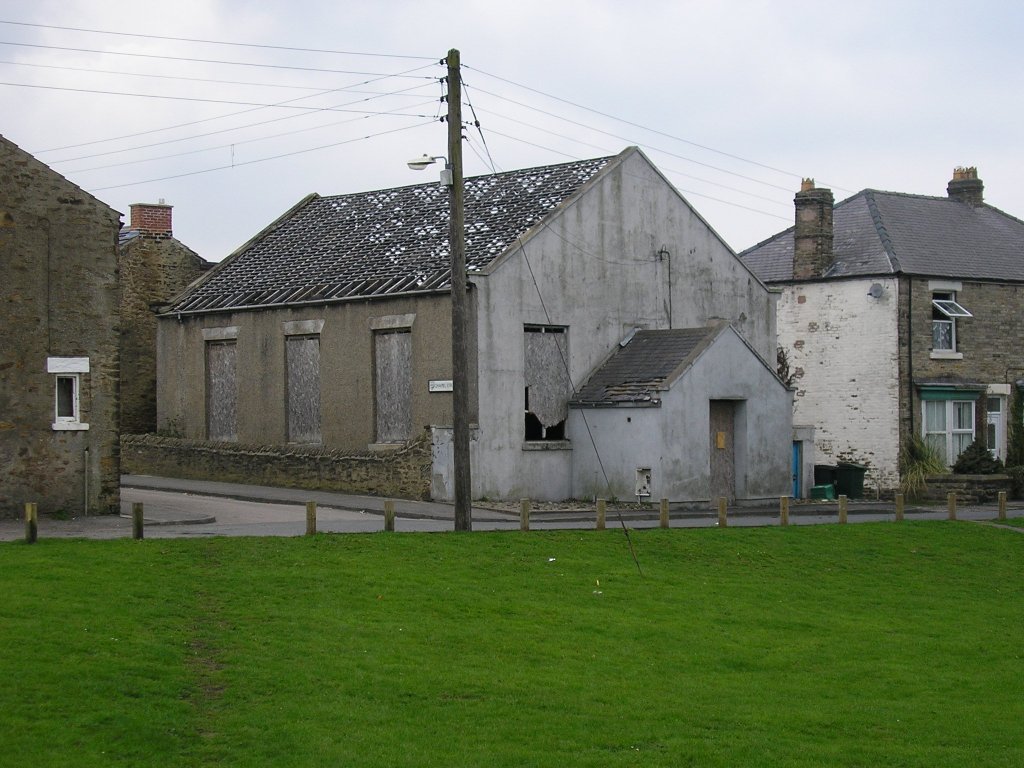
“There is only one other place of worship and that we have perhaps rather disrespectfully passed on our way to church. It is a very pretty building and conspicuously sited. One of its gable ends is surmounted by a cross so that if we were to set it down as a Roman Catholic chapel, we ought to feel safe in making such a guess. But it is nothing of the kind. It was built a few years ago for a sort of private venture school but as the money was not forthcoming, it remained on the builder’s hands. By way of keeping his sunk money warm, he let it out on rental to the former incumbent of the church, Mr Palmer, who freely found the annual ten-pound note in order to keep the Dissenters out of his place. But ten-pound notes are costly even when used to stop leaks in an ecclesiastical vessel. The plug was withdrawn and the Rev. W. Bowman, of Gainford, rushed in with schismatic eagerness to do as much good as he cold without episcopal consecration or permission. He has done, and still does, much for the little place. Amongst other useful arrangements, he has located at Evenwood an earnest-minded evangelist, to whose support he also mainly contributes. There is some talk of purchasing the place but the price asked is a big one and there appears to be some doubt about the validity of the title of the land.”
Below: This building was occupied by the Congregational Methodists.

“We must not omit to mention that there is a British School in the village and that it is very well conducted and attended, though by no means attractive as a building or advantageously situated.
There is a scarcity of shops but such as there are appear to be thriving and well-stocked.
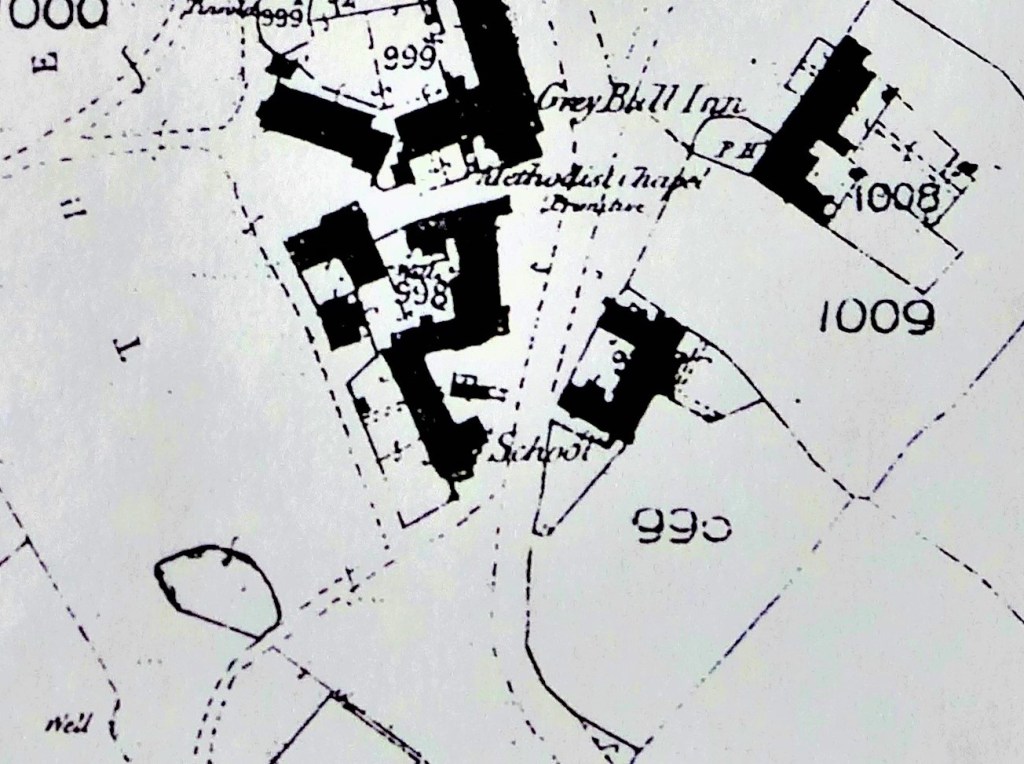
Taken as a whole the village is exceedingly pretty and healthy. There are 2 or 3 or 4 or 5 houses that are far too small, except for bachelors, who can dispense with domestic attendance and comfort. There are a few houses near the British School, which would be none the worse for pulling down and re-building but even the old farm cottages, now almost exclusively inhabited by pitmen, are comfortable, if not very stately places of abode.”
Below: A plan to show buildings to the south of the village green including the British School.
“The building of new cottages is proceeding as rapidly as possible; for not only are old collieries being reopened but new shafts are being sunk and there will soon be work for twice as many hands as now find occupation in the neighbourhood. Four rows to the west of the church are nearly complete. Some of the houses are already occupied but there has been more haste than prudence in the proceeding.”
Below: An aerial photo showing St. Paul’s, the PM Chapel and the 2 terraces known as Chapel Street. These rows are 2 of the 4 being built at the time. Possibly, the other 2 terraces were located in South View.

“Let us hope the pleasant summertime will baffle the insidious advances of rheumatism. The three roomed cottages are as clean, neat and bright as a new pin but they are really two bedroomed. The double houses are beyond fault finding. None of them are as yet accommodated with necessary out-houses. None of them will ever be blessed with a garden. When all the plans have been carried out as to draining and flagging they will be unobjectionable rows, except perhaps, that they are closer together than ought to have been the case in open country.
Whatever they are. They will be jumped at by the thirty or forty miners who during the last 6 months, have emigrated to Evenwood and have been working in the pits, lodging up and down as best they could. At present they go home every weekend to Middleton and the Upper Teesdale. Their visits are angelically brief, for if they were to stop over Sunday night, the first train would just bring them in time to be too late, even if it were itself in time, which if report be true, it seldom is. The men seem to like their change of occupation better than might have been supposed. At all events, they greatly prefer the recompense coal gives them to that ordinarily offered by lead and they will like their new life even better as soon as they have all their human and household belongings about them.
The row of houses called Tees-Hetton runs in the direction of West Auckland. It’s actually built out into the fields and yet there is not an inch of garden and though the front windows look on to a nice green field, there is no access to the front of the rows. If the inmates so much pop their heads out of the windows northwards, they will be trespassing.”
Below: Tees-Hetton Row was later renamed Copeland Row. This aerial photo shows the terraced row in relation to the field to the north and the land developed by the North Bitchburn Coal Company Ltd. – Randolph Colliery, associated coke works and pit heaps.

“The village is one of those many cornered assemblages of cottages which always look interesting and picturesque. There are few straight lines about them. The rows run at all angles and many of them at no particular angle, or curve either. This higgledy-piggledy style of village arrangement has undoubted advantages of high value. It gives a great deal of free space and unlimited playground for youngsters.
But in addition to these irregular and accidental openings for recreation, Evenwood can boast of a fine plot of common ground. It consists mainly of a huge hillock, which however, tradition declares to have been an artificial mound thrown up for the accommodation of a cannon at a time when it became necessary, in the interests of somebody or other, to blow Evenwood Castle to pieces. Now this said castle may have been the Barony Hall of the Evenwoods or Tailbois or it may have been the hunting lodge of their high and mightiness’s, the Bishops of Durham; but there is no doubt that it was a duly fortified post, for though at present its site is occupied by an eminently peaceable looking farmhouse, there is till the trace of a moat and not long ago there were some remains of the ancient wall – some rude and worthless bumpkin, wanting materials for a new pig sty, took the liberty of dismantling this last relic of an interesting ruin – to the great horror of all true lovers of antiquity.”
Below: This plan of 1898 shows the village green and development, much of which was built after the 1873 report.
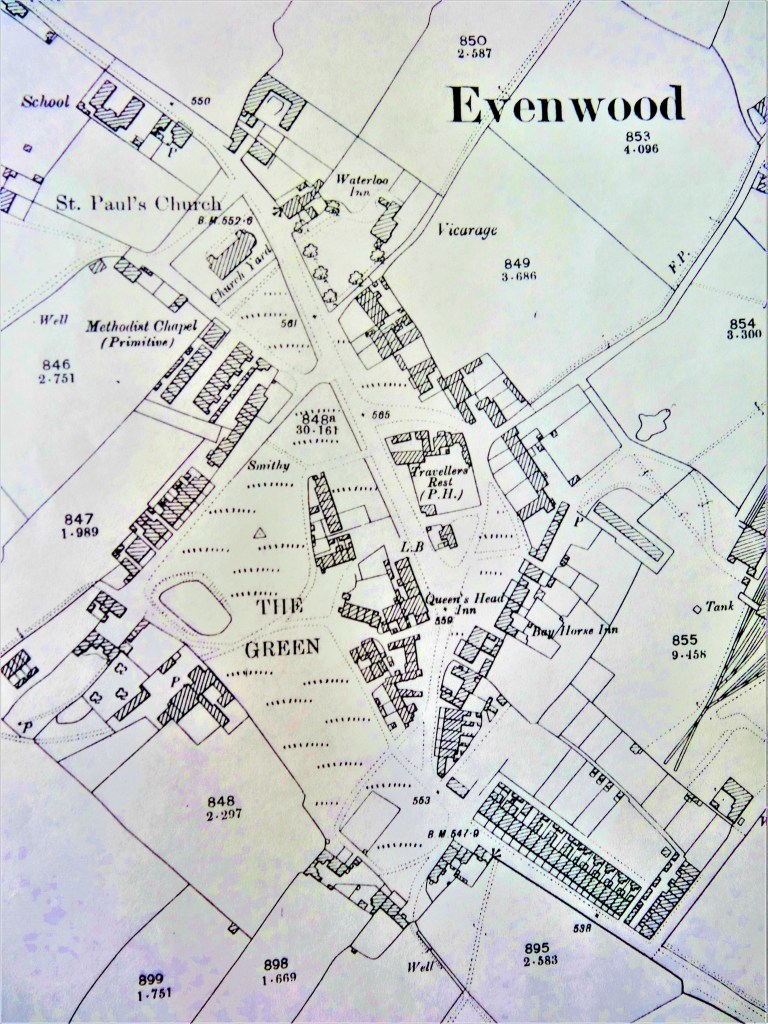
“The great round-bellied hill is there, however, and whatever ill purpose led to its construction, it has for many generations served as a recreation ground for youth and a lounging place for age. It is decidedly one of the nicest bits of free ground to be seen in any of the Durham villages we have visited. It contributes largely to the health and happiness of the entire community. Let no man lay brick or paling thereupon as long as the ages last.”
The village green is a “registered village green” and as such protected.
 EVENWOOD RAMSHAW & DISTRICT HISTORY SOCIETY