ACTIONS AT EAUCOURT L’ABBAYE & THE BUTTE DE WARLENCOURT
1 OCTOBER & 5 NOVEMBER 1916
The 6th Battalion, the Durham Light Infantry [DLI] was the local Territorial Force which recruited men from the Barnard Castle, Bishop Auckland and Spennymoor areas. This work will look at a number of men from the Gaunless Valley villages who lost their lives in the above actions while serving with 6/DLI. Initially, they joined the week-end army, signing up for the defence of the country at home. When asked if they would join the British Expeditionary Force and fight abroad, it is understood that they volunteered to a man. In addition to the men examined in this work, a number of other 6/DLI men died whilst serving overseas, either killed in action, died of wounds or illness. [see appendix 1].
The 1/6th Battalion was formed in Bishop Auckland in August 1914 as part of the Durham Light Infantry Brigade, Northumbrian Division.[1] In May 1915, the battalion came under the orders of the 151st Brigade of the 50th Division, having moved to France 16 April 1915. It served with distinction on the Western Front throughout the war. Other battalions were:
- 1/7th Battalion, DLI
- 1/8th Battalion, DLI
- 1/9th Battalion, DLI
- 1/5th Battalion, the Loyal North Lancs. joined June 1915
The Division saw action at the Second Battle of Ypres, 24 April – 25 May 1915.
It was then involved in the Battle of the Somme:
- 15 – 22 September: The Battle of Flers-Courcelette
- 25 – 28 September: The Battle of Morval
- 1 – 18 October: The Battle of Le Transloy [2]
There are 2 dates which stand out for the 1/6th DLI [3] where it was involved in ferocious fighting:
- 1 October: 5 local men were killed in action
- 5 November: 4 local men were killed in action and 1 died of wounds 3 days later.
They were:
| DATE | NAME & INITIALS | CEMETERY OR MEMORIAL | LOCAL MEMORIAL |
| 01.10.16 | HOLLIDAY J. | Warlencourt | COCKFIELD |
| 01.10.16 | LEE J.C. | Warlencourt | COCKFIELD |
| 01.10.16 | LOWTHER C.E. | Thiepval | BUTTERKNOWLE |
| 01.10.16 | WALLACE R.W. | Thiepval | COCKFIELD |
| 01.10.16 | BAKER R.W. | Thiepval | ST. HELENS |
| 05.11.16 | BRUNSKILL F. | Warlencourt | ETHERLEY |
| 05.11.16 | COX G.T. | Thiepval | EVENWOOD |
| 05.11.16 | HEBDON R. | Warlencourt | ST. HELENS |
| 05.11.16 | WILSON R. | Thiepval | WEST AUCKLAND |
| 08.11.16 | RUSSELL C. | Douchy-les-Ayette | COCKFIELD |
In addition:
- Private J.A. Wardle born at Lands, later moved to live and work at Chilton, was killed in action 1 October 1916 and is commemorated on Thiepval.
- Private Alfred Brown, born in Evenwood, moved to Staindrop, was killed in action 5 November 1916 and is buried at Warlencourt.
1 JULY – 18 NOVEMBER 1916: THE BATTLE OF THE SOMME – an overview [4]
The Battle of the Somme was viewed as a breakthrough battle, as a means of getting through the formidable German trench lines and into a war of movement and decision. Political considerations and the demands of the French High Command influenced the timing of the battle. They demanded British diversionary action to occupy the German Army to relieve the hard pressed French troops at Verdun, to the south.
General Sir Douglas Haig, appointed Commander-in-Chief in December 1915, was responsible for the overall conduct of British Army operations in France and Belgium. This action was to be the British Army’s first major offensive on the Western Front in 1916 and it was entrusted to General Rawlinson’s Fourth Army to deliver the resounding victory. The British Army included thousands of citizen volunteers, keen to take part in what was expected to be a great victory.
The main line of assault ran nearly 14 miles from Maricourt in the south to Serre to the north, with a diversionary attack at Gommecourt 2 miles further to the north. The first objective was to establish a new advanced line on the Montauban to Pozieres Ridge.
The first day, 1 July, was preceded by a week-long artillery bombardment of the German positions. Just prior to zero-hour, the storm of British shells increased and merged with huge mine explosions to herald the infantry attack. At 7.30 am, on a clear midsummer’s morning the British Infantry emerged from their trenches and advanced in extended lines at a slow steady pace over the grassy expanse of a No Man’s Land. They were met with a hail of machine gun fire and rifle fire from the surviving German defenders. Accurate German artillery barrages smashed into the infantry in No Man’s Land and the crowded assembly trenches. The British suffered horrendous casualties:
- Officers killed 993
- Other Ranks killed: 18,247
- Total Killed: 19,240
- Total casualties (killed, wounded and missing): 57,470
In popular imagination, the “Battle of the Somme” has become a byword for military disaster. In the calamitous opening 24 hours the British Army suffered its highest number of casualties in a single day. The loss of great numbers of men from the same towns and villages had a profound impact on those at home. The first day was an abject failure and the following weeks and months of conflict assumed the nature of wearing-down warfare, a war of attrition, by the end of which both the attackers and defenders were totally exhausted.
The Battle of the Somme can be broken down into 12 offensive operations:
- Albert: 1 – 13 July
- Bazantin Ridge: 14 – 17 July
- Delville Wood: 15 July – 13 September
- Pozieres Ridge: 15 July – 3 September
- Guillemont: 23 July – 3 September
- Ginchy: 9 September
- Courcelette: 15 – 22 September
- Morval: 25 – 28 September
- Thiepval: 25 – 28 September
- Le Transloy: 1 – 18 October
- Ancre Heights: 1 October – 11 November
- Ancre: 13 – 18 November
Adverse weather conditions, the autumn rains and early winter sleet and snow turned the battlefield into morass of mud. Such intolerable physical conditions helped to bring to an end Allied offensive operations after four and a half months of slaughter. The fighting brought no significant breakthrough. Territorial gain was a strip of land approximately 20 miles wide by 6 miles deep, at enormous cost. British and Commonwealth forces were calculated to have 419,654 casualties (dead, wounded and missing) of which some 131,000 were dead. French casualties amounted to 204,253. German casualties were estimated between 450,000 to 600,000. In the spring of 1917, the German forces fell back to their newly prepared defences, the Hindenburg Line, and there were no further significant engagements in the Somme sector until the Germans mounted their major offensive in March 1918.
THE BATTLE OF LE TRANSLOY
8th Phase of the Battle of the Somme 1916. [5]
This action commenced 1 October 1916. The village of Eaucourt L’Abbaye was captured and the attack is famous for the action of Lieut.-Col. R. B. Bradford who was awarded the V.C. Private F.M. Britton from Evenwood and Private O. Rushford from Wind Mill were awarded the Military Medal. The following extract describes operations:
“By dawn all preparations, including the alteration of watches to winter time, were completed for the attack, which had been ordered for the 1st October.
The preliminary bombardment commenced at 7.00am and continued till zero hour (3.15pm) when it changed to a barrage. Unfortunately, there were some casualties from shells falling short, the total casualties for the day being about 40, including the Commanding Officer wounded. Lieut.-Col. R. B. Bradford, now commanding the 9th Battalion, asked for and was given permission to take command of the 2 Battalions and for his subsequent work that day was awarded the V. C. He arrived at Battalion H.Q. at zero and at once went up to the front line.
The attack commenced at 3.15pm but partly on account of the failure of the 47th Division on the right and partly owing to the wire not being properly cut, the attackers were held up by machine gun fire and suffered heavy casualties. After considerable fighting with bombs and rifles 3 Lewis gun teams of X Company, under 2nd Lieut. T. Little and 2nd Lieut. C.L. Tyerman and one team of W Company under 2nd Lieut. Barnett succeeded in getting a footing in the first objective. During these operations Lieut.-Col. Bradford arrived on the scene and immediately took charge of the situation and under his direction and leadership the whole of the first objective was gained. A Company of the 9th Battalion then came up and using the new position as a starting point advanced and took the final objective after dark.
About dusk a counter-attack was attempted by the enemy on the front right. Advancing in extended order, about 20 of the enemy were challenged and they all cheered, shouting “Hooray”. As they showed no further friendly signs they were fired on and driven off. During the night a further counter attack developed from the valley on the right but this was also repulsed.
The following day, by organised bombing, the whole of the final objective was captured and held and communication trenches were dug back to North Durham Street.
The casualties during the 2 days had been very heavy and included amongst the officers, in addition to those already mentioned 2nd Lieut. Peacock killed and 2nd Lieut. Lean, Capt. Peberdy, Lieut. Cotching, 2nd Lieut. Barnett and 2nd Lieut. Appleby wounded. Amongst the decorations gained were Military Medals awarded to Corporal Dixon and Privates Rushford and Atkinson, all signallers, and Private Turnbull of X Company. Good work was also done by Sergeants Gowland and Winslow.
On the night of the 2nd October Lieut.-Col. Bradford handed over the command of the Battalion to Lieut. Ebsworth, and it was relieved by the 7th Northumberland Fusiliers the night after.”
The 6/DLI War Diary for October 1916 (Vol. 19) is brief on detail:
“Somme 1916 Oct.1 At 1am summer time altered back to normal by putting clock back 1 hour, this is to 12 midnight. 2Lieut Yaldwyn (Sniping Officer) attached to Y Company for duty. Commanding Officer saw all Company Commanders at 3am to talk over details of the attack. Completed jumping off trenches about dawn and occupied them in battle order by 6am. 60 men (draft and details) brought up from the Transport Lines to act as Carrying Party for the battalion. Artillery bombardment of German trenches from 7am to 3.15pm. 2Lieut. Yaldwyn wounded about noon. The Commanding Officer Major Wilkinson wounded about 1.30pm. Lt. Colonel Bradford of the 9th Durham L.I. took over command of the Battalion for the period of the operations.
3.15pm Assault delivered. 1st objective gained ?on the left later on the right also. 2nd Lieuts ? Cotching, Barnett & Appleby wounded.
Considerable amount of hostile Machine Gun fire from the right during the attack. German trenches not much damaged by Artillery fire. Block established on the right as troops on the right had not obtained their objective.
1 Company of the Durham L.I. sent up to re-inforce. About midnight 2nd objective was gained by combined assault.
2 German bombing attack on our 2nd line right repulsed in the early morning. Fairly quiet day but wet. During the night of the 2/3rd 6 Durham L.I. and 9 Durham L.I. relieved by 7 Northumberland Fusiliers.
3 Relief completed about 4-30am. Lt. Colonel Bradford ceased to be in command and Lieut. Ebworth assumed command of the battalion. Battalion moved to Starfish Line. At 1pm Battalion moved off by platoons at 150 paces interval to BECOURT wood where it took up quarters it had previously occupied there
4 Wet morning – spent in packing up. Battalion moved at 11-45am by platoons to HENENCOURT WOOD, arriving about 4pm, having had dinners en route. Good camp. All battalion in tents.” [6]
There is no summary of casualties for the month of October. There were a total of 65 deaths for the period 1 – 3 October 1916:
- 1 October – 48 other ranks (ORs) killed in action, 1 OR died of wounds
- 2 October – 8 ORs killed in action, 5 ORs died of wounds
- 3 October – 1 OR died of wounds
- In total 63 Other Ranks died. [7]
- 2 officers killed in action, who were – 1 October – 2/Lt William Little and 2 October – 2/Lt David Ronald Peacock [8]
Local men from the Gaunless Valley to be killed 1 October were:
JAMES HOLLIDAY 1887-1916
6/4106 Private James Holliday is buried at grave reference VIII.H.9, Warlencourt British Cemetery, France. [9] He was about 29 years old and is commemorated on Cockfield War Memorial. James Holliday was c.born 1887[10] at Staindrop, the son of John and Margaret Holliday. There were 4 children all born at Staindrop:[11]
- Robert bc.1881
- Thomas bc.1883
- May bc.1885
- James born 1887
In 1891, the family lived at Cockfield where 56 year old John Holliday worked as a colliery banksman.[12] By 1901, Margaret was a widow living at Main Street, Cockfield with 14 year old James who worked as a general colliery labourer. James married Lillian Heckley in 1908.[13] In 1911, 23 year old James worked as a coal miner (hewer) and he and his wife Lily lived at Oxford terrace, Cockfield with their 2 children: [14]
- John William bc.1909
- Doris May bc.1910
James was a keen footballer. There are 3 photographs:
- Undated team, James Holliday and Robert Wallace are both pictured
- 1907 Cockfield FC Wear Valley League Champions and J. Holliday was a player
- 1913-14 Cockfield FC winners of the Auckland Nursing Cup and J. Holliday is not wearing the team strip so may have been a reserve or committee member.
James’ son John (Jack) played professional football for Brentford and Middlesbrough.[15]
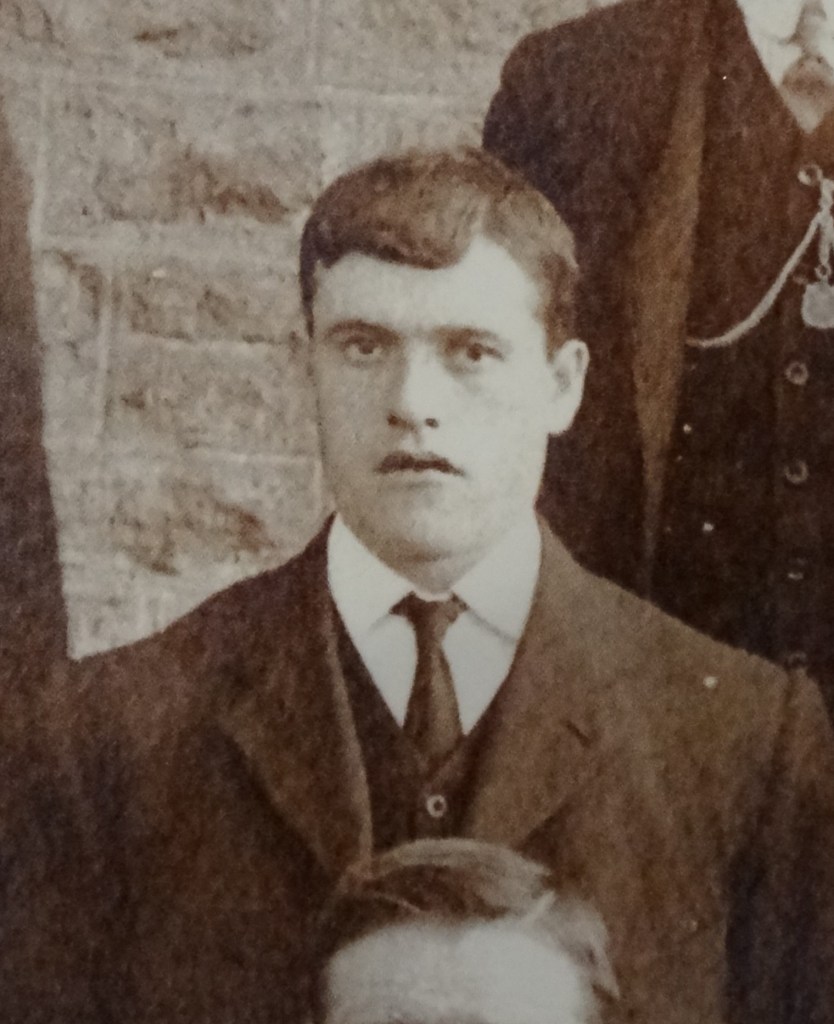
Above: Private J. Holliday
JEREMIAH CAMERON LEE 1893-1916
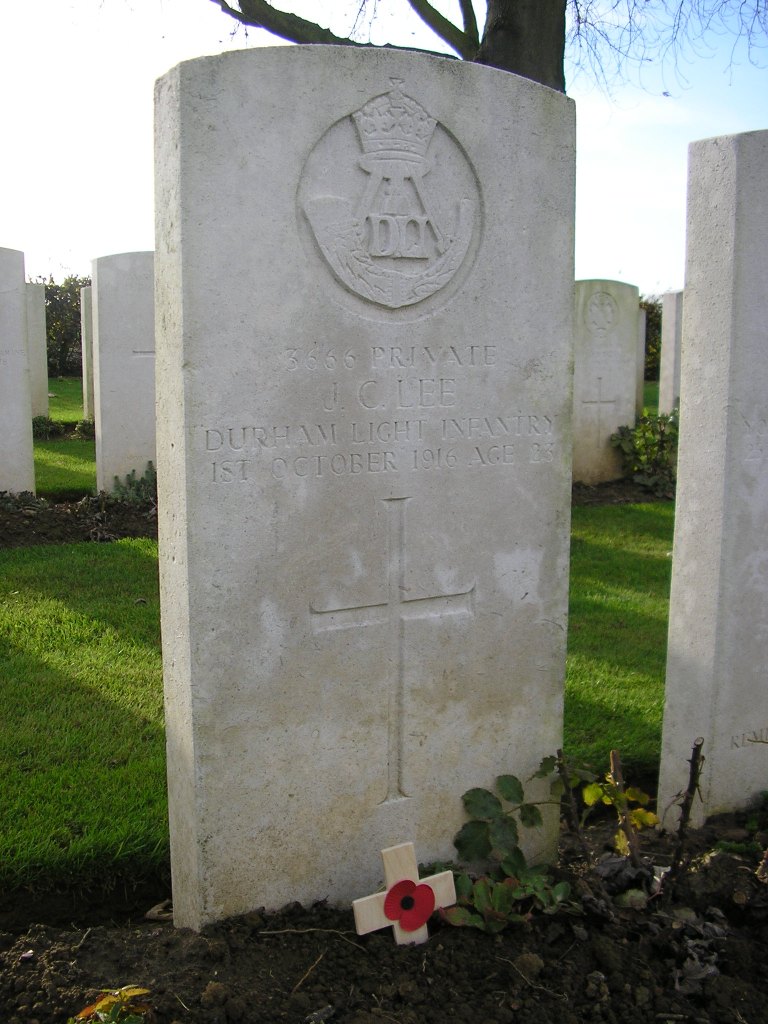
3666 Private Jeremiah Cameron Lee, is buried at grave reference VIII.J.12 Warlencourt British Cemetery, France and commemorated on Cockfield War Memorial. He was 23 years old and married to Mary Jane and lived at Evenwood.[16] Jeremiah “Jerry” Cameron was born c.1893[17] at Cockfield to John and Elizabeth. There were at least 6 children:
- William bc.1882 at Newbiggin
- Laura bc.1886 at Snawgile
- Emma bc.1889 at Middleton in Teesdale
- John Frederick bc.1892 at Middleton in Teesdale
- Jeremiah Cameron bc.1894 at Cockfield
- Minnie bc.1896 at Cockfield
In 1901, Elizabeth was a widow and the family lived at Main Street, Cockfield. Jerry’s brother William worked as a coal miner (hewer) and Jerry was still at school. In 1911, they lived at Front Street and 17 year old Jerry worked as a “braker, underground”.[18] In 1913 Jerry married Mary J. Corner at Evenwood and they lived at Jubilee Terrace, Evenwood.[19]

Above: Believed to be Private J.C. Lee
ROBERT WILLIAM WALLACE 1845 -1916
3974 Private Robert William Wallace has no known grave and is commemorated on the Thiepval Memorial to the Missing of the Somme.[20] He was 22 years old and is commemorated on the Cockfield War Memorial, the memorial plaque in Cockfield Methodist Church and the Roll of Honour, Cockfield Council School. Robert was born 27 September 1894 [21] at Esperley Lane to Robert and Margaret Wallace. There were at least 5 children to their marriage:
- Robert bc.1894 at Cockfield [22]
- Ethel bc. 1896 at Cockfield
- Lavinia bc.1899 at Cockfield
- Jessica bc. 1900 at Cockfield
- Ena bc. 1904 at Cockfield
Also, living with them were:
- Margaret E. Hogg bc.1880 at Tudhoe Colliery
- Son-in-law: Henry Longstaff bc. 1887 at Woodland
- Daughter-in-law: Florence Longstaff bc. 1899 at Cockfield
- Daughter-in-law: Jane Longstaff bc. 1891 at Cockfield
In 1901, the family lived at Esperley Lane. 44 year old Robert (father) worked as a coal miner (hewer) as did 14 year old Henry Longstaff.[23] Robert attended Cockfield Church of England School before attending Cockfield Council School between 14 January 1907 and 25 September 1908 when he left after achieving the qualification age of 14 years.[24] By 1911, the family lived at North Front Street, Cockfield. Henry now aged 24 lived with them but Margaret E. Hogg, Florence and Jane Longstaff were not recorded. Robert, now 16 years old worked as a coal miner.[25]
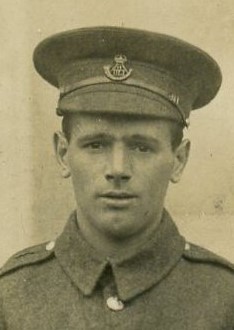
Above: Private R.W. Wallace
The following report appeared in a local newspaper (probably the Northern Echo).
Cockfield Man Falls
Mr. and Mrs. Robt. Wallace, Front St., Cockfield have received an official intimation from the War Office that their son, Robert W., was killed in action on 1 Oct., in France. Deceased enlisted I June 1915 and was drafted to France in September the same year. Robert, who was 22 years of age, was a member of the Sons of Temperance and was of a kind and genial disposition. He is the first member of the “Brotherhood of Cockfield” Society to fall in action. Much sympathy is felt for Mr. and Mrs. Wallave in their bereavement. A memorial service will be held on Sunday evening at the Primitive Methodist Church to be conducted by the Rev. J.M. Craddock.
An Obituary
“In loving memory of Pte. Robert William Wallace, dearly-beloved son of Robert and Margaret Wallace, Front Street, Cockfield who was killed in action October 1st 1916, aged 22 years. Deeply mourned and ever to be remembered by his father, mother, brothers, sisters and relatives.
We think we see his smiling face,
As he bade his last good-bye,
And left his home for ever,
In a foreign land to die.
But, we have one consolation,
He nobly did his best:
Somewhere in France our deep son sleeps,
A hero laid to rest.”
A Poem
At a later date, Kathleen Plews, the daughter of Lavinia Plews nee Wallace, who was the sister of Robert penned this poem.
In Memory of Robert Wallace
Kathleen Plews
More than 90 Springs have danced over my grave,
And in profusion poppies gave,
But still un-answered the question why,
Had I and so many have to die?
More than ninety Springs and Summers too,
Have warmed this earth where men we slew
Then Autumn leaves upon me lie,
And still no one can say just why,
Cold winds, then snow, layer upon layer,
One for each Winter of each year,
Yet still no one has seen my grave,
The ones for whom my life I gave,
But on the village cross I see,
My name there for eternity.
CHARLES LOWTHER 1888-1916
4463 Lance Corporal C. Lowther, is commemorated on the Thiepval Memorial.[26] He was 28 years old and is commemorated on the Butterknowle War Memorial and the memorial plaque in St. John the Evangelist Church, Lynesack. Charles’ brother Second Lieutenant W. Lowther, 5/Yorkshire Regiment was killed in action 27 May 1918 aged 26. [27] Charles Edwin Lowther was born 1888[28] at Copley, the son of William and Margaret Lowther. There were at least 8 children: [29]
- Hilda bc.1886 in the Parish of Lynesack and Softley
- Charles Edwin born 1888 at Copley
- Eleanor bc.1890 at Copley
- William bc.1892 in the Parish of Lynesack and Softley
- Millicent bc.1895 in the Parish of Lynesack and Softley
- Margaret bc.1897 in the Parish of Lynesack and Softley
- Muriel bc.1900 in the Parish of Lynesack and Softley
- John bc.1906 in the Parish of Lynesack and Softley
In 1891, the family lived at Pinfold Lane, Butterknowle and William worked as a grocer/draper.[30] By 1901, the family had increased to 7 children, none recorded as in employment and William was employed as a grocer/drapers assistant”.[31] By 1911, the family lived at Copley Lane, their oldest children Hilda and Charles were not at home and William worked as a grocer. Son, William now aged 19 may be his assistant. An 11-month old grandson Cecil Lowther lives with the family. [32]

Above: Medal Roll for Private C. Lowther
RICHARD WILLIAM BAKER 1882 – 1916
3101 Private Richard William Baker was 33 years old and has no known grave and is commemorated on the Thiepval Memorial[33] and memorial plaque on the St. Helens Colliery Memorial Cottages, Maude Terrace, St. Helen’s Auckland, Bishop Auckland. Richard William was born 18 October 1882,[34] the son of William and Elizabeth Baker. They had at least 7 children:
- Richard William born 1882 at West Cornforth
- John bc. 1884 at Auckland St. Andrew
- Sarah bc. 1886 at Auckland St. Andrew
- Annie bc. 1888 at Auckland St. Andrew
- Ethel bc. 1890 at Shildon
- Elizabeth bc. 1894 at Coundon
- Mary bc.1896 at Coundon
In 1901, the family lived at Fylands Bridge, Bishop Auckland where 38-year old William worked as coal miner [hewer]. 18-year old Richard worked as a coal miner [putter]. [35] In 1906, Richard married Dorothy Ann Siddle.[36] In 1911, they lived at 7 Fylands Bridge with 3 children, all born at Bishop Auckland:
- Dorothy bc.1907
- Mary bc.1908
- James bc.1910
Richard worked as a coal miner [hewer].[37]
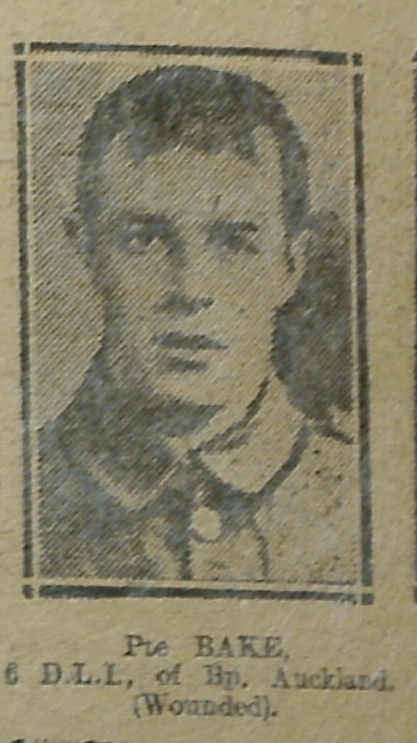
Above: Believed to be Private R.W. Baker
JOHN ALFRED WARDLE 1880 -1916
3914 Private John Alfred Wardle is commemorated on the Thiepval Memorial to the Missing of the Somme.[38] He was 35 years old and is commemorated on the Chilton War Memorials in the parish church and the workingmens’ club. John Alfred was born at Evenwood about 1880[39] and was the son of Edward and Mary Wardle. There were at least 4 children all born at Evenwood: [40]
- George bc.1867
- Elizabeth bc.1875
- William bc.1877
- John Alfred bc.1880
In 1901, the Wardle family resided at Blue House, Lands where 56-year old Edward worked as a coal miner [hewer] as did 24-year old William and 21-year old John. Also living with them were Edward’s grandsons, 6-year old Fred and 4-year old Herbert. [41] The family previously lived at Gordon Lane, Ramshaw.[42] In 1914, John married Martha Anderson and [43] later she lived at Tan Yard Cottages, Aycliffe, Co. Durham. [44]

Above: Private J.A. Wardle
John’s nephew, the above mentioned Herbert, 131539 Sapper H. Wardle MM, 234th Field Company, Royal Engineers was killed in action 31 July 1917 and he is buried at New Irish Farm, Ypres, Belgium[45] and commemorated on Evenwood War Memorial. Another nephew, 14526 Bugler Ralph Wardle, 14th Battalion, the Durham Light Infantry died of wounds 24 April 1917 and is buried at Bethune Town Cemetery, France.[46] He is also commemorated on the Evenwood War Memorial and the Roll of Honour, St. Paul’s Church, Evenwood.[47]
5 NOVEMBER 1916 BATTLE OF ANCRE HEIGHTS: THE BUTTE DE WARLENCOURT [48]
The 1/6th DLI was to see action at Butte de Warlencourt, an ancient burial mound, located between the towns of Albert and Bapaume in northern France. Bapaume was occupied by German troops. The British front line had advanced from a few miles north east of Albert in the direction of Bapaume to the feature known as the Butte de Warlencourt which lay a few miles to the south west of Bapaume. The Butte stood about 50 feet higher than the surrounding land and in theory provided a useful observation point for the Germans particularly towards High Wood and Martinpuich. The Butte was honeycombed with tunnels and dugouts which provided shelter for the German garrison. It had already resisted numerous British attacks over the previous month, October.
3 November, it was the turn of the 151st (Durham) Brigade who moved into line as part of the 50th (Northumbrian) Division. The 151st comprised:
- 1/5th Border Regiment
- 1/6th DLI
- 1/8th DLI
- 1/9th DLI
The 3 D.L.I. Battalions took over the front line positions and the 1/5th Borders came up behind them as the reserve battalion.
The 1/6th Durhams was a battalion recruited mainly in Bishop Auckland and the upper valley of the River Wear, who to the rest of the DLI were known as the “black-buttoned bastards”. The 1/6th were in the centre of the line. The 1/8th was to the right and the 1/9th, known as the “Gateshead Ghurkas” were to the left. Together they would attack the Butte on the 5th November 1916.
The 1/9th was under the command of Lieutenant Colonel Roland Bradford, a remarkable 24 years old man. Prior to his death, his father, George Bradford was manager of Henry Stobart & Co. Ltd. collieries in the Bishop Auckland area [49] and West Carterthorne Coal Co.[50] The family lived at Carwood Cottage, Witton Park until 1894. The young Roland Bradford was educated at Queen Elizabeth’s Grammar School, Darlington before attending Epsom College, Surrey then pursuing an Army career with the DLI.[51]
It is recorded that:
“Under Roland, the 9th became one of the finest battalions in the British Army. Known for its “esprit de corps”, much of the battalion’s efficiency and camaraderie can be traced to Roland’s leadership and the keen interest he took in the well-being of his men.”[52]
The1/9th Durhams were charged with capturing the Butte and a quarry beside its west face. The 1/6 and 1/8th Durhams were to seize the Gird Trench and Gird Support Trenches. The 28th Australian Division was to attack alongside the 8th battalion. In support, to the right were the 1/4th Northumberland Fusiliers, to the left, the 1/6th N.Fs. and the 1/5th Border Regiment were in reserve. Zero hour was set for 0910 on Sunday, 5 November.
The 50th Division attacked with 1/8 DLI (151 Brigade) on the right. The men had to pull one another out of the mud before they could start. They almost reached the German front line but were stopped by machine gun fire and gradually fell back during the day. The 1/6 DLI suffered a similar fate except on the left where they linked with 1/9 DLI in the line. The 1/9 DLI went through 2 lines of German trenches, reached the Butte and established a post on the Bepaume road – some entering the Warlencourt line. But these advanced posts were forced back and at 10.00pm the enemy were still holding the quarry and 500 yards of the German front line. By midnight the Durhams had been forced back – to their own lines.
The Durhams: more detail [53]
In the early hours of Sunday morning, the companies moved forward to man the front line trench. The weather was dreadful – heavy rain, a howling gale, it was bitterly cold and there were rumours that men had drowned in the mud. Owing to the boggy ground, progress was extremely slow. The trench was in a deplorable condition and the men had to march along the parados to reach their allocated places. Unfortunately, they were in full view of the enemy – shell, machine gun and rifle fire were thrown at them.
“The enemy kept up a ceaseless bombardment of our trenches in conjunction with the merciless rain and cold.”
Lance Corporal Harry Cruddace, 1/6th Bn., DLI.
As Zero Hour struck, all the available artillery laid down a barrage some 200 yards in front of the jumping off line.
“Nothing but HE was used. We began with a stationary barrage of four minutes whilst the infantry were getting out of their trenches and thereafter the creeping barrage was lifted in range 50 yards every minute and firing continued at the rate of 4 rounds per minute.”
Brigadier General Hugh Tudor, Commander Royal Artillery 9th Division.
The Durhams went over the top – with mud high above their knees, wading, slipping, stumbling and falling forward, laden with the usual infantry equipment necessary for such an attack (rifle, packs, grenades, entrenching tool, pick, Lewis gun drums) – it was worse than they could ever have imagined.
“The officers’ whistles sounded the advance. Immediately, the first wave mounted the trench and made off in the direction of the enemy trenches. They were met by terrific and annihilating fire and crumpled up like snow in summer. The second wave was by this time on its way. I was in that wave and placed my gun sections in single file to make a less target. The enemy barrage was doing enormous damage and our fighting strength was fast diminishing.”
Lance Corporal Harry Cruddace, 1/6th Bn., DLI.
Clearly, the Germans were not caught by surprise and with such a narrow front attack they could concentrate all their machine gun fire on a devastating onslaught on the hapless Durhams. The British artillery failed to eliminate the German batteries. They opened up a barrage of shells all along the sector. They succeeded in isolating the British front line and cut off the assaulting troops from any reserves. The Durhams were isolated and fought the battle on their own.
On the right the 1/8th was badly hit by a combination of both German shell fire and British shells dropping short. They were even hit from behind by their own long range machine gun barrage that was meant to be supporting them! Many men had difficulty getting out of the trench and needed assistance from their mates – all under heavy fire. Despite this, the left of the line managed to get within 30 yards of the Butte before they were overwhelmed. The few survivors fell back in disarray to their original front line.
Meanwhile, the1/6th Durhams were dying one by one as they found themselves marooned between the lines:
“By this time the whole line was held up and Lieutenant Ludgate ordered me to proceed and engage the enemy machine guns, a task almost impossible. Out of my 2 sections of fourteen men there were two of us left – a No. 1 on the gun by the name of Private Allen and myself. I pushed on with one gun and a quantity of ammunition to about 30 yards from the German trench and took up position in a shell hole. We opened fire on the opposing troops who formed an excellent target…After firing one or two magazines, the enemy found us with a machine gun and succeeded in wounding my No. 1 in 4 places down his left side…I carried on until want of ammunition forced me to withdraw to our troops in the rear…we set about organising and consolidating in preparation for a counter attack from the enemy.”
Lance Corporal Harry Cruddace, 1/6th Bn., DLI
The wounded were left scattered around No Man’s Land, marooned in shell holes and slowly sinking down. Many who were too weak to save themselves must have slowly drowned. The only success came on the left where the 1/9th Durhams directly faced the Butte. Why this should have been is unclear but they swept up and over the Butte and by 10.00 the Durhams grabbed most of the low mound and the surrounding trenches, including the German front line trench, Gird trench. But the first German counter attack commenced at about 12.00. Bombing attacks then hand to hand fighting took place. The 1/9th Durhams were entirely cut off from any reinforcements by the accurate German artillery fire and well directed machine gun fire. As their numbers gradually dwindled, they fell back from their advanced position around the Butte to Butte Alley to where the 1/6th had its bloc. Despite the desperate need for assistance, they hung on until 18.00 when the enemy launched another determined counter attack preceded by a terrific bombardment. Yet more German reinforcements appeared, hand to hand fighting and bayonet charges bit deep, the exhausted Durhams had been fighting all day with no respite. Retreat had become inevitable and the precious gains of the morning were lost to the German counter attack.
“At about 11 pm battalions of Prussians delivered a fresh counter attack. They came in great force from our front and also worked round from both flanks. Our men were overwhelmed. Many died fighting, others were compelled to surrender. It was only a handful of men who found thier way back to Maxwell Trench and they were completely exhausted by their great efforts and the strain of the fighting.”
Lieutenant Colonel Roland Bradford, 1/9th Bn., DLI
Eventually the survivors fell back across No Man’s Land and the hard pressing Germans were soon threatening even the jumping off positions of the British front line. Back in the front line the Durhams rejoined their comrades of the 1/6th and the 1/8th Battalions who had fallen back hours before.
“The expected happened and the enemy counter attacked under the cover of darkness but we staved off the assault at a great price. Despite our weakened condition we held on till the night of 6th November.”
Lance Corporal Harry Cruddace, 1/6th Bn., DLI
After hard fighting, the Germans were held back and so, after a day of drama and death, the situation was exactly as it had been before they started. On the evening of 6th November, they were relieved by the 1/5th Durhams who formed part of the 150th Brigade.
“Snag Trench was full of mud and water with bodies sticking out all along. It is in fact no exaggeration when I say that in our part we had to tread from body to body to get past. Dead from all regiments were there, including our division, South Africans and Jocks of the 9th Division and hands, arms and legs were sticking out of parados and parapet where the dead had been hastily buried.”
Lieutenant Cuthbert Marley, 1/5th Bn., DLI
The 6/DLI War Diary contains the following account: [54]
IN THE TRENCHES
5.11.16
Companies moved into battle positions about dawn, being rather late in getting onto position and it was daylight before “Z” Company arrived.
9.10AM Zero hour. Advance started well but got held up by machine gun and rifle fire before getting very far.
10AM “W” Company sent up on right to reinforce X Company.
11.35AM Battalion placed under command of Col. Bradford of 9th Durham Light Infantry in order to ensure safety of his right flank.
11.50AM 2ndLt G. W Robson ordered to bring up his raiding party and establish a double block on the right of the Battalion in the GIRD LINE.
1210PM 2LtMcVicker went out with Private Parker and Private Dowson to reconnoitre
12.30PM Commanding Officer (Major A.E. Ebworth) went to MAXWELL TRENCH and sent up men remaining there to reinforce companies in front.
4.20PM Sergeant Young reported at Headquarters with remainder of raiding party, 2Lt. G.W. Robson having been killed. This party were given flare lights to be taken to the QUARRY.
8PM 2Lt. K.B. Stuart and 2Lt. R.H.C. Wharrier collected about 150 men from MAXWELL TRENCH and endeavouring to get to THE BUTTE to reinforce 9th Durham Light Infantry, 2Lt. K.B. Stuart was killed.
11PM German counter attack forced 9th Durham Light Infantry to retire from ground gained.
6.11.16
1AM Orders to resume attack at 8AM cancelled.
10AM Headquarters moved back to normal position. During the night 6th/7th Battalion was relieved by 5th Durham Light Infantry and moved back to the old camp at MEMETZ WOOD
Casualties during the period in the front line
Officers
Killed – 2/Lt. K.B. Stuart, 2/Lt G.W. Robson, 2/Lt A.S. Robson
Wounded – 2/Lt. Ludgate, 2/Lt Tyerman, 2/Lt R.H. Stewart, Lt. G. Corbett, 2/Lt. T. Burton
Missing – 2/Lt. H. Fell, 2/Lt. Applegarth, 2/Lt. A.S. Ritman
Casualties amongst the ranks – approximately 150
It has since been estimated that this action, contributed the following numbers of casualties:
The 1/6 DLI
- 11 officers killed, wounded or missing
- 34 other ranks dead
- 114 wounded
- 111 missing
The 1/8 DLI
- 9 officers killed, wounded or missing
- 38 other ranks dead
- 100 wounded
- 83 missing
The 1/9 DLI
- 17officers killed, wounded or missing
- 30 other ranks dead
- 250 wounded
- 111 missing
The 151st Machine Gun Company
- 3 dead
- 20 wounded
- 8 missing
It should be noted that “missing” usually meant dead or Prisoners of War, some of the men were wounded and would die. There are 10 officers and 264 other of the above DLI Battalions with 5 November 1916 recorded as their date of death. [55]
One who survived this ordeal and lived to tell the tale was Corporal Monty Watson M.M. and Bar, “A” Section, 151 Machine Gun Company, a pitman from Cockfield. His story is below. [56]
151 MGC had 2 Vickers guns with each front battalion, 6 guns in support and 4 in reserve (16 guns). 2 guns were attached to 9/DLI and when the Butte was captured, Corporal T.H. Rutherford of “B” Section, established his gun on the Bapaume Road but very soon afterwards became casualties. Corporal W. Mewes’ gun team attached to the same battalion suffered the same fate. Corporal M. Watson then went forward to replace those knocked out. Both flanks were open and Serjeant J. Glennell and Corporal M. Butler also went forward with their guns to help cover the exposed positions and the 3 guns played a vital role in repulsing the first German counter-attack which took place at about 11.00pm, 5 November. The Germans counter-attacked again in strength and with the 151 Brigade decimated, it was forced to withdraw. It was relieved by the 150 Brigade at night, 6 November. A whole German Guards Division was rushed up from Bapaume to take part in the counter-attack at midnight, 5 November and these elite troops were well supported by guns of army corps strength. A plan for a British attack 7 November was abandoned due to very heavy rain and the Butte remained in German hands.
The following account recalls the actions of Corporal M. Watson:
“The position was most precarious which made Captain Palmer, in charge of infantry on the spot, decide to climb the Butte and discover what was happening on the German side of the hill. What he saw convinced him that the Germans were about to launch a counter-attack on a big scale.
Arriving back in our lines Captain Palmer immediately ordered his men to return to the original trenches and Corporal Watson was instructed to get his gun back right away to the old gun position.
Watson reached up to take the gun from the trench, turned round and found his solitary gunner Pte. McRoberts holding a revolver in the ribs of a Prussian Guardsman, who had somehow found his way to the rear of the machine-gun post.
Watson knew that McRoberts’ revolver was unloaded for they had no revolver ammunition left. Corporal Watson took over and both the gun and the Prussian Guardsman were safely brought back to 151 Machine Gun Company HQ where Major Grierson DSO, Croix de Guerre CO of 151 Machine Gun Company obtained valuable information from the prisoner.” [57]
So why had the Durhams failed 5 November 1916? Perhaps Brigadier General Hugh Tudor and Lieutenant Colonel Roland Bradford had the answers.
“The attack is fixed for tomorrow, in spite of the weather. It seems rather hopeless expecting infantry to attack with any success in this mud. The trench mortars have only their muzzles showing above it. Yesterday we had 2 barrages by brigades. They seemed fairly good but I should like more guns. To be effective, a barrage should be an 18-pounder to every 7 yards of enemy front and the guns should be capable of firing 4 rounds a minute at least to start with, without the recuperator springs giving out.”
Brigadier General Hugh Tudor, Commander Royal Artillery, 9th Division
“There were many reasons why the 9th DLI was unable to hold its ground. The failure of the troops on the right to reach their objectives and the fact that the division on our left was not attacking caused both flanks of the battalion to be in the air. The positions to be held were very much exposed and the Germans could see all our trenches and control their fire accordingly. It was a local attack and the enemy was able to concentrate his guns onto a small portion of our line. The ground was a sea of mud and it was almost impossible to consolidate our posts. The terribly intense German barrages and the difficult nature of the ground prevented reinforcements from being sent up to help the 9th DLI. Four hundred yards north of the Butte the enemy had a steep bank behind which they were able to assemble without being molested. The terrain was very favourable to a German counter-attack.”
Lieutenant Colonel Roland Bradford, 1/9 Bn., DLI
Clearly, the contention was that they had not failed rather they had no chance of success given the shortcomings of the British artillery barrage, a narrow fronted attack against superior forces and appalling weather conditions. With the benefit of hindsight, it is generally agreed that:
- The possession of the Butte was not a major asset to the enemy
- From the British trenches it was possible to prevent the Germans from using it as an observation point.
- In any case, the Butte would have been of little use as an observation point
- The Butte had become an obsession
- The newspapers talked about “the Miniature Gibraltar” so it had to be taken
- It was a local operation, so costly and rarely worthwhile. Sadly, actions like the attack of the 151st Brigade on the Butte de Warlencourt on the 5th November 1916 had no real importance within the context of the Somme offensive. This kind of attack achieved nothing but swollen casualty lists. Any change in tactics would be too late for the gallant Durhams.
With almost 1000 casualties, misery was brought to many Durham homes including:
- Private Fred Brunskill, 1/6 DLI of High Etherley and buried at Warlencourt British Cemetery and commemorated on Etherley War Memorial.
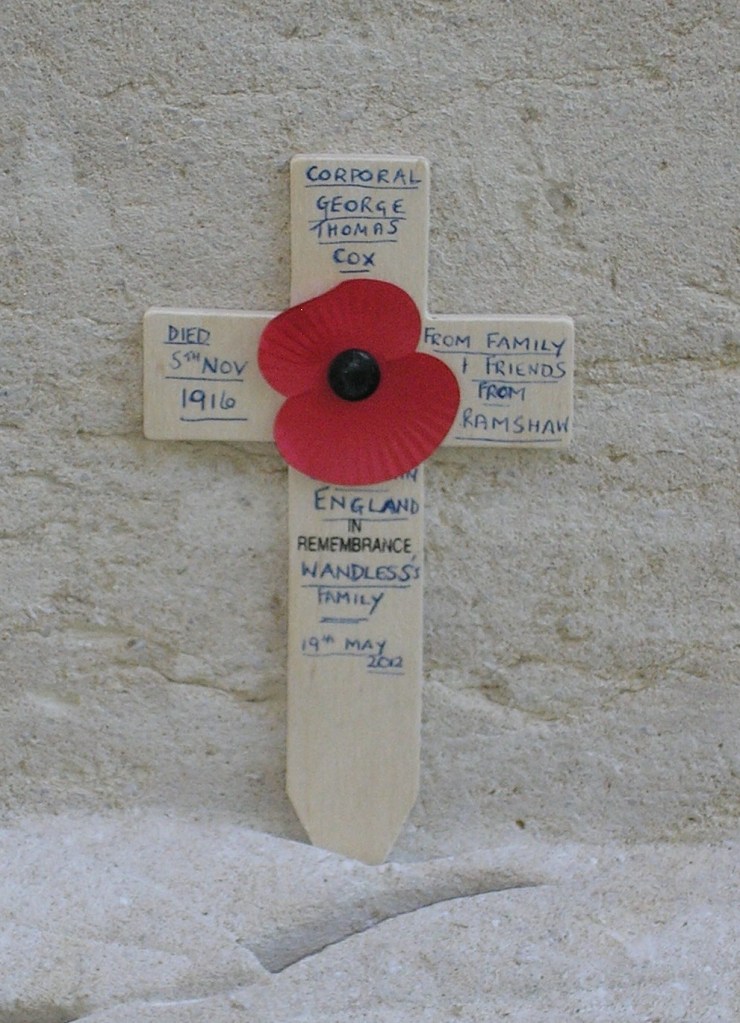
- Corporal George Cox, 1/6 DLI born Evenwood and commemorated on the Thiepval Memorial and Evenwood War Memorial.[58]
- Corporal Ralph Hebdon, 1/6 DLI, born Barnard Castle and buried in Warlencourt British Cemetery and commemorated on the St. Helens Colliery Memorial Cottages memorial plaque.
- Private Robert Wilson, 1/6 DLI of West Auckland and commemorated on the Thiepval Memorial and the West Auckland War Memorial.
One other casualty had local connections:
- Private Alfred Brown, 1/6 DLI, born Evenwood and is buried in Warlencourt British Cemetery and is commemorated on the war memorial in St. Mary’s Parish Church, Staindrop.
No doubt in such close communities these service men were known to each other.
FREDERICK BRUNSKILL 1897 – 1916
3429 Private Frederick Brunskill, 1/6 DLI is buried at grave ref, VIII.B.11 Warlencourt British Cemetery, France.[59] He was 19 years old and is commemorated on the Etherley War Memorial in St. Cuthbert’s Churchyard and the Roll of Honour in St. Cuthbert’s Church, Etherley. Frederick Brunskill was born 1897 [60] at Etherley the son of Frederick and Emma Brunskill. Emma was born in Newmarket, Cambridge in 1865, had been married previously and had 3 children to that marriage:
- Ester Gill bc 1887 at Toft Hill
- Sarah Annie Gill bc.1890 at Toft Hill
- Philip Gill bc. 1893 at Toft Hill
Emma Sangster married Frederick Brunskill in 1897 [61] and they had at least 4 children: [62]
Margaret bc.1896 at Toft Hill
Frederick bc.1898 at Etherley
Lizzie Annie bc.1901 at Etherley
George Albert bc.1906 at Etherley
In 1901, they lived at Hunters Hill (between Etherley and Spring Gardens, West Auckland) and Frederick was employed as a highway labourer.[63] He died in 1906.[64] By 1911 the family lived at High Etherley. 46 year old widowed Emma was the head of the family and only 18 year old Philip Gill is recorded as in employment, working as a coal miner. [65]
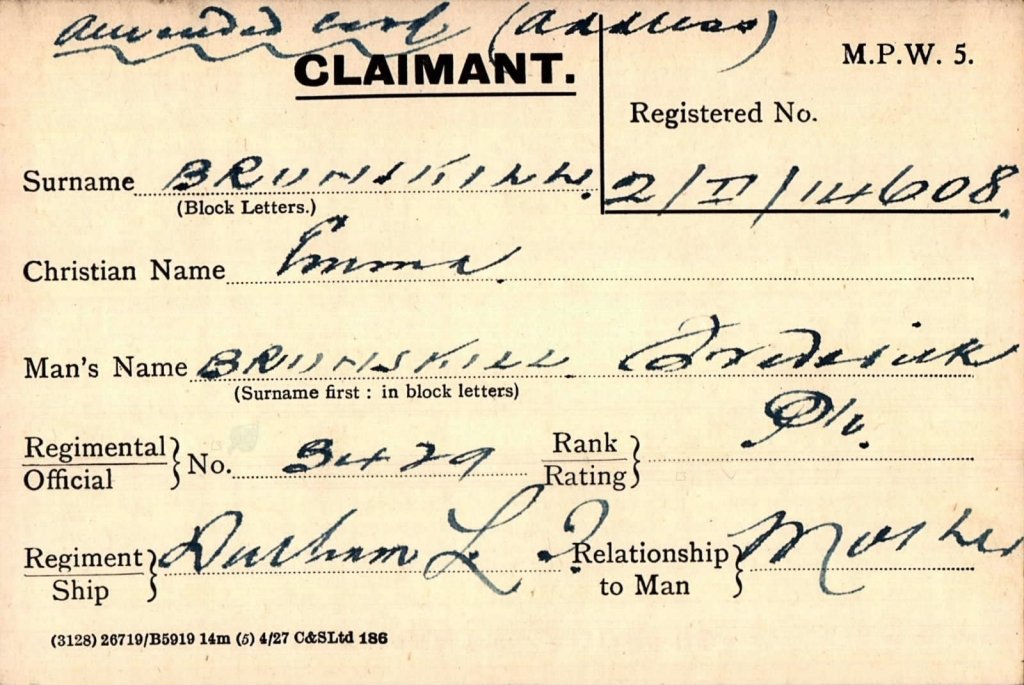
Above: Pension Card for Private F. Brunskill
GEORGE THOMAS COX 1888 – 1916
3472 Corporal George Thomas Cox, 1/6 DLI is commemorated on the Thiepval Memorial, France.[66] He was 29 years old and is commemorated on the Evenwood War Memorial. George Thomas was born c.1888 at Evenwood the son of John and Annie Cox. There were 7 children all born at Evenwood:
- Elizabeth bc.1887
- George Thomas born 1888
- Florence bc. 1890
- Alice bc.1891
- John bc.1895
- Margaret bc. 1899
- June bc. 1901
In 1901, the family lived at the Oaks, Evenwood where 36 year old John worked as a coal miner (shifter). George Thomas (known as “Doad”) worked as a coal miner (pony driver). [67]
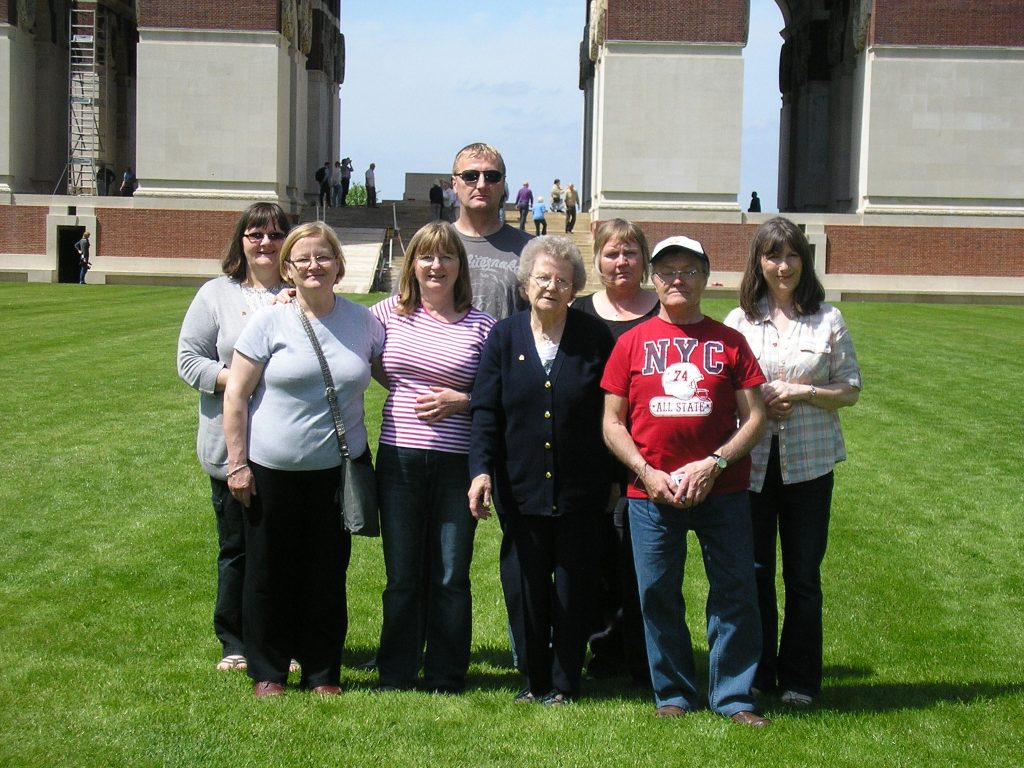
RALPH WILLIAM HEBDON 1891 – 1916
2211 Corporal Ralph Hebdon 1/6 DLI is buried at, grave ref. VIII.B.6 Warlencourt British Cemetery, France [68] and commemorated on the St. Helens Colliery Memorial Cottages. Ralph Hebdon was born 1891[69] at Ettersgill near Middleton in Teesdale. He was 4 months old at the time of the 1891 census and lived with his widowed grandmother Elizabeth Bell, her daughter Margaret Ann Hebdon and son, Leonard Hebdon at Low Beck Head, Forest & Frith, Teesdale. [70] In 1901 he lived with his grandmother, at the same house with her daughter Elizabeth, her son Leonard and another grandson Ernest aged 4. [71] By 1911, 20 year old Ralph lived at Fylands Bridge, Tindale Crescent, Bishop Auckland lodging with his aunt and uncle, Sarah and Michael Bewsher and cousin Thomas. Ralph worked as a coal miner (putter). [72] In 1912, Ralph married Susan A. Labron at Bishop Auckland.[73]
By 1901, Ernest lived at Newbiggin near Middleton in Teesdale with his mother Elizabeth Hebdon and his uncle Leonard. [74] Ernest and Ralph were cousins.[75] Ernest served with 1/7th Northumberland Fusiliers and was killed in action 26 October 1917. [76]

Above: Corporal R.W. Hebdon
ROBERT WILSON 1895-1916
3124 Private Robert Wilson 1/6th DLI is commemorated on the Thiepval Memorial.[77] He was 21 years old and is commemorated on the West Auckland War Memorial and the Roll of Honour, West Auckland Memorial Hall. Robert Wilson was born 1895[78] at Bishop Auckland the son of Thomas and Jane Ann Wilson. There were 6 children, all born at Bishop Auckland:[79]
- Elizabeth bc.1887
- Jane bc.1890
- Robert born 1895
- Alice bc.1897
- Ella bc.1899
- Ada bc.1900
In 1901, the family lived at Woodhouses, Bishop Auckland and 48 year old Thomas worked as a “colliery boilersmith”. [80] In 1911, the family lived at Spring Gardens and Thomas worked as a “boilersmith”, 21 year old Jane was a factory hand and 14 year old Robert worked as a “screener – above ground.[81] [a colliery worker] Later Mrs. Wilson lived at 3 Johnson Terrace, West Auckland.[82]
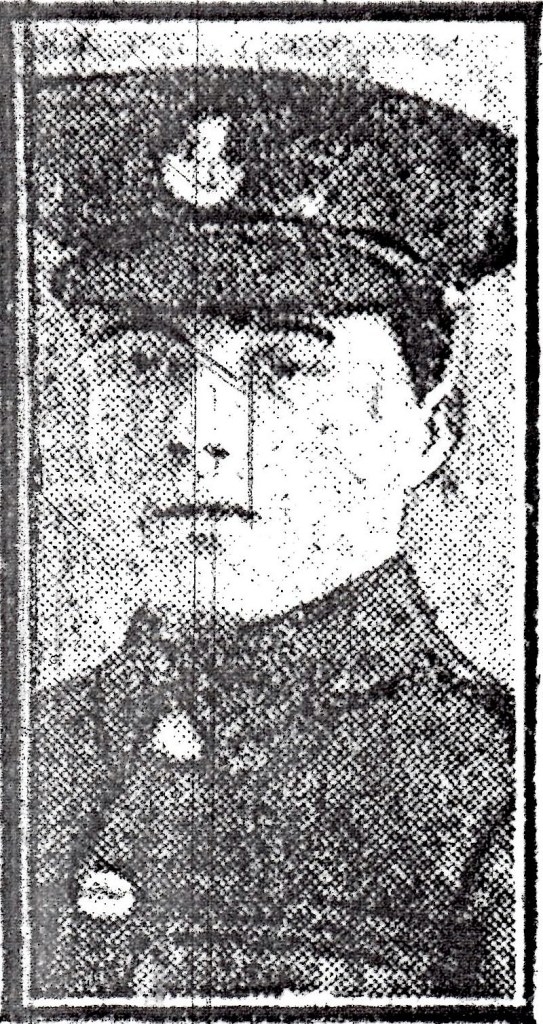
Above: Private R. Wilson
CHARLES JAMES RUSSELL 1898 – 1916
7421 Private Charles Russell, 1/9th DLI died of wounds 8 November 1916 and is buried at grave reference III.E.6 Douchy-les-Ayette British Cemetery.[83] He was 18 years old and is commemorated on the Cockfield War Memorial. Charles James was born 1898 at Poplar, London[84] to James and Elizabeth Russell. There were at least 3 children:
- Elizabeth bc. 1891 at Erith, Kent
- Charles James born 1898 at Poplar, London
- George born 1901 at West Ham, Essex[85]
In 1901, the family lived at Walthamstow where James worked on the railway.[86] By 1911, the family lived at Draft Yard, Cockfield and James worked as a “shift man at the colliery.” Charles was 13 years old and still a school boy. [87]

Above: Medal Roll for Private C. Russell
ALFRED BROWN 1893 – 1916
1672 Private Alfred Brown, 1/6 DLI was killed in action 5 November 1916 and is buried at grave ref. VIII. B.7, Warlencourt British Cemetery, France.[88] He was 23 years old and is commemorated on St. Mary’s Church War Memorial, Staindrop. Alfred was born 1893[89] at Evenwood the son of James and Annie Brown. There were 7 children:[90]
- Alfred born 1893 at Evenwood
- Joseph bc.1897 at Evenwood
- George bc.1900 at Morley
- Jane bc.1902 at Morley
- Francis Annie bc.1903 at Morley
- John James bc.1908 at Wackerfield
- Doris Mary bc.1900 at Staindrop
In 1901 the family lived at Morley where James worked as a coal miner (banksman: pitheap).[91] By 1911, the family lived at Main Street, Staindrop. James aged 44 years worked as a coal miner (hewer), Alfred aged 17 and his brother Joseph aged 14 were coal miners (putters). George aged 11 was at school together with his younger sister Jane aged 9. Other siblings were Francis Annie aged 8, John James aged 3 and Doris Mary aged 7 months. Jonathan Watson aged 57, a widower boarded with the family – he was also a coal miner (a hewer).[92]
In 1914, Alfred married Clara Elizabeth Dent who came from Bedale, North Yorkshire.[93] Their daughter Eleanor was born 3 August 1916. March 1917, Clara lived at Deanery View, West End, Staindrop.[94]

Above: Private Alfred Brown
COMMONWEALTH WAR GRAVE COMMISSION CEMETERIES & THE THIEPVAL MEMORIAL TO THE MISSING OF THE SOMME
WARLENCOURT BRITISH CEMETERY
Warlencourt British Cemetery which lies on to the south east side of Warlencourt 5kms south west of Bapaume. The cemetery was made in late 1919 when graves were brought in from small cemeteries and the battlefields of Warlencourt and Le Sars. It contains 3,505 Commonwealth burials and commemorations from the First World War, 1,823 are unidentified.[95]
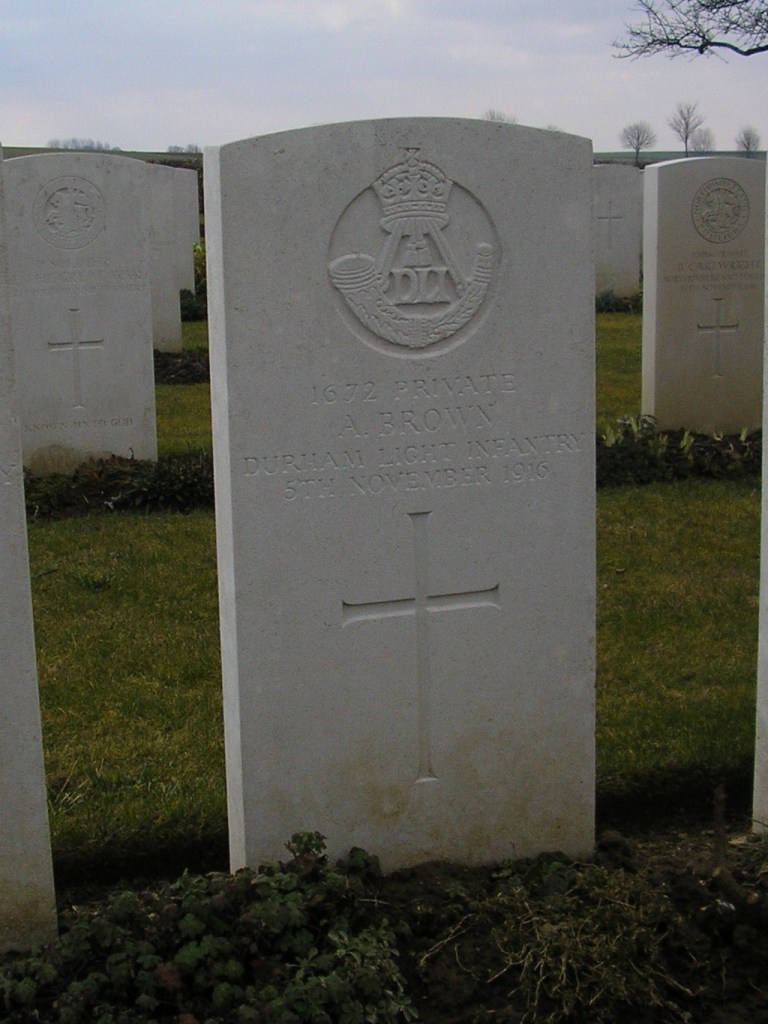
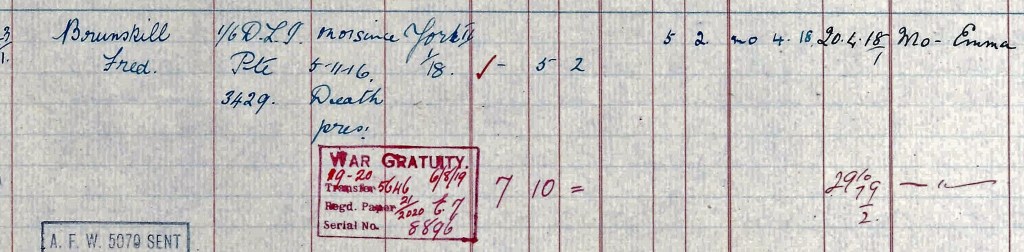
Above: Register of Soldiers Effects – entry for Private F. Brunskill


Above: Headstone of Corporal R. Hebdon
DOUCHY-LES-AYETTE BRITISH CEMETERY
There are now over 700 1914-18 war casualties commemorated on this site, nearly 1/3 are unidentified. Many battlefield graves including that of Private C. Russell were brought reinterred here.[96]

THE THIEPVAL MEMORIAL, THE MEMORIAL TO THE MISSING OF THE SOMME
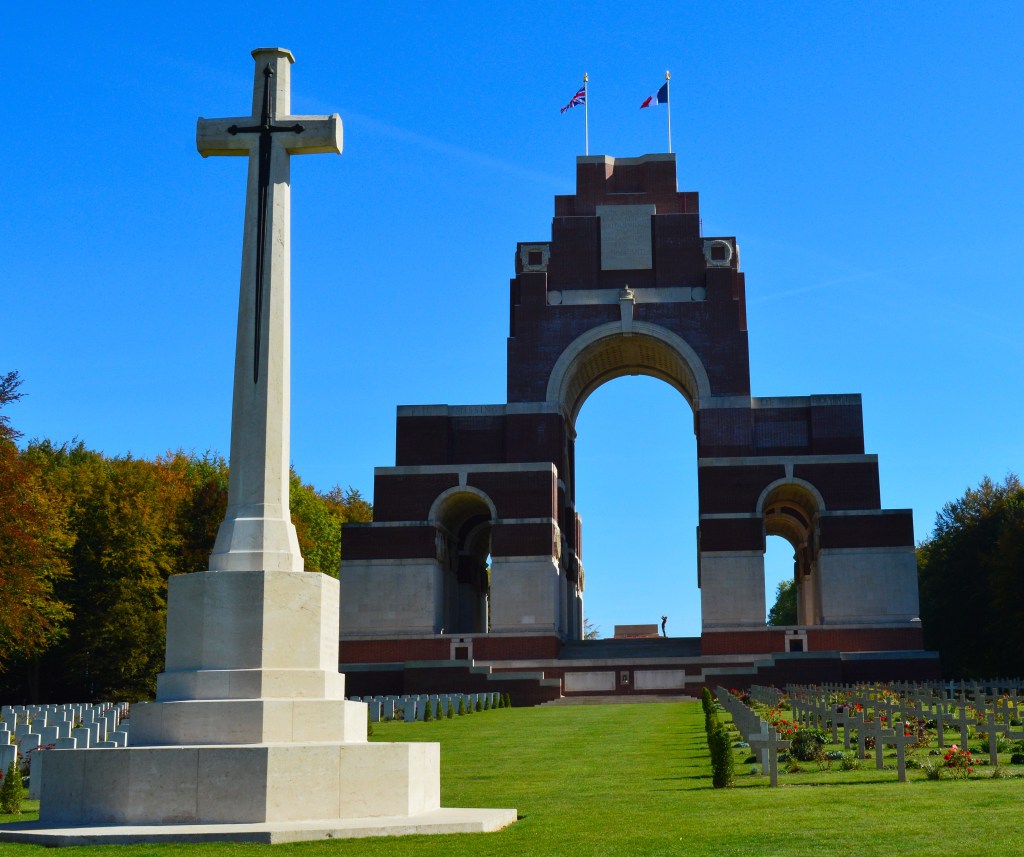
The Thiepval Memorial which bears the names of more than 72,000 officers and men of the UK and South African forces who died in the Somme sector and who have no known grave. Over 90% of those commemorated died between July and November 1916, the duration of what we now call the Battle of the Somme. The memorial, designed by Sir Edwin Lutyens, was built between 1928 and 1932 and unveiled by the Prince of Wales, in the presence of the President of France, on 31 July 1932. [97]

Above: Inscription for Private C. Lowther
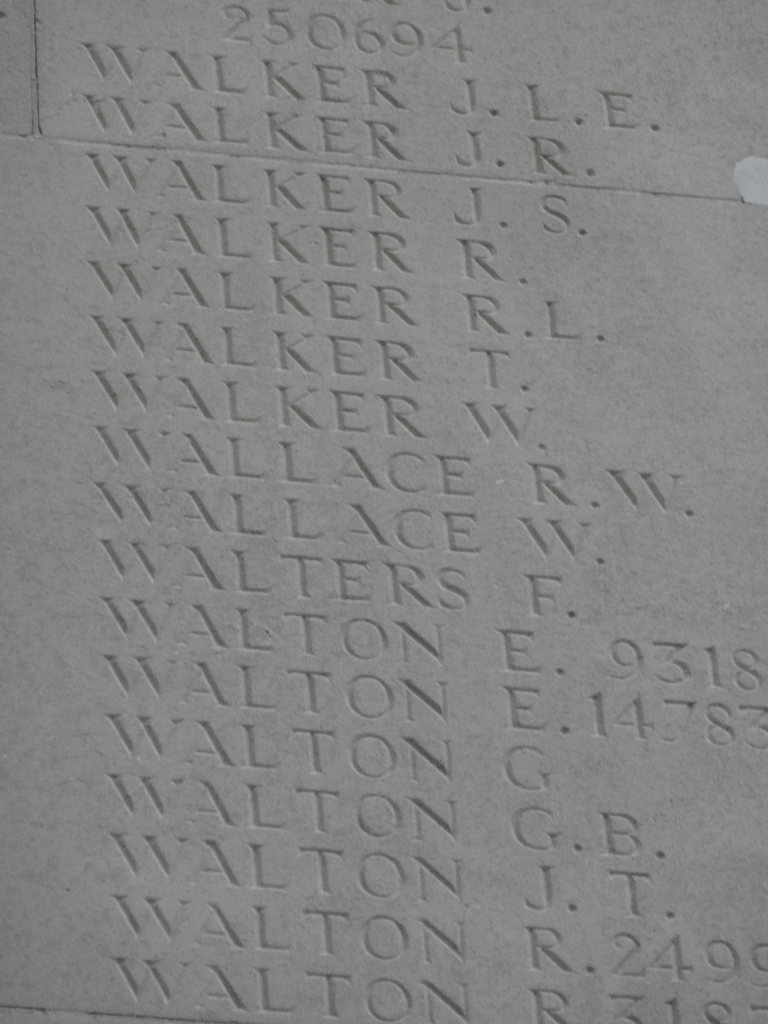
Above: Inscription for Private R.W. Wallace

Above: Inscription for Private J.A. Wardle
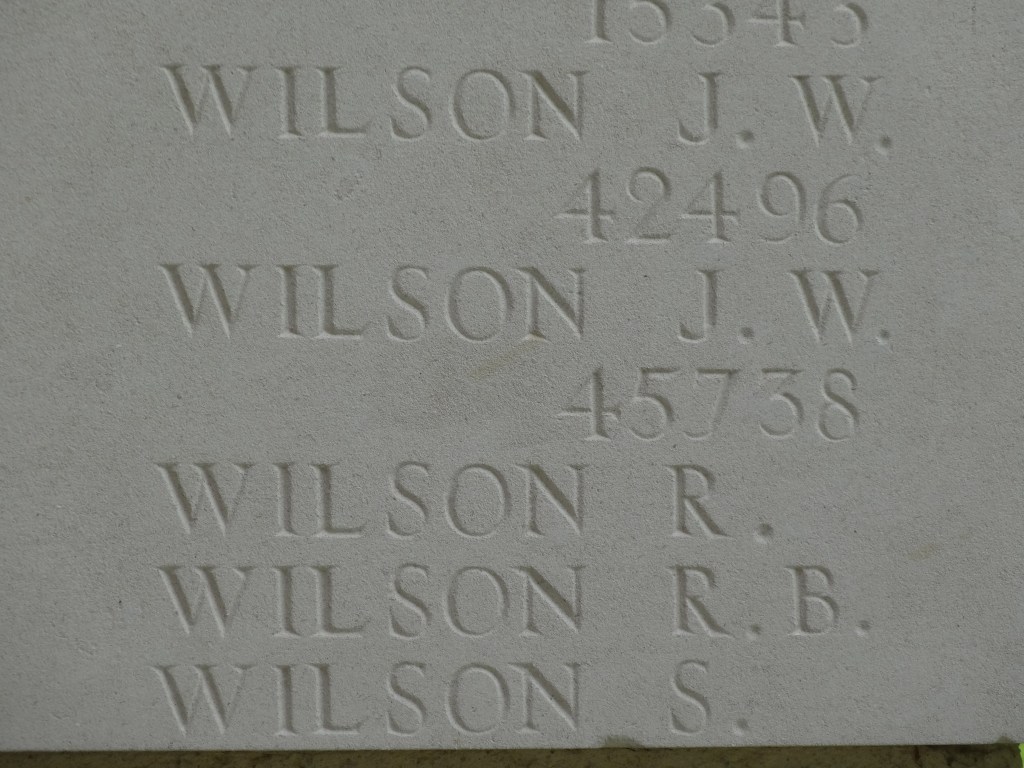
Above: Inscription for Private R. Wilson

Above: Medal Roll for Private R.W. Baker
OTHER LOCAL MEMORIALS & COMMEMORATIONS
Durham Cathedral: The Durham Light Infantry Chapel
The First World War took a terrible toll on the D.L.I. with more than 12,600 dead and thousands wounded. The Regiment was such a part of county life that there was hardly a family that hadn’t suffered. In 1922, the Regiment’s officers and the Cathedral Chapter resolved to create a memorial chapel in the south transept. The Bishop of Durham, Hensley Henson dedicated the Chapel 20 October 1923.

Durham Cathedral: The Book of Remembrance

More than 12,600 names fill the book for the First World War. The pages are turned daily as the books are in date order. Casualties are recorded on the date they died.
Butte de Warlencourt Memorial

The Western Front Association erected a Memorial to those who fell in the capture of the Butte de Warlencourt. The Butte is now clad with trees and the Memorial is positioned to the east on the high ground in a small clearing overlooking the battleground. Due to the dangerous nature of the site, access is by way of a clearly marked footpath. The gate is usually locked and only limited access is available. The Commonwealth War Graves Commission Warlencourt Cemetery is located about a kilometre to the north, visible from the Memorial and here lie other souls who lost their lives in actions about that time.
The Butte is now (2023) in the private ownership of Bob Patterson and details can be found at:
https://www.buttedewarlencourt.com/
St. Andrew’s Church, South Church, Bishop Auckland

The cross was brought to St. Andrew’s and placed in the chapel on the 26th June 1927. The cross is inscribed as follows:
D.L.I. – in Remembrance of The Gallant Officers, N.C.O.’s & Men of the 6th Battn.
The Durham Light Infantry who fell in the attack on the Butte de Warlencourt
Nov. 5th & 6th 1916
A brass tablet is inscribed as follows:
“This wooden Memorial Cross of the 6th Bn. The Durham Light Infantry was originally erected on the summit of the Butte be Warlencourt in the Department of the Somme, France immediately after the severe attack which they made there on the
5th and 6th days of November 1916
The Cross with its plinth was prepared and constructed by the Pioneers of the unit under war conditions from material which was, it is believed, supplied by the Royal Engineers. The Memorial remained where it was erected for nearly 10 years exposed to all the varying climatic conditions of Northern France until the Autumn of 1926 when at the request of the unit it was brought to England and placed in the Church on 26th June 1927”
APPENDIX 1: 1/6 BATTALION DURHAM LIGHT INFANTRY
CASUALTIES: GAUNLESS VALLEY MEN
- 1620 JACKSON Edward [270002]
- 2021 JACKSON John P. then transferred to MGC
- 2142 POLKINGHORN William then transferred to Lancs. Fusiliers
- 2197 PRIESTLEY Gordon [250165]
- 2211 HEBDON Ralph
- 2490 LANE Robert
- 2751 FAIRHURST Thomas
- 2756 FIELD John R. [250264]
- 2943 STEVENS George [250296]
- 2944 SIMPSON Christopher [250297]
- 3101 BAKER Richard
- 3124 WILSON Robert
- 3159 OATES Joseph then transferred to Yorks. Regiment
- 3166 DUNN Thomas W.
- 3171 SMART Robert [250339]
- 3418 GREAVESON Walter [250393]
- 3429 BRUNSKILL Fred
- 3470 SNOWBALL Walter [250400]
- 3472 COX George Thomas
- 3487 HESELTINE James then transferred to York & Lancaster Regiment
- 3529 HARRISON J.C. then transferred to Northumberland Fusiliers
- 3666 LEE Jerry C.
- 3678 SAMS Arthur then transferred to Royal Irish Regiment
- 3803 RUSHFORD Oliver [250440]
- 3851 STOREY William R. then transferred to Loyal North Lancs. Regiment
- 3972 GOWLAND Thomas
- 3973 LAMB William [250467]
- 3974 WALLACE Robert W.
- 4012 OLIVER Edwin A.
- 4073 PINKNEY Thomas
- 4106 HOLLIDAY James
- 4189 CRADOCK A.
- 4333 SIMPSON Thomas W. [250523]
- 4463 LOWTHER Charles
- 4874 JUDGE George then transferred to King’s Own Yorkshire Light Infantry
- 4896 CONLON Robert W. then transferred to York & Lancaster Regiment
- 8774 TALLON William [?]
- 30238 CLARKE John
- 251168 SMITH Thomas
- 252054 MIDDLEMAS Mark Goliath discharged as over age then re-joined the colours
APPENDIX 2: FOR INFORMATION
TERRITORIAL FORCE RE-NUMBERING
FROM 1 JANUARY 1917 & TOOK EFFECT 1 MARCH 1917
DURHAM LIGHT INFANTRY
200,001 – 250,000: 5/DLI
250,001 – 275,000: 6/DLI
275,001 – 300,000: 7/DLI
300,001 – 325,000: 8/DLI
325,001 – 350,000: 9/DLI
350,001 – 375,000: 26/DLI
375,001 – 400,000: 27/DLI
Source: http://www.1914-1918.net/TF_renumbering_infantry.htm
LEST WE FORGET
REFERENCES
With thanks to Chris Baker and the Long Long Trail website – a great resource – https://www.longlongtrail.co.uk/about/
And the late Harry Moses for his book “The Faithfull Sixth”.
[1] http://www.1914-1918.net/dli.htm
[2] http://www.1914-1918.net/50div.htm
[3] The 6/DLI was to become known as the 1/6 DLI – the first line of the battalion. There was a second line, which was referred to as 2/6 DLI
[4] Various sources including http://www.1914-1918.net, Peter Hart “The Somme” Keegan “The First World War”
[5] Capt. Ainsworth “The 6th Battalion DLI in the Great War & H. Moses “The Faithfull Sixth”
[6] National Archives catalogue reference WO/95/2840
[7] Soldiers Died in the Great War
[8] Officers Died in the Great War
[9] Commonwealth War Graves Commission
[10] England & Wales Birth Index 1837-1915 Vol.10 p.238 Teesdale 1887 Q3
[11] 1891 census
[12] 1901 census
[13] England & Wales Marriage Index 1837-1915 Vol.10a p.531 Teesdale 1908 Q2
[14] 1911 census
[15] Brentford photograph & conversation with Neville Kirby (Cockfield)
[16] Commonwealth War Graves Commission
[17] England & Wales Birth Index 1837-1915 Vol.10a p.272 Teesdale 1893 Q2
[18] 1911 census
[19] England & Wales Marriage Index 1837-1915 Vol.10a p.447 Auckland 1913Q4
[20] Commonwealth War Graves Commission
[21] Cockfield Council School Admissions Register
[22] There are 2 RWW recorded, Q3.1894 Teesdale Vol.10a p.260 and Q1.1895 Auckland Vol.10a p.244 His birth certificate has not been researched
[23] 1901 census
[24] Cockfield Council School Admissions Register
[25] 1911 census
[26] Commonwealth War Graves Commission
[27] CWGC
[28] England & Wales 1837-1915 Birth Index Vol.10a p.230 Auckland 1888 Q2
[29] 1891, 1901 & 1911 census records
[30] 1891 census
[31] 1901 census
[32] 1911 census Note: Charles Lowther not traced
[33] Commonwealth War Graves Commission
[34] Select Births & Christenings 1538-1975
[35] 1901 census
[36] England & Wales Marriage Index 1837-1915 Auckland 1906 Q1
[37] 1911 census
[38] CWGC
[39] England & Wales Birth Index 1837-1915 Vol.10a p.208 Auckland 1880 Q1
[40] 1891 census
[41] 1901 census
[42] 1891 census
[43] England & Wales Marriage Index 1837-1915 Vol.10 p.390 Sedgefield 1914 Q3
[44] CWGC
[45] CWGC
[46] Commonwealth War Graves Commission
[47] CWGC
[48] Hart
[49] “The Fighting Bradfords” H. Moses p8
[50] http://www.dmm.org.uk/company/w031.htm
[51] Moses
[52] Moses
[53] Hart
[54] 6/DLI War Diary (Vol. 20 renumbered Vol.17)
[55] Officers & Soldiers Died in the Great War
[56] “Machine Gunner 1914-1918” C.E. Crutchley 1973 p77-81
[57] “Machine Gunner 1914-1918” C.E. Crutchley 1973 p77-81
[58] CWGC
[59] Commonwealth War Graves Commission
[60] England & Wales 1837-1915 Birth Index Vol.10a p.256 Auckland 1897 Q2
[61] England & Wales 1837-1915 Marriage Index Vol.10a Auckland 1897 Q1
[62] 1901 & 1911 census
[63] 1901 census
[64] England & Wales 1837-1915 Death Index Vol. 10a Auckland 1906 Q1
[65] 1911 census
[66] Commonwealth War Graves Commission
[67] 1901 census
[68] Commonwealth War Graves Commission
[69] England & Wales BMD Birth Index Teesdale Vol.10a p.272 Q1 1891
[70] 1891 census
[71] 1901 census
[72] 1911 census
[73] England & Wales Marriage Index 1837-1915 Auckland 1912 Q2 Vol.10a p.347
[74] 1911 census
[75] Teesdale Mercury 7 November 1917: In Memoriam
[76] Commonwealth War Graves Commission
[77] Commonwealth War Graves Commission
[78] England & Wales Birth Index 1837-1915 Vol.10 p.201 Auckland 1895 Q2
[79] 1901 & 1911 census
[80] 1901 census
[81] 1911 census
[82] CWGC
[83] Commonwealth War Graves Commission
[84] England & Wales Birth Index 1837-1915 Vol.1a p.630 Poplar London 1898 Q3
[85] Ditto Vol.4a p.304 West Ham Essex 1901 Q2
[86] 1901 census
[87] 1911 census – probably should have been recorded as a “shaftsman”
[88] Commonwealth War Graves Commission
[89] England & Wales Birth Index 1837-1915 Vol.10a p.229 Auckland 1893 Q4
[90] 1901 & 1911 census
[91] 1901 census
[92] 1911 census
[93] England & Wales Marriage Index 1837-1915 Vol.10a p.583 Teesdale 1914 Q3
[94] Effects Form
[95] CWGC
[96] CWGC
[97] Commonwealth War Graves Commission
 EVENWOOD RAMSHAW & DISTRICT HISTORY SOCIETY