THE GOOD PEOPLE OF EVENWOOD WERE NOT HAPPY
The Dispute
On the 7th of October 1865, the Newcastle Chronicle reported that an “exciting scene between a clergyman and his parishioners” had taken place at Evenwood near Bishop Auckland.
At this time, there was no Anglican Church. Those of this faith tended to use St. Helen’s Church. There was a Primitive Methodist Chapel at Evenwood and a Wesleyan Methodist Chapel at Oaks Bank. The Roman Catholics did not have an established church in the village and travelled to Gainford. The Church of England authorities wanted to build a church in order to offer services for the growing population. It could be argued that the Methodists presented a challenge to the established church of the nation since it found support in the growing industrial communities, particularly the in the mining villages of County Durham.
In response to this, the Ecclesiastical Commissioners granted the vicar, the Rev C. Palmer, part of Evenwood village green on which to build a church with a yard and enclosure. The newspaper reported:
“Some of the parishioners disputed the legality of this means of disposing of the ground and on its being rumoured that formal possession of the green would be taken on Thursday for the purpose of building a church with cemetery attached, the villages gathered in considerable numbers about the middle of the day.”
“Amongst the company were some of the principle inhabitants who expressed their determination to prevent by every possible means any attempt to deprive them of their place of recreation by turning it into a graveyard.”
The principal protagonists were Mr. Vart, senior and junior, Mr Jacob Wright, Mr Bowbank and Mr Matthew Bowman. The vicar and his party arrived shortly after midday and sparked a 6-hour stand-off with a group of “dissentients” who were determined to “prevent the consummation of the undertaking”.
At 6pm, after an afternoon of antagonism, the architect, John Ross, arrived from Darlington with the church plans. On the ground on the green, Mr Ross laid out the 4 stobs – pieces of wood – to represent the 4 corners of the proposed church.
“As soon as he attempted to drive in the first one, Mr Bowman stepped forward and said, “We don’t intend to allow that” and suiting the action to the word, he kicked the piece of wood and broke it into pieces and following Mr Ross to the other 3 corners made all the “stobs” disappear by the same process.”
The vicar called on the policeman, Superintendent Henderson to take Mr Bowman into custody and Supt. Henderson said it would be appropriate for a summons to be taken out against the stob-kicker so that he could be tried for wilful damage. A deputation of the leading villagers then descended on the Bishop of Durham, The Right Reverend Charles Thomas Baring[1] in Auckland Castle. The article concluded:
“His lordship who promised them to go to Evenwood to see the place and do all he could to amicably and peaceably settle the dispute and here the matter now rests.”
Who were the leading Protesters?
They were described as “some of the principle inhabitants.” The Electoral Roll records men able to vote at General Elections. At this time, few men were able to vote and, as such, they would have been regarded as leading members of the local community.
Messrs. Vart, senior and junior. The 1868 Electoral Roll for the Parish of Evenwood identifies 4 men named Vart. They are John and Ralph from Evenwood Mill, Ralph from Ramshaw and William from Evenwood. The baptism of John Vart was recorded in the Quaker Quarterly Meetings for Staindrop. It is likely that John’s parents, Ralph and Hannah, were practising Quakers and as such would have strong views on most subjects which may have been passed down their children. The siting of a church and its graveyard on the village green, directly opposite the Primitive Methodist Chapel may have been such a subject where strong opinions were exchanged. Although not specifically named, we think that John Vart and one of his sons took part in the protest. In 1861, John Vart was a miller and farmer of 172 acres employing 5 men. He was succeeded by his son Ralph at Evenwood Mill and perhaps Ralph joined the protest. We will never know unless names are provided in other sources.
John Vart’s daughter Hannah married Thomas W. Bowbank. She sadly died in 1862. Thomas remarried in 1864. He was a farmer of 216 acres and another included on the Electoral Roll thus a man of high standing. We think his farm was Kays Hall Farm, Evenwood. By October 1865, he was about 41 years old and joined his father-in-law and brother-in-law in the protest.
Jacob Wright was born in 1800 at St. Helen’s Auckland. He appears in the 1851 census as a farmer of 60 acres, the 1861 census as a farmer of 25 acres and 1871 as a “retired farmer.” It is likely that he sold his land to one of the coal companies working Thrushwood and/orTees Hetton Collieries. He was another included on the Electoral roll of 1868. His standing in the community was to rise in the years following his death in 1882. He established a charity which built homes for the elderly of Evenwood and surrounding area. In 1885, the Jacob Wright Almshouses were dedicated to his name.
Matthew Bowman was about 48 years old, a man from Northumberland, who typical of his calling, worked at various pits throughout the district including those at Shildon and Coundon before moving to Evenwood in the mid-1850s. His 3 sons were also coal miners. By 1871, he was an overman at one of the collieries. Not being a land or property owner, he was not eligible to vote. Perhaps he was a Primitive Methodist and since the chapel was sited opposite the enclosure intended for the grave yard, he held a strong opinion on the suitability of the site and the loss of recreational land for the public. It is evident that Matthew Bowman took direct action in kicking down the timber stakes, then called stobs.
The Resolution to the Dispute
We have seen no details of the meeting which took place but the way development proceeded seems to indicate an amicable agreement. As we see the scene today, St. Paul’s church was built and stands in an enclosure behind a stone wall. It is a small tree-lined plot without a graveyard. The church was consecrated in September 1867 and could seat 800 worshippers. The green to the immediate north of the enclosure is bounded by a timber fence. The large village green lies beyond to the south. The cemetery is located at Oaks Bank, some distance to the north along the road to Ramshaw.
It looks as if the bishop was able to compromise with the protesters of Evenwood and most of the village green was retained. Although the northern section bounded by the timber fence is not part of the registered village green. This land is still held by the Church Commissioners,[2] the successors to the Ecclesiastical Commissioners.[3]
The rest of the village green is “registered” and covered by legislation which protects it’s use for the public recreation. It is to be hoped that the deeds of Mr. Vart, senior and junior, Mr Jacob Wright, Mr Bowbank and Mr Matthew Bowman were not in vain.
PHOTOGRAPHS

Above: 1859, the first edition OS Map to show Evenwood Green

Above: 1898, the 2nd edition of the OS Map to show St. Paul’s Church
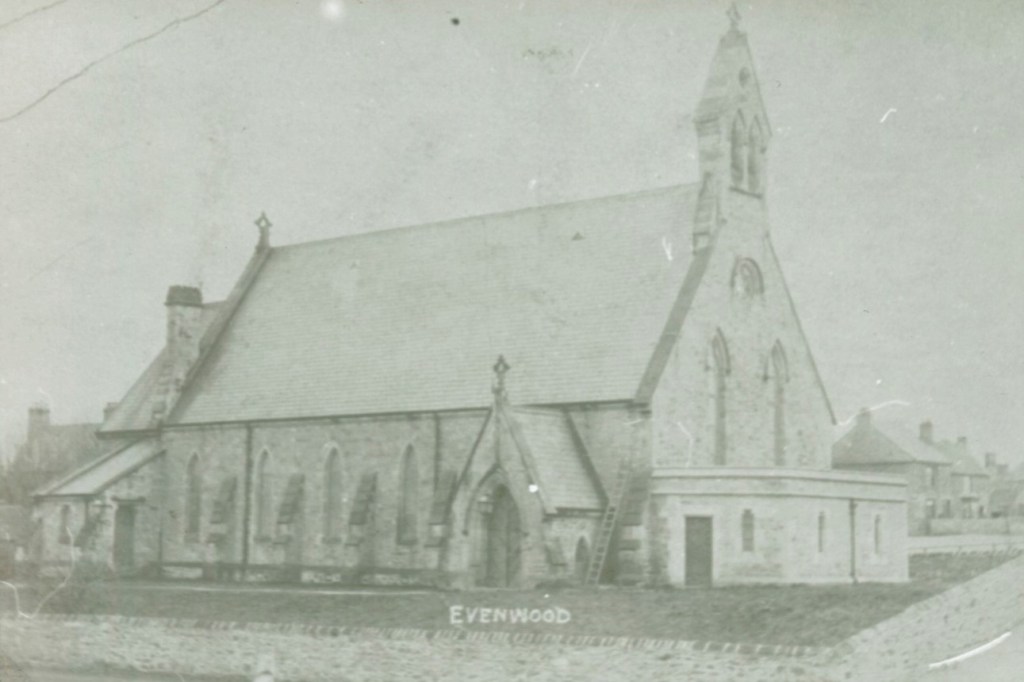
Above: St. Paul’s Church
ACKNOWLEDGEMENTS
ER&DHS member Brenda Robinson, now sadly departed
Chris Lloyd, Northern Echo article dated 10 October 2015
REFERENCES
[1] Between 1861 and 1879, The Right Reverend Charles Thomas Baring was the Bishop of Durham.
[2] The Church Commissioners, in the Church of England, is an organization established in 1947 that joined two corporations, Queen Anne’s Bounty and the Ecclesiastical Commissioners (the actual merger took place in 1948); it helps with the expenses of poor parishes. The Governors of the Bounty of Queen Anne for the Augmentation of the Maintenance of the Poor Clergy was established by Queen Anne in 1704.
[3] The Ecclesiastical Commissioners were created by act of Parliament in 1836. Subsequent legislation greatly extended their administrative powers and also vested in them a great deal of church property. The income from the property was primarily used to augment the clergy’s income.
 EVENWOOD RAMSHAW & DISTRICT HISTORY SOCIETY