VARIOUS LEGAL DOCUMENTS
ER&DHS received a number of documents associated with Railey Fell, Bitchburn and Brusselton Collieries. They are a series of legal agreements made over a 30-year period between 1781 and 1811 involving Richard Peirse, his son and heir Richard William Christopher Peirse and John Flintoff. Other characters were involved in the decision making process, such as, among others, William Stobart and John Smith (both viewers). George Dixon from Cockfield was also mentioned.
The above mentioned Richard William Peirse of Thimbleby Lodge, near Osmotherley was the grandson of Thomas Peirse who obtained the 1714 lease for Carterthorne Colliery and the son of Richard and Rachael Peirse. (Refer to the post relating to the 1714 lease elsewhere on this website.)
The following provides an insight into how business operated at the turn of the 18/19th centuries in the fledgling coal industry of south west Durham prior to the opening of the Stockton and Darlington Railway which revolutionised industry in the north east and wider world.

Above: 1768: A Detail from Armstrong’s Map of County Durham showing rural scenes including a small coal pit worked by 2 men with a windlass,
12 November 1781: An agreement was made between:
- Charles Fawcett, Recorder of Newcastle-upon-Tyne & John Flintoff
- Richard William Peirse
To work Railey Fell, Bitchburn and Brusselton Collieries. The term of the lease was 31 years from 1 December 1781 which would take the agreement to 1812. Mr. Flintoff could give up the lease after 7, 14, 21 or 28 years (i.e. 1788, 1795, 1802 or 1809).
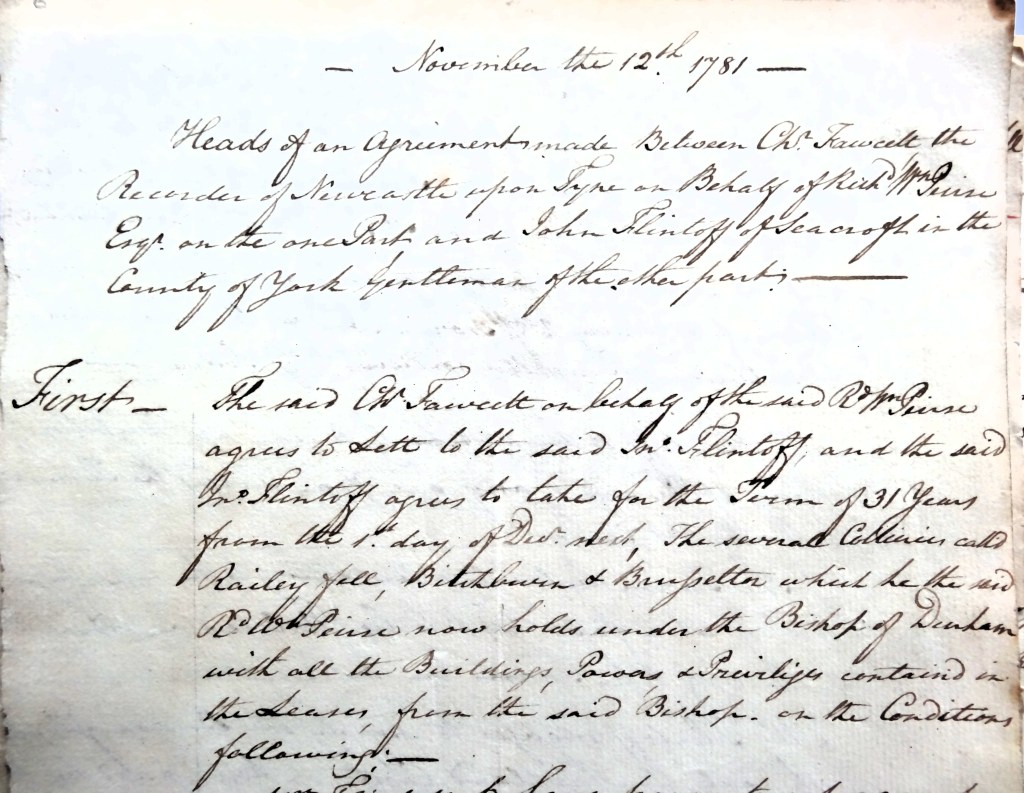
Above: 12 November 1781: Heads of Terms of the Agreement
The main terms were that:
- Mr. Flintoff could get 9000 scores of corves from Railey Fell Colliery, (22 corves to the score, 8 pecks to the corf), for which he paid an Annual Rent of £800 in quarterly payments whether that quantity was achieved in any one year or not.[1]
- And 2000 scores of like corves from Bitchburn Colliery, for which he paid £100 per annum by quarterly payments.
- Also 2000 scores from Brusselton Colliery for which he paid £100 per annum by quarterly payments.
- Mr. Flintoff agreed to pay for overworking at Railey Fell Colliery at the rate of 2 shillings per score and for the overworking at Bitchburn & Brusselton Collieries, 1 shilling per score.
- Mr. Flintoff was at liberty to give up Brusselton Colliery at the end of any year during the term by giving 12months notice.
- The farm belonging the colliery to be taken by Mr. Flintoff at a fair rent to be valued according to the rate of the farms in the neighbourhood.
- Mr. Flintoff to supply the Bishop of Durham with coal at Auckland Castle on being paid by the Bishop 1d p (per) horse load and 4d per cart load.
1 December 1781: Railey Fell Colliery was “entered upon”, presumably this means coal was drawn. Since there was only 2 weeks between the signing of the agreement and the drawing of coal then it is assumed that the pit was either already won i.e. a working pit or the coal was very near to the surface and took little time to find.

Above: Confirmation that Railey Fell Colliery was “entered upon” 1 December 1781
2 January 1783: Brusselton Colliery was “entered upon”.
2 April 1783: Bitchburn was “entered upon”. A Mr. Jackson was the previous tenant of Brusselton & Bitchburn Collieries.

Above: Confirmation that Brusselton was entered 2 January 1783 and Bitchburn 2 April 1783
21 August 1784: Mr. Flintoff “gave up” Brusselton Colliery having only worked it for less than 2 years, 1 year 7 months.

Above: Confirmation that Brusselton Colliery was given up 21 August 1784
5 December 1782 to 1810: The table shows the annual amount of coal drawn from Etherley & Railey Fell Colliery and Bitchburn Colliery. The 1781 agreement mentions Railey Fell Colliery however the table below lists Etherley & Railey Fell – this infers that there were 2 different collieries. The location of Railey Fell Colliery is presently unknown. Brusselton Colliery was given up, short of 2 years in operation. Was the Etherley Colliery later known as “Old Etherley Colliery” and situated near Witton Park?
The quantities were given in scores and corves. The agreement defines that there were 22 corves to the score and 8 pecks to the corf. The corf was a tub or large basket used to bring coal out of the pit. One peck, as a measure of dry goods, was 12 pounds (lb) in imperial weight. It should be noted that some sources quote 14 lb.
The output of Etherley & Railey Fell Colliery exceeded the agreed 9000 score in 8 of the 29 years worked. Bitchburn did not exceed its output quota of 2000 score.
For the purpose of this calculation, both weights (12lb & 14 lb) will be used. The agreed output of 9000 score will be used to illustrate the amount of coal drawn from Etherley/Railey Fell Collieries in imperial weight measures.
9000 score x 22 corves = 198,000 corves x 8 pecks = 1,584,000 pecks x 12 pounds = 19,008,000 lb which (divide by 2240) is 8,486 tons pa, about 163 tons per week, 27 tons per day (assuming the pit worked 52 weeks per year and 6 days per week). If the larger weight of 14 lb is to be used in the calculation, then the weight is 22,176,000/2240 = 9,900 tons pa., roughly 192 tons per week, 32 tons per day. The output is estimated to be between 163 and 192 tons of coal per week.
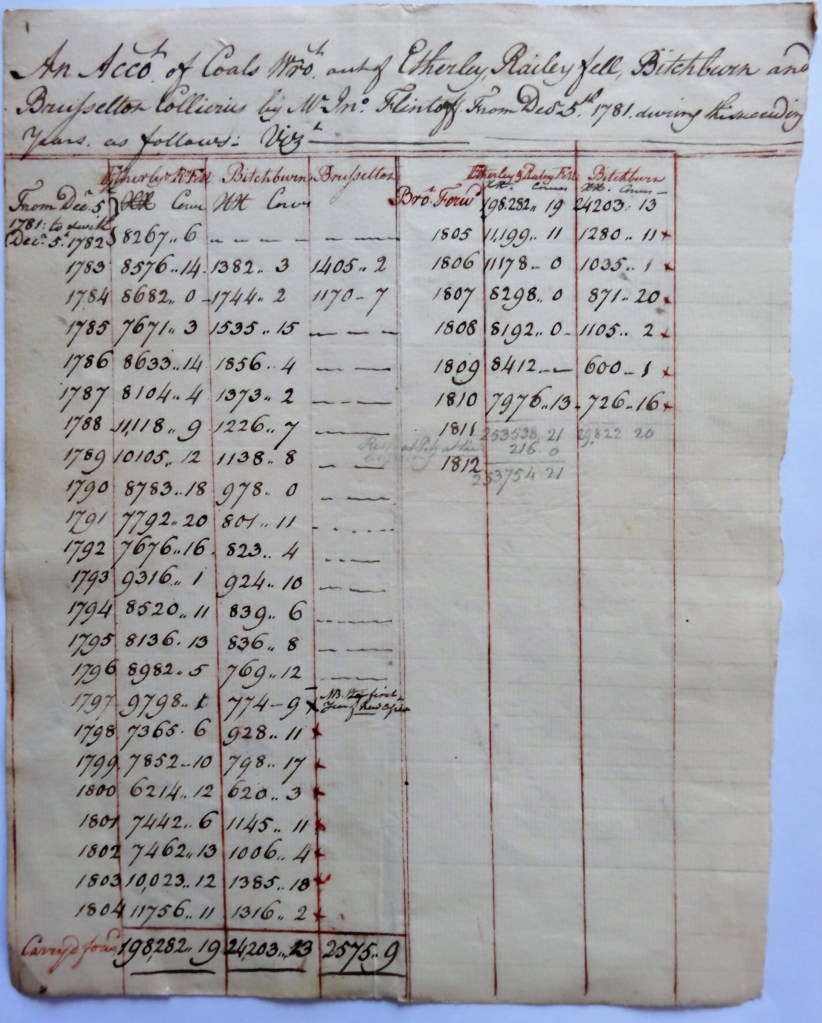
Above: Table to show the output from Etherley & Railey Fell Collieries, Bitchburn and Brusselton Collieries, 1781 to 1810.
24 December 1787: An agreement was made to settle a dispute between John Flintoff and Gorge Dixon and partners. Mr R.W. Peirse was involved in his capacity as the holder of the lease. The issue was examined by 2 Viewers, John Smith (Houghton-le-Spring) & William Stobart (Fatfield). At the Railey Fell Colliery (which is defined as the Lands Pit in Bunker Hill Colliery)[2] an “outstroke” took place into the adjoining colliery of Mr. George Dixon of Cockfield & Partners. Presumably, this means that the workings from the Flintoff pit entered the workings of the Dixon pit, taking its coal. The situation was investigated by the 2 viewers and the verdict was that Flintoff had caused the problem. A remedy was agreed to make good the situation. The report is written using the mining vocabulary of the day but I do not understand the terminology. A specialist mining engineer with knowledge of historic terms is required to translate the exact meaning of the agreement. John Smith was the author of the agreement which was counter signed by William Stobart. John Flintoff approved the report.
Other names of pits were Sand Pit owned by Dixon and Bolton Pit owned by Flintoff. Dixon had another pit at Green Field near a colliery owned by Sir John Eden where a similar issue was cited.[3]

Above: 1787, Introduction to the Report prepared by John Smith & William Stobart, Viewers which led to the Agreement dated 24 December 1787.
4 November 1796: At Bitchburn Colliery, quantities of coal fell short of the agreed output. Flintoff sought permission from Peirse to take more coal from Etherley & Railey Fell Collieries. An agreement was reached, dated 4 November 1796.

Above: Part of the Agreement 4 November 1796
1802 – 1810: In accordance with the terms of the agreement, coals were supplied to the Bishop of Durham and the following table gives details of the period 1802 to 1810:

Above: A detail of a page which shows a table relating to the Amount of Coal supplied to the Bishop of Durham at Auckland Castle.
18 July 1811: For an unknown reason, Mr. Peirse made a schedule of his properties which were occupied by Mr. Flintoff. It is likely that Mr. Peirse was getting his affairs into good order with a view to disposing of his assets. To take speculation further, perhaps Mr. William Stobart, the Viewer, or other members of his family were interested in purchasing the whole coal mining and property business or perhaps offered advice to other family members.
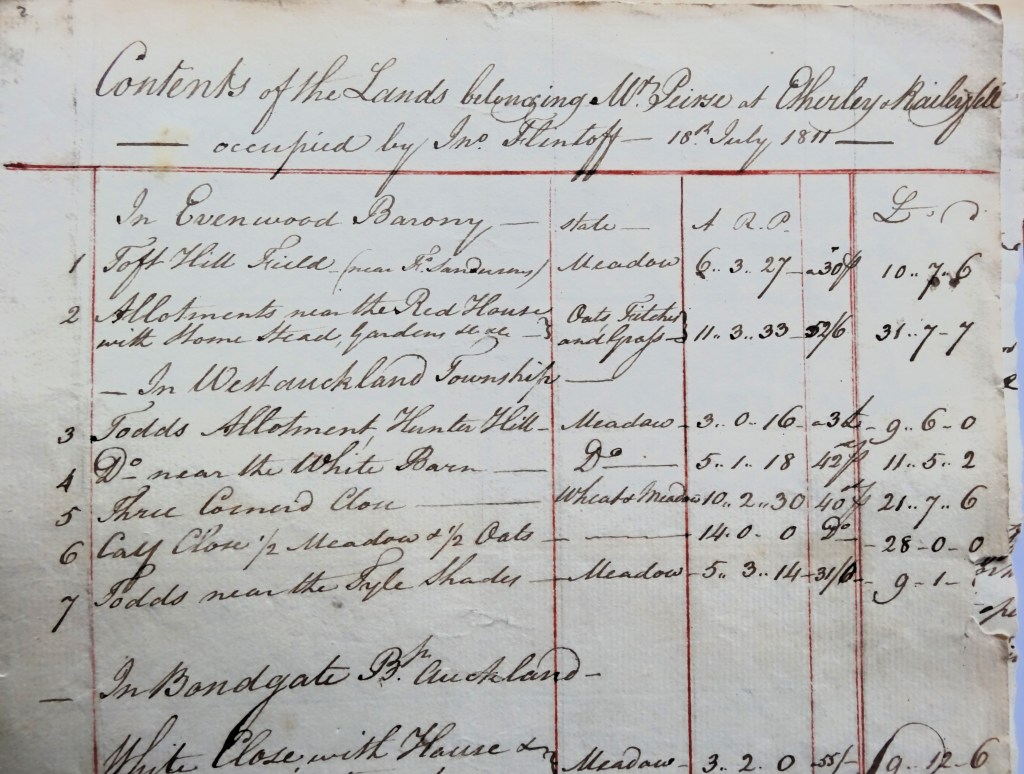
Above: Land belonging to R.W. Peirse in Evenwood & Barony and Bondgate, Bishop Auckland occupied by John Flintoff.
29 July 1811: A meeting was held between Mr R.W.C Peirse and John Flintoff. Mr Flintoff proposed to renew the agreement of the Railey Fell & Etherley Collieries. It was proposed to give Mr. Peirse £2500 per annum[4] and for Flintoff to work 10,000 scores of 10 peck corves, of 22 corves to the score, for the term of 14 years from the 5 December 1812. The agreement was signed 8 December 1812 and witnessed by Henry Hirst, George Ford Clarke and William Stobart. The agreement would expire, 14 years hence, in December 1826. The increased output raised the limit to between about 11, 786 to 13,750 tons pa.[5]
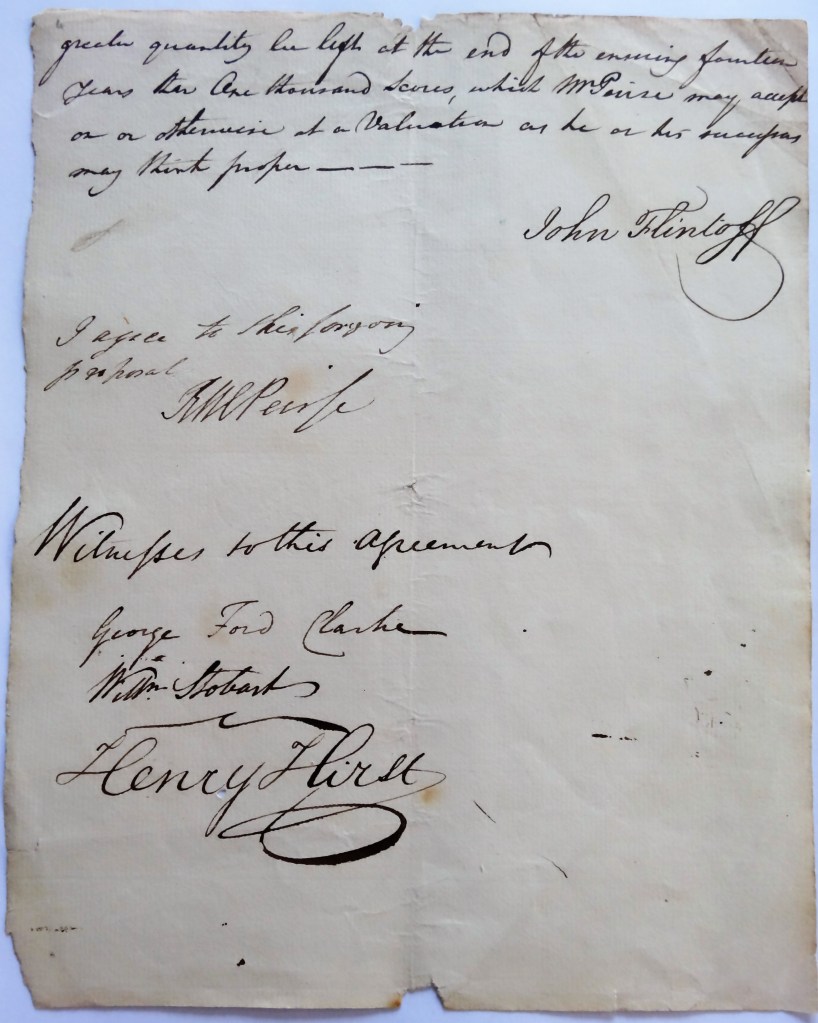
Above: A detail of the last page of the Agreement dated 29 July 1811
OBSERVATIONS
Research indicates that there are leases dating back to 1383, 1425, 1525, 1569, 1647 and 1784 which relate to Railey Fell.[6] British Coal records at Coal House, Team Valley, Gateshead (now probably with the Coal Authority HQ) indicated that unnamed seams were abandoned at Etherley and Railey Fell Collieries.[7]
Richard William Peirse died November 1798. His heir was Richard William Christopher Peirse (1781-1844) and the family then lived at Thimbleby Lodge (later called Thimbleby Hall). The family chapel, where many are buried, is at Hutton Bonville.[8]
The 1759 Land Tax Return for Evenwood & Barony records that a colliery was the property of Mr. Peirse. From 1783 to 1827, the Land Tax Returns record that members of the Flintoff family occupied land owned by members of the Peirse family. Various entries related to the Peirse family – Richard William Peirse, R.W. Peirse., R., R.W. and then a Robert (?) The Flintoff family have 2 entries as Mary Flintoff in 1810 and 1812 and the 1824 entry is recorded as. “the exrs of Mr. Flintoff”. 1827 is the last Flintoff entry. In 1828, the Peirse land was occupied by Henry Stobart.
It is assumed that Henry Stobart acquired the Railey Fell lease about 1827/28.[9] The Stobart family may also have bought the properties within Etherley and the Railey Fell area. For instance, the land owned by Rachael Peirse recorded on the Allotment Plan surveyed in 1769 by Richard Richardson and situated north of Red House, was later developed for a large property known as Etherley Lodge. It was owned by the Stobart family.[10]
John Flintoff had other coal mining interests in the area. A 1796 plan shows Norwood Colliery situated to the immediate east of the modern day village of High Lands. It was the property of the Earl of Strathmore and worked by George and John Dixon together with John Flintoff. The plan of the workings shows that there were a number of pits and drifts, some with names – Lane Side Pit, East Field Pit, Quick Hedge Pit, Dyke Pit. A water course led down from the site to the River Gaunless. There were 2 roads leading to the colliery, one from Butterknowle Lane to the west and one from Evenwood Bridge, known as Norwood Lane.[11]

Above: The Title block of the 1796 plan of Norwood Colliery
1821-30: The Strathmore Estate Plan is undated but likely to have been printed between 1821 and 1830 since: [12]
- 1820: The 10th Earl of Strathmore died. He left his estate to his wife, Mary and 5 other Trustees, in the name of his son. The notation, “Evenwood Park belonging to the Trustees of the late Earl of Strathmore” is used therefore it is post 1820/21.
- 1830: The Haggerleases branch railway line entered the Gaunless Valley and it is not marked on the map. Such an important feature is likely to have been surveyed and had it been present would have been indicated on the map.
This plan shows 3 estates on the Railey Fell area and all have indications of coal mining, either named or unnamed pits and boreholes:
- The Gordon Estate belonging to John Trotter Esq. – there are 4 named pits, Gordon, Healey, Jacksons and Hodgsons, a new winning to the north of Gordon Pit, 6 old pits to the west of Gordon Gill with the note, “old pits won by a level made from Gordon Beck” and a slag heap to the extreme northwest of the estate. The Gordon Pit was recorded on Bell’s maps and the first OS map of 1859.[13]
- The Ramshaw Estate belonging to Thomas Humphries – there are 4 named pits, A or Mary, B and C Pits, Ramshaw Engine Pit at 8 fathoms and 5 unnamed pits either side of the coal road which leads eastwards to King Pit and an unnamed pit, both lie outside the boundary of the estate. There are 5 boreholes within the estate. [14]
- Evenwood Park belonging to the Trustees of the late Earl of Strathmore – this is the most developed estate with a coal road leading from Evenwood Bridge over the River Gaunless along the eastern boundary of the estate (called Norwood Lane on the 1796 plan). There are 10 named pits, Isabella, Tube, Nook, William, Bowes, North, another Tube Pit, Birch Tree, Norwood Engine Pit 20 fathoms and Dyke Pit, 6 unnamed pits and 4 named Crow Coal Pit. There are 4 pits, south of the River Gaunless with the notation, “4 pits sunk to the yard coal seam”. These workings were known collectively as Norwood Colliery and worked by Dixon and Flintoff. The Earl of Strathmore petitioned for this colliery to be linked into the proposed railway being promoted by the Stockton & Darlington Railway Company. He was successful and the Haggerleases Branch struck off from St. Helen’s Auckland along the Gaunless Valley and terminated at Haggerleases Lane near Butterknowle. It ran to the south of the colliery and was opened in 1830. Initially, a tramway named the Isabella Railway linked the “old” Norwood Colliery into the new Norwood Colliery and coke works which were established to the immediate north of the railway.
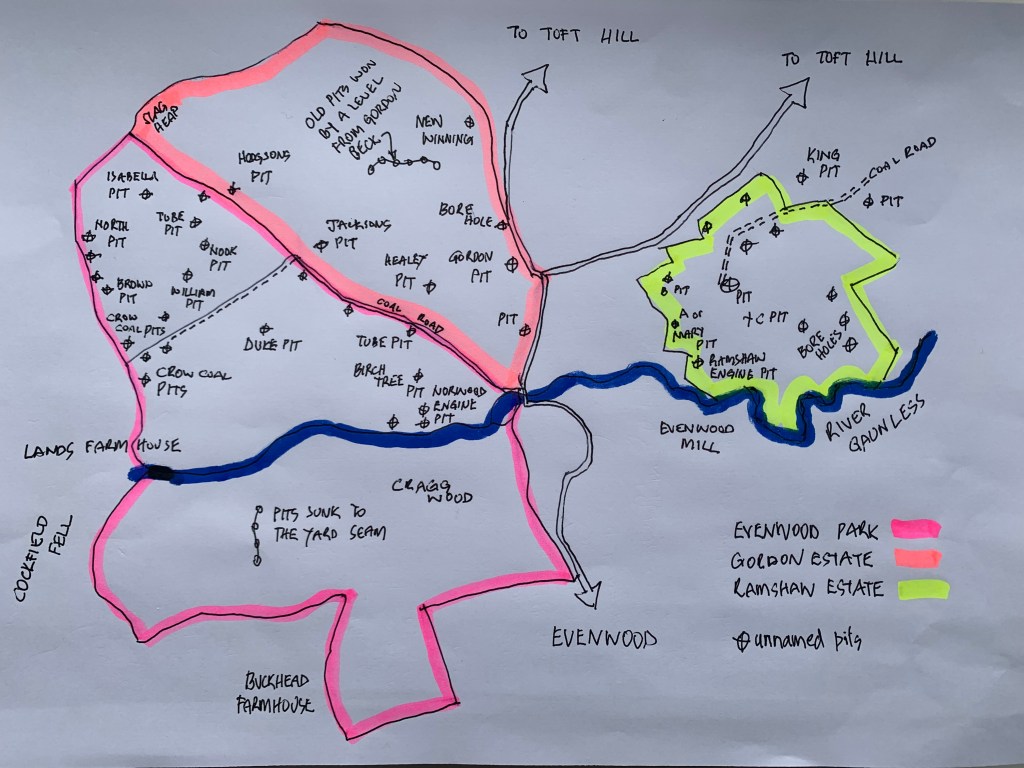
Above: Sketch Map to show pits within the Estates on part of Railey Fell, as indicated on the Strathmore Plan.[15]
Given that there are no other obvious candidates for the site of Railey Fell Colliery which was subject to the agreements above, it may be possible that the pits on Ramshaw Estate were, collectively known as Railey Fell Colliery. Once the Stobart family established themselves in the area after 1828, Henry Stobart & Co. Ltd. developed many drifts and workings. Tramways were used to lead the coal tubs into the screens at West Tees Colliery at the north end of Gordon Lane, Ramshaw. This colliery was linked to the Haggerleases Branch and the rail network beyond. Locally, the Henry Stobart & Co. pits and drifts were known simply as “Railey Fell”.
ACKNOWLEDGEMENTS
Thanks to Mrs. Anthea Tallentire who loaned us the documents and allowed ED&RHS to copy and post on the website.
Maria Bloss for transcribing records associated with the Land Tax Returns for Evenwood & Barony and passing them onto ER&DHS.
REFERENCES
[1] £800 is about £176,000 today and £100 about £21,920 today.
[2] The exact location of these pits is unknown.
[3] Workings around Deborah Wood, north of West Auckland and east of Toft Hill which are recorded on the 1st edition of the OS map (1859) are likely to be the site of Dixon’s Greenfield Pit and that colliery owned by Sir John Eden.
[4] £2500 in 1811, is worth about £258,350 today
[5] Calculated at 12 and 14lb per peck
[6] “Annals of Coal Mines and the Coal Trade” (2 Vols.) 1898 R.L. Galloway Vol. 1 p.452 as quoted in “1851 Evenwood” E. Anderson et al p.15
[7] The author visited Coal House and examined the Catalogue of Abandoned Mines records.
[8] “Pedigree of Peirse of Bedale and Thimbleby” from “Pedigrees of the County Families of Yorkshire Vol.III North and East Riding” 1874 Joseph Foster.
[9] Information provided by Maria Bloss – some interpretation of names may have resulted in different spelling but it seems obvious that the records refer to the Peirse family.
[10] . In WW1, it was offered by the Stobart family to be used for recovering, wounded soldiers and known as Red House V.A. Hospital. The Red House name was retained for this purpose.
[11] “The Story of the Gaunless Valley: A North Pennine History” Niall Hammond p.22
[12] Strathmore Papers ref: P12/3/26
[13] Much of the Gordon and the Evenwood Park Estate, north of the River Gaunless and the track bed of the Haggerleases Railway was subject to opencast coalmining during the 1990s by Coal Contactors Ltd.
[14] The northern part of the Ramshaw Estate was worked later by drift mining.
[15] Strathmore Papers ref: P12/3/26 Note: Brown’s Pit in Evenwood Park should read Bowes Pit (my mistatke).
 EVENWOOD RAMSHAW & DISTRICT HISTORY SOCIETY