The Darlington coal merchants wanted their mines to the west of Bishop Auckland to be linked with the River Tees which was navigable from Stockton to the sea. Thus their coal could be available to a wider market as a result of improved transport links. Robert Whitworth surveyed the route and the navigable canal was designed by James Brindley, the eminent engineer of the day. The resulting proposal was shown in the 1768 Stockton to Darlington to Winston map.
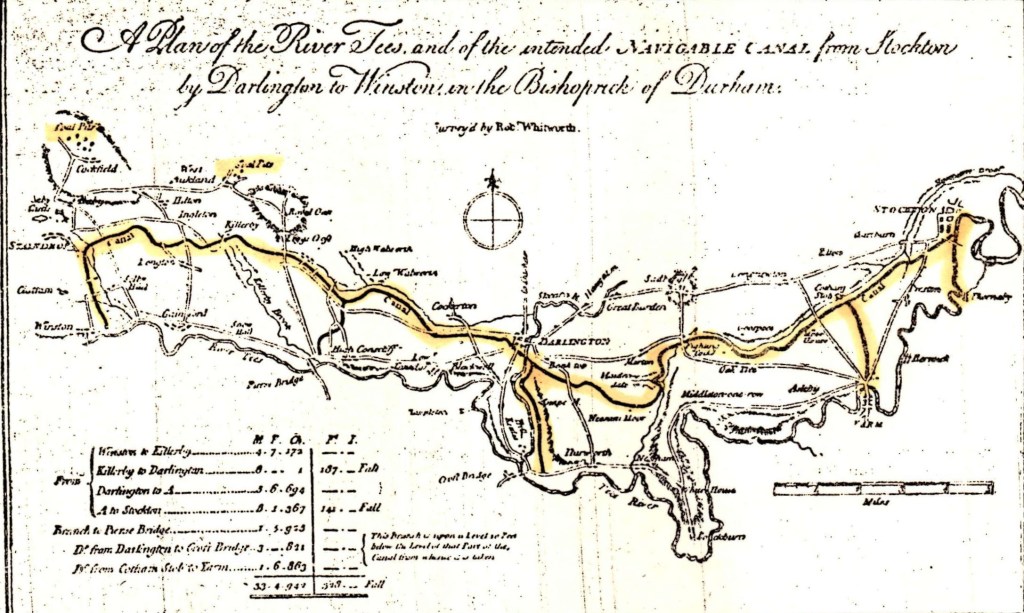
Above: 1768: A Plan to show the proposed route of the Winston to Darlington to Stockton Canal.
In 1770, a report was published but it proved impossible to raise sufficient funds to implement the scheme.
The book, “History of Britain in Maps” (2017) by Philip Parker includes an excellent detail of the 1768 Stockton – Darlington – Winston map. The images below show details from the map.
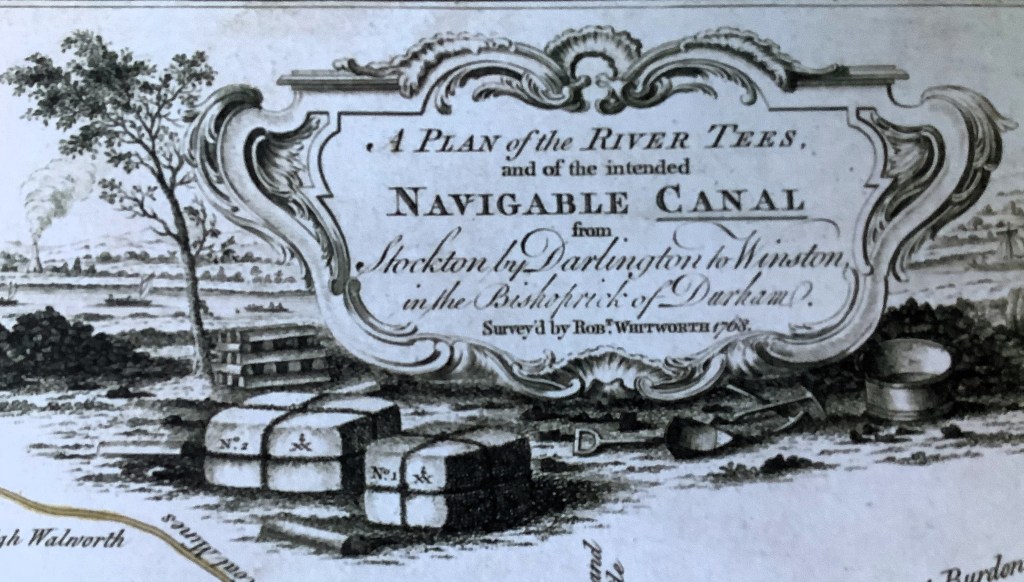
Above: A Detail of the Title Block.
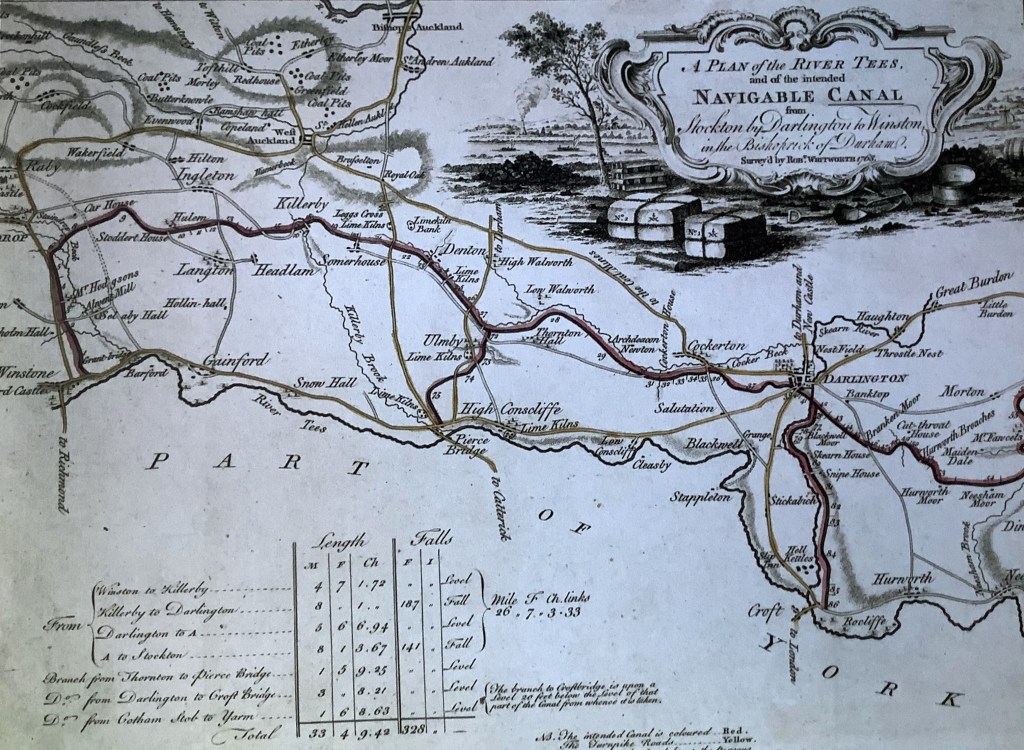
Above: A Detail to show the Western Section of the Proposed Canal with extensions to Piercebridge and Croft.
The western route of the proposed canal was from Winston north to Staindrop, then east to Hulem and onto Killerby, north of Summerhouse and onto Denton to Low Walworth, Archdeacon Newton, Cockerton and Darlington.
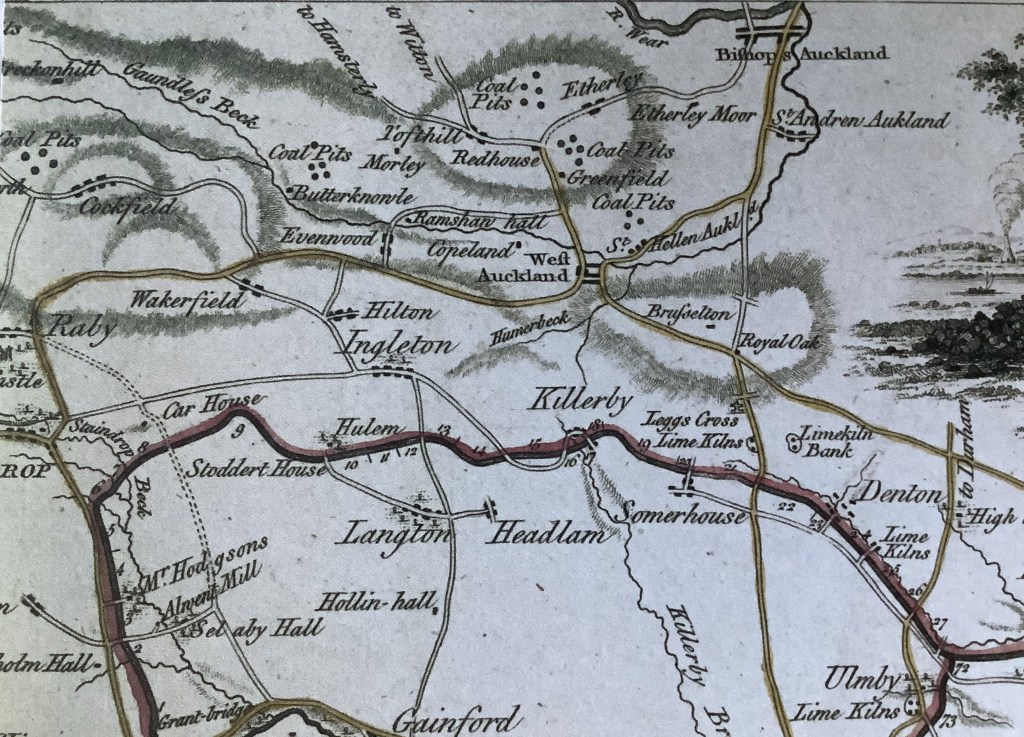
Above: A Detail to show the Coal Mines West of Bishop Auckland.
There were 5 locations for the coal mines:
- North of St. Helen’s Auckland (probably owned by the Musgrave family)
- North of West Auckland at Greenfields (probably owned by the Eden family)
- North of Toft Hill and Etherley, probably the Railey Fell and Etherley Collieries and the Phoenix Pit (probably owned by Richard Pierse Esq.)
- North of Evenwood probably Norwood Colliery on land owned by Lord Strathmore (& George Bowes) and worked by Dixon and Flintoff. The above map states Butterknowle but this is not the village of Butterknowle as we know it today. Probably, it then referred to Butterknowle Lane.
- North of Cockfield and Copley Lane.
At this time, the coal mines in our area were developed but on a small scale. This was until a new mode of transport was invented. About 55 years later, Robert Stephenson and the world famous Stockton and Darlington Railway was the scheme which successfully connected the Auckland Coalfield to the port at Stockton. The Phoenix Pit at Witton Park was linked to Stockton and beyond via the Etherley and Brusselton Inclines and the railway from Shildon via Darlington. The Black Boy Pit at Auckland Park was connected by another branch line and in 1830, the Haggerleases Branch was opened which meant coal from Norwood Colliery and pits at Copley could be exported more widely.
2025 will mark the 200th anniversary of the opening of the Stockton and Darlington Railway.
 EVENWOOD RAMSHAW & DISTRICT HISTORY SOCIETY